

Agentic AI in Healthcare 2026: How Autonomous Agents Are Transforming Patient Care From eliminating clinician burnout to compressing drug discovery timelines: here is how agentic AI is moving from proof-of-concept to real-world clinical impact. By Style Overloaded the technology has transitioned from reactive, rules-based algorithms into autonomous, goal-directed systems capable of multi-step reasoning, independent planning,
Agentic AI in Healthcare 2026: How Autonomous Agents Are Transforming Patient Care
From eliminating clinician burnout to compressing drug discovery timelines: here is how agentic AI is moving from proof-of-concept to real-world clinical impact.
How Agentic AI Is Drastically Reducing Clinician Burnout
Administrative documentation remains one of the leading causes of physician burnout, according to the American Medical Association. In direct response, health systems in 2026 are scaling Ambient AI scribes and intelligent clinical workflow agents.
During consultations, specialized AI agents securely listen to patient-doctor dialogue (with full patient consent), cross-reference longitudinal data from the Electronic Health Record (EHR), and draft real-time, highly structured clinical notes, automatically.
Physicians are saving thousands of charting hours annually. By shifting documentation from an after-hours burden to a real-time background task, clinicians can direct their full attention to face-to-face patient engagement, significantly reducing diagnostic errors caused by fatigue.
Streamlining the Care Journey: Prior Authorizations & Smart Triage
Medical care frequently stalls due to administrative bottlenecks insurance approvals and overloaded emergency departments being the most costly. Agentic AI is eliminating these delays in two critical ways.
Prior Authorization AI Agents
When a doctor orders a specialized surgery or medication, an AI agent scans the EHR, extracts relevant lab results and clinical history, packages the data to match specific payer policies, and autonomously submits the authorization request. If a claim is denied, the agent identifies the missing documentation and prepares a corrected resubmission, compressing a process that once took weeks down to days.
Smart Triage Agents
High-volume clinics deploy conversational agents across voice and text channels to handle patient intake. These agents assess symptom severity, dynamically route low-acuity cases to appropriate wellness solutions, and immediately escalate high-risk patients to human specialists, freeing clinical staff for critical decisions.
Advancing Precision Medicine and Preventative Diagnostics with AI
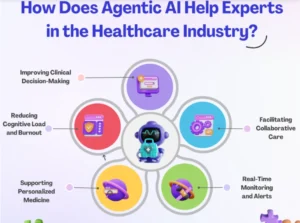
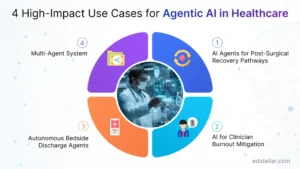 Agentic AI platforms excel at synthesizing massive, multi-source datasets that would take a human clinician days to analyze. In 2026, this capability is powering a new generation of preventative and personalized care.
Dynamic agent platforms connect real-time data from personal wearable devices smartwatches and continuous glucose monitors with a patient’s full EMR history and genomic sequencing data to create a continuously updated health profile.
Instead of reacting to health crises, these agents monitor vital signs continuously to flag early abnormalities such as arrhythmias or volatile glucose trends. Generative AI models are now predicting long-term risks of complex conditions including Alzheimer’s disease and chronic kidney disease, years before physical symptoms appear.
Compressing the Drug Discovery Timeline from Years to Months
Bringing life-saving therapeutics to market historically required upwards of a decade. Multi-agent AI systems have fundamentally altered that trajectory, offering one of the most dramatic ROI cases in modern pharmaceutical research.
Autonomous biomedical agents simulate millions of molecular interactions simultaneously, predicting how newly engineered compounds will behave inside the human body, without a single lab test at the earliest stages.
By optimizing chemical structures and identifying promising drug combinations digitally, agentic AI platforms are compressing early-stage R&D timelines from years to months, accelerating the pipeline for targeted cancer therapies, rare disease treatments, and next-generation vaccines.
The 10-20-70 Guardrail for Responsible AI in Healthcare (2026)
While the ROI for healthcare AI is high, industry leaders consistently emphasize that technology is only part of the equation. Maximizing patient outcomes requires the 10-20-70 rule, a framework placing human oversight at the center of every AI deployment.
 10%
10%AI Algorithms
Effort allocated to the core AI models and agent logic.
Data Infrastructure
HIPAA-compliant architecture, data pipelines, and integration layers.
People & Processes
Human-in-the-loop clinical oversight remains the final authority for every autonomous decision.
Frequently Asked Questions: Agentic AI in Healthcare
What is agentic AI in healthcare?
How does agentic AI reduce clinician burnout?
What is the 10-20-70 rule for AI in healthcare?
Can AI agents speed up drug discovery timelines?
Are AI agents replacing doctors in clinical settings?






















Leave a Comment
Your email address will not be published. Required fields are marked with *