
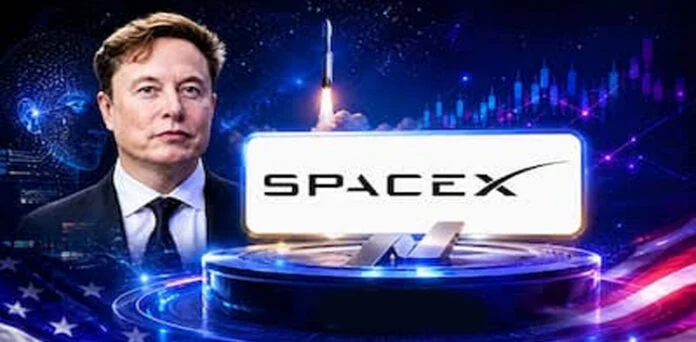
SpaceX Market Crash: Elon Musk’s Aerospace Giant Erases $400 Billion in Single-Day Wall Street Rout Space Exploration Technologies Corp. (SpaceX), the commercial aerospace powerhouse led by billionaire Elon Musk, has sent shockwaves through global financial markets. Just days after its monumental initial public offering (IPO) on the Nasdaq exchange, the company’s newly minted stock (SPCX)
SpaceX Market Crash: Elon Musk’s Aerospace Giant Erases $400 Billion in Single-Day Wall Street Rout
Space Exploration Technologies Corp. (SpaceX), the commercial aerospace powerhouse led by billionaire Elon Musk, has sent shockwaves through global financial markets. Just days after its monumental initial public offering (IPO) on the Nasdaq exchange, the company’s newly minted stock (SPCX) experienced a historic selloff. In a single trading session, SpaceX’s market capitalization plummeted by a staggering $400.8 billion, marking the second-largest one-day wipeout of corporate value in U.S. stock market history.
The abrupt reversal has caught retail investors off guard, shifting the market narrative from post-IPO euphoria to severe tech-sector anxiety.
The Hard Numbers: Inside the SpaceX (SPCX) Selloff
The sharp downturn, which accelerated rapidly toward Monday’s closing bell, erased a massive portion of the premium built up during the stock’s first week of trading. Below is a breakdown of the critical financial metrics following the correction:
This sudden correction reshuffled the leaderboard of the world’s most valuable corporations. With its valuation resting at $2.03 trillion, SpaceX slipped to the No. 7 spot globally, falling just behind Taiwan Semiconductor Manufacturing Company (TSMC), which holds a market cap of $2.06 trillion. As noted in a Morningstar Report, anyone who chased the stock after its first-day closing pop of $160.95 is now holding a paper loss, underscoring the extreme volatility of mega-cap listings.
3 Core Drivers Behind the $400 Billion Market Cap Slump
Market analysts emphasize that this downward spiral was not triggered by a rocket failure or an operational anomaly at Cape Canaveral. Instead, it was the result of a broader macroeconomic storm and complex internal balance-sheet restructuring.
1. Surging Treasury Yields and Federal Reserve Rate Fears
The primary catalyst behind the broader market retreat was a sharp spike in U.S. government bond yields, with the two-year Treasury note climbing to 4.23%. Investors are increasingly betting that the Federal Reserve will raise interest rates as early as September to curb persistent inflation. Higher borrowing costs act as a heavy anchor on growth-oriented tech stocks, especially those like SpaceX that trade at premium multiples relative to immediate revenue.
2. The Cost of Elon Musk’s Interconnected AI Architecture
Investors are looking closely at how SpaceX’s finances intersect with Musk’s other tech ventures. Concurrently with the stock slide, SpaceX announced a massive senior unsecured notes offering to raise capital. This capital is intended to clear a $20 billion bridge loan utilized to manage debts associated with Musk’s artificial intelligence startup, xAI, and the social media platform X.
While SpaceX recently secured high-profile computing power agreements—including a $150 million-per-month deal to lease its Colossus 2 data center infrastructure to open-source startup Reflection AI—the market remains anxious about the sheer volume of capital being funneled into artificial intelligence before yielding concrete, long-term returns.
3. Aggressive Profit-Taking Post-IPO
SpaceX officially priced its historic IPO at $135 per share on June 11, debuting on June 12 to absolute market mania. The stock quickly surged past $210 in the subsequent sessions as retail and options traders rushed in. A massive pullback is standard for major public listings once initial buyers begin locked-in profit taking. As the rally lost momentum, institutional sell orders triggered automated stop-losses, accelerating the intraday slide.
A Reality Check for Investors: Despite the dramatic $400 billion drop, SpaceX is not in a freefall. The closing price of $154.60 remains roughly 14.5% above its initial $135 IPO floor. Early allocation participants are still comfortably in the green; the damage is localized to traders who bought during the peak momentum of mid-June.
For continued updates on market conditions, macro trends, and deep dives into corporate restructurings, explore our dedicated analyses at styleoverloaded.com and tracking of global enterprise maneuvers at styleoverloaded.com/business.
Strategic Action Plan for Retail Traders
Avoid Panic Selling: The sharp reversal has already shown signs of stabilizing, with the stock bouncing back 2.4% in subsequent trading sessions. Sudden selloffs followed by quick technical bounces often indicate the establishment of a localized price floor.
Keep an Eye on Index Inclusions: Volatility is expected to remain high, but SpaceX will soon be eligible for fast-track inclusion into major indexes like the Nasdaq 100. This milestone will automatically drive significant capital inflows from passive index funds, providing structural support to the share price.
Assess the Long-Term Moat: SpaceX maintains an absolute monopoly on commercial orbital launches and global satellite internet via Starlink. Temporary balance sheet adjustments to fund AI architecture do not diminish the company’s core aerospace dominance.
Know more about it:
Did SpaceX stock crash below its IPO price?
No. While SpaceX stock dropped significantly from its peak of $225.64, it closed at $154.60, which is still 14.5% higher than its initial IPO listing price of $135.
Why did Elon Musk’s company lose value so quickly?
The loss was driven by macroeconomic pressures, including rising U.S. bond yields and fears of Fed rate hikes. Additionally, the company’s move to issue new debt to clear a $20 billion bridge loan linked to xAI and X caused short-term institutional anxiety.
Is SPCX stock a buy after the $400 billion correction?
Financial analysts have mixed outlooks. Bullish firms maintain long-term price targets above $400 based on projected Starlink expansions, while cautious analysts suggest waiting until macro interest-rate pressures settle before building a long position.
Read more: France Confirms First Ebola Case| what Ebola is?
The Ultimate 2026 Health Guide: Explaining the Top 5 Medical Breakthroughs and Evergreen Trends
StyleOverloaded.com | Pakistan’s Premier Lifestyle, Fashion & Global News Destination Written by the StyleOverloaded Editorial Team | Published: June 25, 2026 Sources: WHO, CDC, Al Jazeera, ABC News, France 24, MSF, BBC, Gavi, Wikipedia 2026 Ebola Epidemic






















Leave a Comment
Your email address will not be published. Required fields are marked with *