
Healthy skin requires more than cleansing, moisturising, and following an elaborate skincare routine. One of the most important steps in everyday skin care is protecting your skin from the sun. Whether you are walking to work, travelling, shopping, exercising outdoors, or simply enjoying a sunny afternoon, ultraviolet (UV) radiation can affect your skin even when
Healthy skin requires more than cleansing, moisturising, and following an elaborate skincare routine. One of the most important steps in everyday skin care is protecting your skin from the sun. Whether you are walking to work, travelling, shopping, exercising outdoors, or simply enjoying a sunny afternoon, ultraviolet (UV) radiation can affect your skin even when the weather does not feel particularly hot.
Sunscreen helps protect the skin against harmful ultraviolet radiation, reducing the risk of sunburn and contributing to the prevention of premature skin ageing and skin cancer. However, choosing the right product can feel confusing when supermarket and beauty-store shelves are filled with SPF numbers, mineral formulas, chemical filters, tinted sunscreens, and different finishes.
The good news is that understanding sunscreen does not have to be complicated. Once you know what SPF means, which ingredients provide protection, and how to apply the product correctly, you can make better decisions for your skin.
Whether you have oily, dry, sensitive, or combination skin, this guide explains everything you need to know about sunscreen, from its different types and benefits to practical application techniques and common mistakes.
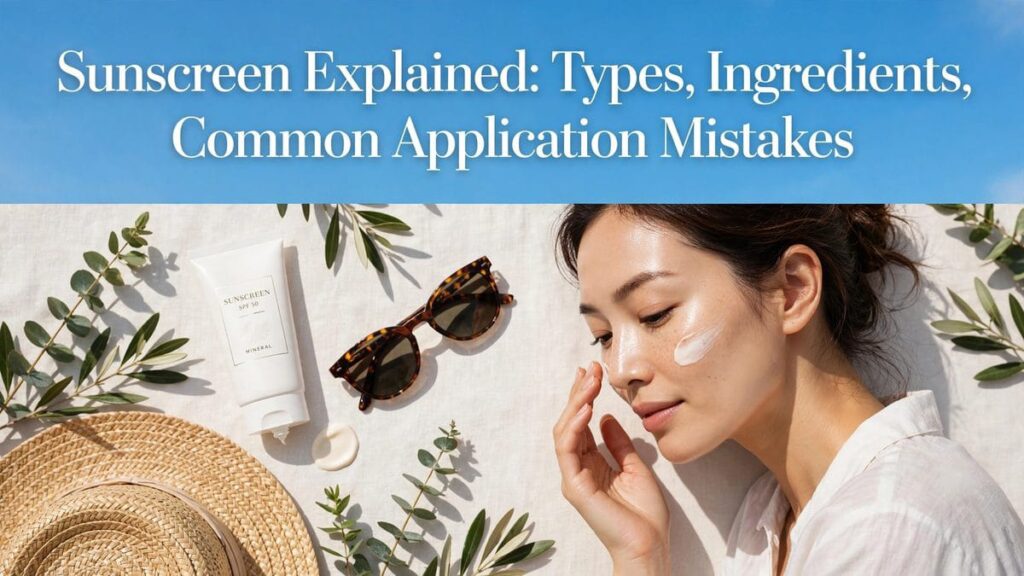
Suggested Opening Image: A professional skincare flat-lay featuring a sunscreen tube, sunglasses, a sun hat, a moisturiser, and a few fresh botanical elements against a clean, sunlit background.
Image alt text: Sunscreen skincare essentials for everyday sun protection
Good skincare is not only about nourishing your skin. It is also about protecting it from the damage you cannot always see.
📋 Table of Contents
- What Is Sunscreen and Why Is It Important?
- Understanding SPF and Broad-Spectrum Protection
- Different Types of Sunscreen
- Important Sunscreen Ingredients to Know
- Benefits of Using Sunscreen Regularly
- How to Apply Sunscreen Correctly
- Common Sunscreen Mistakes to Avoid
- How to Choose Sunscreen for Your Skin Type
- Frequently Asked Questions
- Conclusion: Make Sun Protection a Daily Habit
🌿 What Is Sunscreen and Why Is It Important?
Sunscreen is a skincare product designed to protect the skin against ultraviolet radiation from the sun. It contains UV filters that absorb, reflect, or scatter UV radiation, depending on the ingredients and formulation.
Sunlight contains different types of ultraviolet radiation, but UVA and UVB are particularly important when discussing skin protection.
- UVA rays: Penetrate more deeply into the skin and contribute to premature ageing, wrinkles, and changes in skin appearance. They can also pass through window glass.
- UVB rays: Primarily affect the outer layers of the skin and are a major cause of sunburn. They also contribute to skin cancer.
Repeated exposure to ultraviolet radiation can damage skin cells over time. This is why sunscreen is an important part of a long-term skincare routine rather than something reserved exclusively for beach holidays.
A suitable broad-spectrum sunscreen helps protect against both UVA and UVB radiation.
🔍 Understanding SPF and Broad-Spectrum Protection
 SPF stands for Sun Protection Factor. It indicates how effectively a sunscreen protects against sunburn-causing UV radiation, primarily UVB.
Many people assume that a higher SPF means they can stay in the sun all day without reapplying sunscreen. Unfortunately, this is not how sun protection works.
What Do Different SPF Numbers Mean?
Here is a simplified comparison:
| SPF Rating | Approximate UVB Protection |
|---|---|
| SPF 15 | 93% |
| SPF 30 | 97% |
| SPF 50 | 98% |
| SPF 100 | 99% |
These figures represent laboratory-tested protection when sunscreen is applied correctly and generously. Actual protection depends heavily on application.
The American Academy of Dermatology recommends choosing a broad-spectrum sunscreen with SPF 30 or higher.
What Does Broad-Spectrum Mean?
Broad-spectrum sunscreen protects against both UVA and UVB radiation.
When shopping for sunscreen, look for these important label details:
- Broad-spectrum protection.
- SPF 30 or higher.
- Water-resistant protection if you swim or sweat.
Remember that SPF alone does not tell you how well a product protects against UVA rays. Broad-spectrum labelling is therefore important.
🧴 Different Types of Sunscreen
 Sunscreens are available in different formulations, and understanding their differences can help you choose a product that feels comfortable on your skin.
The main categories include mineral, chemical, and hybrid sunscreens.
Mineral Sunscreen
Mineral sunscreen is also known as physical sunscreen. Its main active ingredients are zinc oxide and titanium dioxide.
These ingredients protect the skin by absorbing and reflecting or scattering UV radiation.
Advantages:
- Zinc oxide provides broad-spectrum protection.
- Often suitable for people who prefer mineral-based formulas.
- Available in formulations designed for sensitive skin.
- Can be useful for people who experience irritation with certain chemical filters.
Possible disadvantages:
- Some formulas leave a visible white cast.
- Certain products can feel thick or leave a powdery finish.
- May require careful blending to achieve an even appearance.
Tinted mineral sunscreens can help reduce the appearance of white cast and may offer additional protection against visible light when formulated with iron oxides.
Chemical Sunscreen
Chemical sunscreens use organic UV filters to absorb ultraviolet radiation and convert the absorbed energy into a small amount of heat.
Examples of chemical sunscreen filters include:
- Avobenzone
- Octocrylene
- Octisalate
- Octinoxate
- Homosalate
- Bemotrizinol
The exact ingredients available depend on the country and its regulatory requirements.
Advantages:
- Often have lightweight textures.
- Many formulas spread easily.
- Usually leave less visible residue.
- Available in lotions, gels, fluids, and sprays.
Possible disadvantages:
- Some formulas may irritate sensitive skin or eyes.
- Certain products can feel uncomfortable around the eye area.
- Individual ingredients may not suit everyone.
Hybrid Sunscreen
Hybrid sunscreens combine mineral and chemical UV filters in one formulation.
They are designed to provide protection using different types of UV filters while offering a particular texture or finish.
Depending on the formulation, a hybrid sunscreen may offer:
- A lighter feel than some traditional mineral formulas.
- Less visible white residue.
- Broad-spectrum protection.
- A balance between cosmetic appearance and sun protection.
Always check the product label rather than assuming that every hybrid sunscreen provides the same level of protection.
Other Sunscreen Formulations
Sunscreen also comes in several product formats.
| Formulation | Best Suited For | Main Feature |
|---|---|---|
| Lotion | Everyday use | Easy to spread over larger areas |
| Gel | People who prefer lightweight textures | Often feels less greasy |
| Cream | Dry skin | Can provide a richer moisturising feel |
| Fluid | Facial application | Thin consistency and easy layering |
| Spray | Body application and outdoor activities | Convenient application |
| Stick | Targeted areas and touch-ups | Portable and easy to carry |
| Tinted sunscreen | People who prefer a cosmetic finish | Adds colour while providing UV protection |
A product’s formulation does not automatically determine its effectiveness. The SPF, broad-spectrum label, water resistance, and correct application matter more.
Suggested Image: A collection of mineral, chemical, hybrid, tinted, gel, and sunscreen-stick products arranged on a skincare vanity.
🧪 Important Sunscreen Ingredients to Know
Reading the ingredient list can help you understand what kind of protection a sunscreen offers.
Here are some commonly used sunscreen ingredients.
| Ingredient | Main Function |
|---|---|
| Zinc Oxide | Provides broad-spectrum UV protection |
| Titanium Dioxide | Protects against UV radiation |
| Avobenzone | Provides UVA protection |
| Octocrylene | Provides UVB protection and helps stabilise certain formulas |
| Octisalate | Primarily provides UVB protection |
| Octinoxate | Primarily provides UVB protection |
| Bemotrizinol | Provides broad-spectrum UV protection |
Not every sunscreen contains all these ingredients. Different countries also have different rules governing which UV filters may be used.
What About Niacinamide and Vitamin E?
Some sunscreens contain additional skincare ingredients.
- Niacinamide: A skincare ingredient commonly used to support the skin barrier and improve the appearance of uneven skin tone.
- Vitamin E: An antioxidant ingredient used in some skincare formulations.
- Glycerin: A humectant that helps attract and retain moisture.
- Hyaluronic Acid: A humectant that helps hydrate the skin.
These ingredients can contribute to a formula’s skincare benefits, but they do not replace the UV filters responsible for sun protection.
🌸 Benefits of Using Sunscreen Regularly
Sunscreen is one of the most useful products you can include in your daily skincare routine.
Its benefits extend beyond preventing temporary redness after spending time outdoors.
1. Helps Prevent Sunburn
UVB radiation is a major cause of sunburn. Applying sunscreen correctly helps reduce the amount of UV radiation reaching the skin.
2. Helps Reduce Premature Skin Ageing
Repeated sun exposure contributes to wrinkles, uneven pigmentation, and loss of skin elasticity.
Regular broad-spectrum sun protection helps reduce the effects of photoageing.
3. Helps Reduce Skin Cancer Risk
Ultraviolet radiation damages DNA in skin cells and contributes to skin cancer.
Using sunscreen as part of a wider sun-protection routine can help reduce UV exposure and skin cancer risk.
4. Helps Prevent Uneven Skin Tone
Sun exposure can worsen certain forms of pigmentation, including dark spots and melasma.
Consistent sun protection can help prevent existing pigmentation from becoming more noticeable.
5. Supports Long-Term Skin Health
Sunscreen helps protect skin against repeated UV exposure, making it an important part of a consistent skincare routine.
However, sunscreen should not be your only form of protection. Shade, protective clothing, and sunglasses also matter.
☀️ How to Apply Sunscreen Correctly
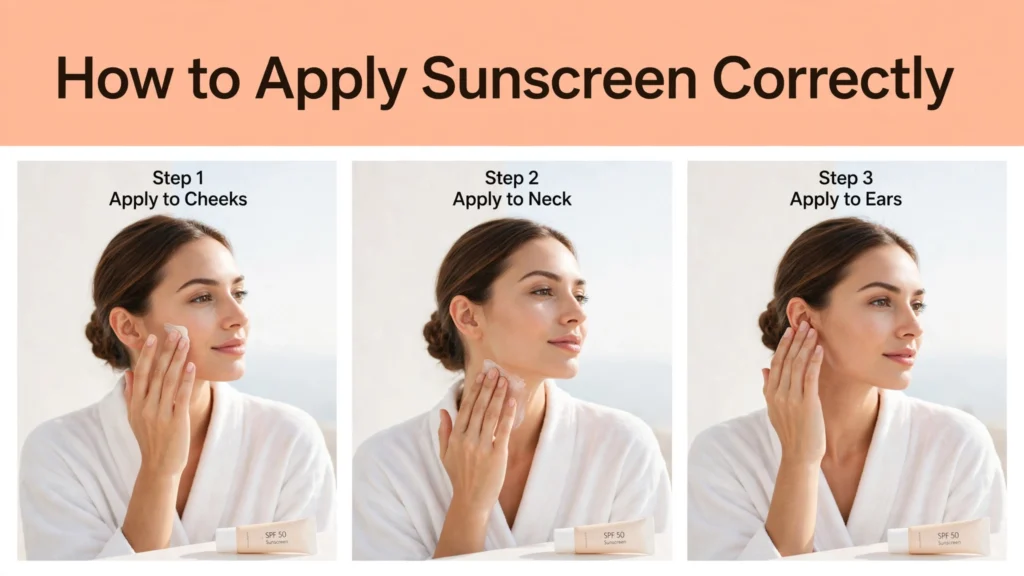 Even an excellent sunscreen cannot provide its intended protection if it is applied incorrectly.
Follow these practical steps to make your application routine more effective.
Morning Application
- Cleanse your face using a gentle cleanser.
- Apply your usual skincare products, such as moisturiser.
- Apply a generous, even layer of broad-spectrum SPF 30 or higher sunscreen.
- Cover your face, ears, neck, and other exposed areas.
- Allow the product to settle according to its instructions before applying makeup.
For body application, the US Food and Drug Administration uses approximately one ounce (a shot-glass amount) as a general guide for covering an average adult’s exposed body.
When Should You Reapply?
Sunscreen generally needs to be reapplied at least every two hours when outdoors.
Reapply sooner after:
- Swimming.
- Heavy sweating.
- Drying your skin with a towel.
- Other activities that remove the product.
Water-resistant sunscreens are labelled for either 40 or 80 minutes of water exposure. These labels do not mean that the product is waterproof.
Don’t Forget These Commonly Missed Areas
- Ears and behind the ears.
- Back of the neck.
- Lips (use an SPF lip balm).
- Hands and fingers.
- Tops of the feet.
- Hairline.
- Exposed scalp.
⚠️ Common Sunscreen Mistakes to Avoid
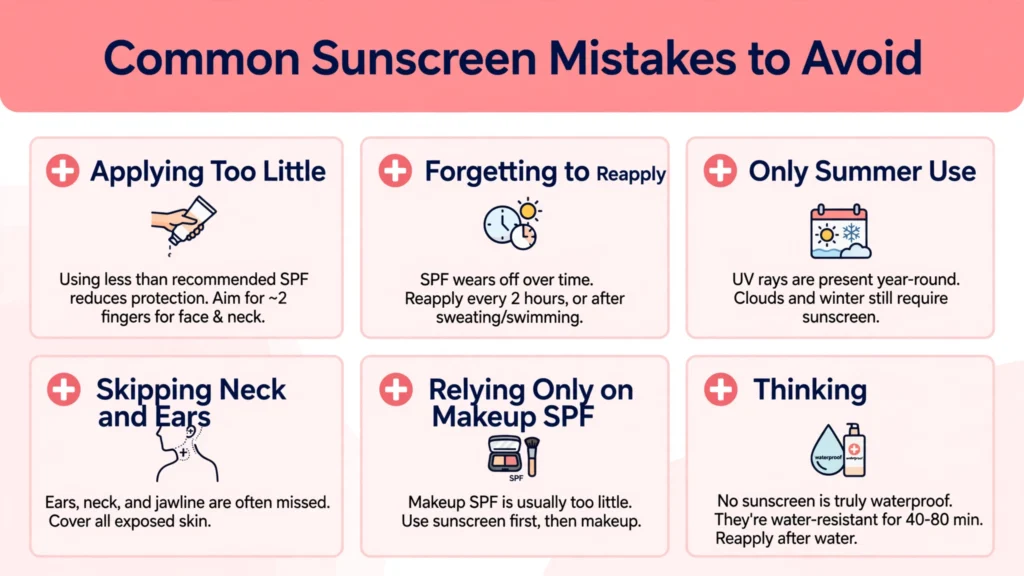 Many people own sunscreen but do not use it effectively. Small application mistakes can reduce the protection they receive.`
Here are some common habits worth correcting.
- Applying too little sunscreen: A thin layer may not provide the labelled SPF protection. Apply a generous and even amount.
- Forgetting to reapply: Sunscreen wears off through sweating, swimming, towel drying, and everyday activities. Reapply as directed.
- Using sunscreen only during summer: UV exposure can occur throughout the year. Consider the UV index and your outdoor exposure when deciding on sun protection.
- Choosing SPF without checking broad-spectrum protection: SPF primarily describes UVB protection. Look for broad-spectrum labelling.
- Ignoring the neck and ears: These exposed areas are frequently missed during application.
- Relying only on makeup with SPF: Makeup is often applied too thinly and unevenly to provide the labelled protection. Use a dedicated sunscreen underneath.
- Assuming waterproof sunscreen exists: No sunscreen is completely waterproof. Look for tested water-resistant products instead.
- Skipping sunscreen on cloudy days: Clouds do not eliminate UV radiation. Protection may still be necessary depending on the UV index and exposure.
- Mixing sunscreen with moisturiser: Mixing products can interfere with the sunscreen’s tested formulation and reduce even coverage. Apply them separately.
A simple routine followed consistently is more useful than buying several expensive sunscreen products and using them incorrectly.
💗 How to Choose Sunscreen for Your Skin Type
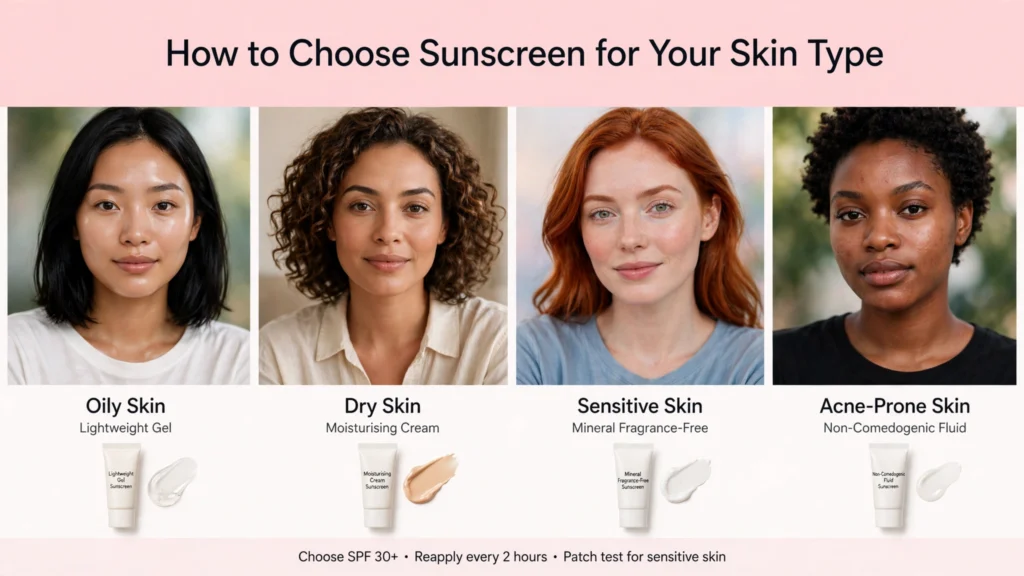 The best sunscreen is one that provides reliable protection and feels comfortable enough to use regularly.
Different skin types may prefer different textures and formulations.
| Skin Type | Sunscreen Features to Consider |
|---|---|
| Oily Skin | Lightweight gel or fluid formulas |
| Dry Skin | Cream-based or moisturising formulas |
| Combination Skin | Lightweight lotions or balanced fluid formulas |
| Sensitive Skin | Fragrance-free formulas; consider mineral filters |
| Acne-Prone Skin | Lightweight, non-comedogenic-labelled products |
| Normal Skin | Any suitable broad-spectrum formulation |
Sunscreen for Oily Skin
If your skin becomes shiny throughout the day, consider lightweight gel, fluid, or non-greasy formulations.
A matte-finish product may also feel more comfortable if you dislike a shiny appearance.
Sunscreen for Dry Skin
Cream-based sunscreens containing moisturising ingredients such as glycerin can be a comfortable option.
You can also apply your regular moisturiser before sunscreen if your skin needs additional hydration.
Sunscreen for Sensitive Skin
People with sensitive skin may prefer fragrance-free mineral sunscreens containing zinc oxide or titanium dioxide.
However, no ingredient category is guaranteed to suit everyone. Patch testing a new product can help identify potential irritation.
Sunscreen for Acne-Prone Skin
Look for lightweight formulas labelled non-comedogenic.
This labelling indicates that the product is formulated to reduce the likelihood of clogging pores, although individual reactions can still vary.
PINK TIP — COMFORT MATTERS
Do not choose sunscreen solely because it is popular on social media. Consider your skin’s needs, the climate you live in, the product’s protection level, and whether you enjoy wearing its texture every day.
❓ Frequently Asked Questions
1. Which SPF is best for everyday use?
A broad-spectrum sunscreen with SPF 30 or higher is a practical everyday choice. Choose a formulation that feels comfortable and follow its application instructions.
2. Should I wear sunscreen indoors?
It depends on your surroundings. UVA rays can pass through ordinary window glass, so sunscreen may be useful if you spend considerable time near sunny windows. It is particularly important when you are exposed to direct sunlight.
3. Is mineral sunscreen better than chemical sunscreen?
Neither category is universally better. Both can provide effective protection when properly formulated and applied. Choose according to your skin’s needs, preferences, and tolerance.
4. Can I use sunscreen under makeup?
Yes. Apply sunscreen as the final step of your skincare routine before makeup. Allow it to settle according to the manufacturer’s instructions.
5. Does sunscreen prevent tanning?
Sunscreen reduces UV exposure and helps prevent sunburn, but it does not block all UV radiation. Some tanning and skin damage can still occur. Avoid deliberately tanning your skin.
6. How often should sunscreen be applied?
Reapply at least every two hours when outdoors and after swimming, sweating, or towel drying. Follow the specific instructions for water-resistant products.
7. Can people with dark skin use sunscreen?
Absolutely. All skin tones can experience UV damage. Sunscreen helps protect against sunburn, premature ageing, and skin cancer regardless of skin colour.
8. Does sunscreen expire?
Yes. Check the expiry date and follow the storage instructions. Avoid using sunscreen that has expired or changed noticeably in colour, texture, or smell.
🌷 Conclusion: Make Sun Protection a Daily Habit
Sunscreen is not simply another beauty product to keep on your bathroom shelf. It is an important part of protecting your skin against the effects of everyday ultraviolet exposure.
Understanding SPF, choosing broad-spectrum protection, learning about mineral and chemical formulas, and applying sunscreen correctly can make a meaningful difference to your skincare routine.
You do not need an expensive collection of products or a complicated ten-step routine. Start with one suitable broad-spectrum sunscreen, apply it generously, remember to reapply when necessary, and combine it with protective clothing, sunglasses, and shade.
My Final Thoughts on Sunscreen
In my opinion, sunscreen deserves a more important place in everyday beauty routines than it often receives. People regularly spend money on moisturisers, serums, face masks, and other skincare products, yet sometimes overlook the simple habit of protecting their skin from the sun.
I believe the best approach is to focus on consistency rather than chasing expensive products or the highest SPF number available. A sunscreen that suits your skin, feels comfortable, and fits your daily routine is more likely to become a habit.
It is also important to remember that skincare should be practical. You do not need to follow every trending beauty recommendation or purchase several different formulas. Understand your skin, read product labels, and choose protection that meets your actual needs.
Ultimately, healthy-looking skin is not achieved overnight. It comes from thoughtful everyday habits, realistic expectations, and taking care of your skin before problems become noticeable.
Protect your skin today, and let your skincare routine work towards healthier skin for years to come. 🌸
📚 Recommended References and Further Reading
The following authoritative resources support the scientific and practical information in this article:
- American Academy of Dermatology – How to Select Sunscreen
- American Academy of Dermatology – How to Decode a Sunscreen Label
- US Food and Drug Administration – Sunscreen: How to Help Protect Your Skin from the Sun
- World Health Organization – Protecting Against Skin Cancer
- World Health Organization – Ultraviolet Radiation





















Leave a Comment
Your email address will not be published. Required fields are marked with *