
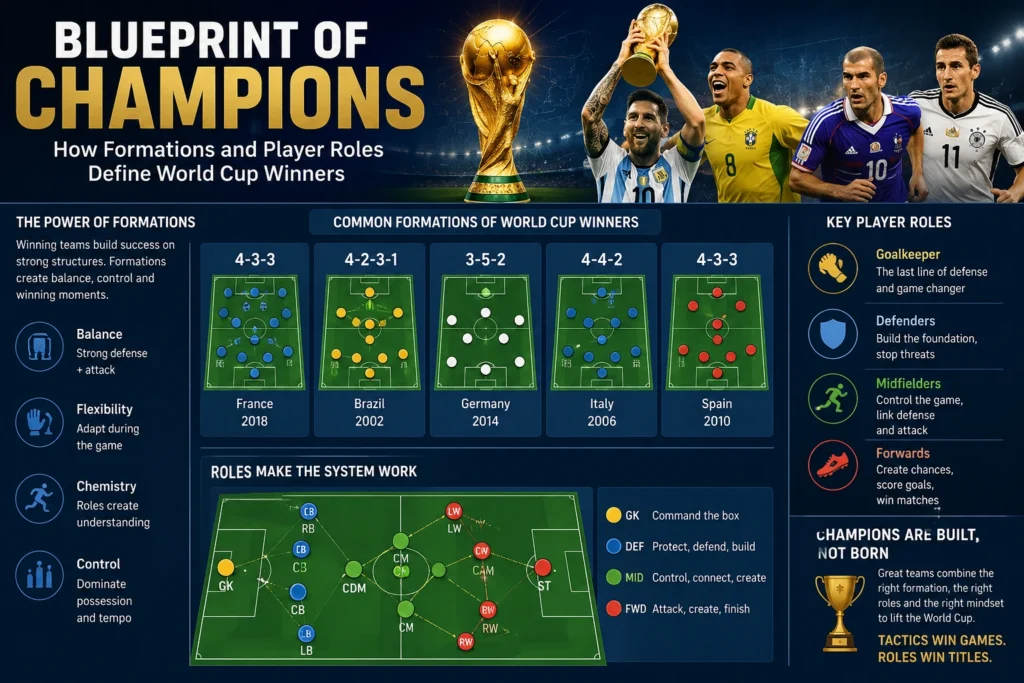
Blueprint of Champions: How Formations and Player Roles Define World Cup Winners June 23, 2026 In the modern era of elite football, talent alone no longer guarantees silverware. As witnessed in the historic 2026 FIFA World Cup group stages—where tactical masterminds are shifting pieces like grandmasters the difference between a premature exit and lifting the
Blueprint of Champions: How Formations and Player Roles Define World Cup Winners
June 23, 2026 In the modern era of elite football, talent alone no longer guarantees silverware. As witnessed in the historic 2026 FIFA World Cup group stages—where tactical masterminds are shifting pieces like grandmasters the difference between a premature exit and lifting the golden trophy comes down to structural design.
While individual geniuses like Lionel Messi grab the headlines, championships are won in the tactical laboratory. The seamless synchronization between a team’s chosen formation and the hyper-specific roles assigned to its players is what separates temporary contenders from immortal champions.
Here is an elite-level breakdown of how tactical formations and modern player roles dictate the destiny of championship-winning teams.
1. The Evolution of Formations: From Rigid Structures to Fluid Systems
Historically, football formations were treated as rigid, static lines: a 4-4-2 meant four defenders, four midfielders, and two strikers. Today, championship-winning managers view formations not as a starting shape, but as a fluid framework that alters drastically depending on whether a team has possession of the ball.
The Domination of the 3-2-4-1 Rest Defense
Popularized at the club level by tactical innovators and now adopted by elite national teams, the 3-2-4-1 system has become the blueprint for suffocating opponents.
-
Out of Possession: The team often drops into a compact 4-5-1 or 5-4-1 to protect the penalty box.
-
In Possession: A traditional fullback tucks inside to form a three-man backline, while a defensive midfielder pushes up to form a double-pivot (the “box midfield”).
This dynamic shift creates numerical superiorities (overloads) in the center of the pitch, allowing teams to control the tempo of the game and execute a flawless “rest defense” preventing counter-attacks before they even begin.
2. The Micro-Roles Moving Modern Football
As formations have become more fluid, player roles have become incredibly specialized. The days of the traditional, one-dimensional footballer are gone. Tournament-winning squads rely on hyper-specific profiles.
The Inverted Fullback: The Midfield Catalyst
No role has disrupted modern tactics more than the Inverted Fullback. Instead of hugging the touchline and overlapping down the flank, this defender drifts inside into the midfield when their team has the ball.
-
The Impact: This creates a temporary 3-man midfield, giving the team a passing outlet to bypass an opponent’s high press. It frees up advanced playmakers to operate higher up the pitch without leaving the defense exposed.
The “Regista” or Deep-Lying Playmaker
Championship teams almost always possess a structural anchor in the midfield a player who doesn’t rely on physical tackling, but on elite spatial awareness and passing range. Think of Andrea Pirlo in 2006, Sergio Busquets in 2010, or Enzo Fernández for Argentina today.
-
The Impact: They dictate the rhythm, act as the escape valve under pressure, and shield the center-backs.
The Space Investigator (Raumdeuter)
Coined by Thomas Müller, the Raumdeuter role is critical for breaking down low-block defenses. These are players who do not possess explosive pace or flashy dribbling skills but have an elite understanding of blind spots in an opponent’s backline. By making unselfish, off-the-ball runs, they pull defenders out of position, creating vacuums for star forwards to exploit.
3. The Blueprint: Statistical Profiles of Recent Champions
To understand why formations and roles must align, we only look at the data profiles of the world’s most successful teams.
| Championship Team | Primary Base Formation | In-Possession Shape | Key Tactical Catalyst |
| Argentina (2022/2026) | 4-3-3 / 4-4-2 | 3-2-4-1 / 3-5-2 | The False No. 10 (Messi) & Workrate Engines (De Paul/Mac Allister) |
| France (2018) | 4-2-3-1 | 4-4-2 Diamond | The Defensive Hybrid Wing (Blaise Matuidi) |
| Germany (2014) | 4-3-3 | 2-3-5 | The Inverted Fullback / Midfield Pivot (Philipp Lahm) |
4. Why Rigid Systems Fail on the Big Stage
The primary reason highly talented squads crash out of major tournaments is tactical predictability. When a manager forces elite players into strict, uncompromising positions, intelligent opposition coaches can easily map out a defensive counter-strategy.
For example, a team relying strictly on traditional wingers who only cross from wide areas becomes incredibly easy to defend against if the opponent deploys low-block center-backs with elite aerial capabilities. Championship winners win because they possess tactical variability the ability to change their in-possession shape mid-game without making a single substitution.
The Verdict: The Human Element within the Machine
Formations are ultimately just numbers on a whiteboard; it is the execution of modern player roles that breathes life into them. The teams that will dominate the knockout stages of the 2026 World Cup are those whose managers successfully map their system around the unique traits of their superstars, while maintaining defensive stability through structural fluidity.
-
To see how these exact tactical principles are being applied to break historical records in real-time, read our breaking news coverage on Lionel Messi Breaking the All-Time World Cup Scoring Record.
-
For an academic breakdown of football tactical evolutions over the last decade, explore the The Coaches’ Voice Tactical Archives.
-
Keep track of live tactical lineups and heatmaps for the ongoing tournament via the FIFA World Cup Match Center.

















Leave a Comment
Your email address will not be published. Required fields are marked with *