
Most hair growth listicles copy the same ten tips without explaining why they work. This guide breaks down the real growth cycle, honest timelines, and the one distinction growth vs. retention that changes your whole routine.
Hair Growth Tips for Women That Actually Work
Search “hair growth tips for women” and you’ll get the same ten items in a different order every time: oil your hair, eat protein, trim regularly, avoid heat, stay hydrated, repeat. Nobody explains why those specific things matter, which means you’re following a checklist without understanding what it’s actually doing or why it sometimes doesn’t seem to work at all.
Here’s the piece almost every guide skips: there are two completely different problems hiding inside “hair growth,” and most tips only solve one of them. Once you understand which is which, your routine stops being a guessing game.
 Understand the Hair Growth Cycle First
 Understand the Hair Growth Cycle First
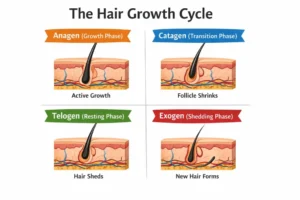
Every strand of hair on your head is cycling through four phases, on its own timeline, independent of the hair next to it which is why you never lose it all at once.
- Anagen (growth phase): Hair is actively growing from the follicle. This phase lasts anywhere from two to seven years and determines how long a single strand can ultimately get.
- Catagen (transition phase): A short phase where growth slows and the follicle begins to shrink.
- Telogen (resting phase): The strand stops growing and simply sits in place while a new hair begins forming underneath it.
- Exogen (shedding phase): The resting strand releases and falls out, and the follicle restarts the cycle from Anagen.
This matters because it explains something that trips a lot of women up: a hair care routine can only influence strands currently in the Anagen phase. If a strand is already in Telogen or Exogen, no oil or serum is going to “save” it from shedding that’s simply where it is in its cycle. What your routine can do is support a healthy scalp environment so more follicles stay in Anagen longer, and just as important protect the length you’ve already grown so it doesn’t break off before it gets the chance to matter.
How Fast Does Hair Actually Grow?
This is where most advice quietly avoids giving you a real number, because the real number is humbling: healthy hair grows about 1 to 1.5 centimetres a month, which works out to roughly 15 to 18 centimetres a year. That’s it. No product changes this rate dramatically the entire hair care industry operates within this narrow biological window.
What that means practically: if you’re hoping to go from shoulder-length to waist-length, you’re realistically looking at a couple of years of consistent care, not a couple of months. This isn’t discouraging it’s just honest, and it protects you from chasing a “miracle” every few weeks when a product doesn’t show waist-length results in three weeks.
The Genetics Reality Check
Almost no hair growth article says this part clearly: genetics sets the ceiling on both your growth rate and your maximum hair length (yes, hair has a genetically programmed maximum length, tied to how long your Anagen phase runs). You cannot oil, massage, or supplement your way past your own biology. What you can do is make sure you’re growing at your actual potential rate, rather than being held back by a stressed scalp, poor nutrition, or constant breakage which is where real, controllable improvement lives.
 Growth vs. Retention: The Distinction That Changes Everything
 Growth vs. Retention: The Distinction That Changes Everything
This is the single most useful reframe in this entire guide, and almost no competitor content makes it explicit.
Growth-rate tips influence how fast new hair forms at the follicle. Scalp massage, oiling, nutrition, and stress management all fall here.
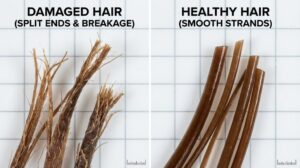
Retention tips determine how much of that new growth you actually keep, by preventing breakage along the length of hair you already have. Trimming, gentle handling, heat avoidance, and protecting hair while you sleep all fall here.
Here’s why this matters: a lot of women do every growth-rate tip perfectly oiling twice a week, taking supplements, eating well — and still feel like their hair “isn’t growing,” when in reality it is growing, just as fast as it’s breaking off at the ends. You can’t out-oil a retention problem. If your ends are damaged, dry, or handled roughly, you need to fix retention before growth-rate tips will ever show visible results.
Tips That Actually Support Growth Rate
- Scalp massage, 5–10 minutes, a few times a week. This is the one growth-rate tip with real mechanical logic behind it increased blood flow to the follicle supports a healthier growth environment. Do it during oiling for the easiest routine to stick to.

- Regular oiling. Coconut, castor, kalonji, and mustard oil are all commonly used locally for this see our full breakdown in Best Hair Oils in Pakistan for what actually suits your hair type.
- A protein, iron, and biotin-rich diet. Hair is built from protein, and deficiencies in iron and biotin are common causes of slow, thin growth. Full food-by-food detail is in Hair Growth Foods.
- Managing stress. Chronic stress can push more follicles into the resting phase prematurely, which is part of why stressful periods often show up as hair thinning a few months later.
- Being cautious with unsupervised supplements. High-dose biotin and other supplements are heavily marketed for hair growth, but taking them without an actual deficiency rarely adds benefit and can, in some cases, interfere with certain lab tests. If you suspect a real deficiency, a blood test and a doctor’s guidance is a better starting point than guessing.

Tips That Protect the Length You’re Already Growing
- Trim every 6–8 weeks. This feels counterproductive but it’s the most important retention habit removing split ends before they travel further up the shaft and force a bigger cut later.
- Detangle gently, starting from the ends. Work upward in sections rather than dragging a brush from root to tip, which puts the most stress on already-fragile ends.
- Sleep on silk or satin, either a pillowcase or a loosely wrapped scarf/bonnet. Cotton creates friction overnight that roughens the cuticle and contributes to breakage you won’t notice until it’s already happened.
- Use a heat protectant every time you use hot tools, and keep heat styling occasional rather than a daily habit.
- Avoid tight hairstyles and pins pulling on the same section repeatedly. Constant tension, especially near the hairline from tight buns, ponytails, or hijab pins, can lead to traction-related thinning over time rotating your parting and loosening tension protects against this.
- Space out chemical treatments. Frequent dyeing, bleaching, or straightening compounds damage faster than hair can recover between sessions.
Desi Remedies Worth Keeping in Your Routine
A few traditional ingredients genuinely earn their place here, not just as ritual but for real function: mustard oil is widely used for its antibacterial properties on oily, dandruff-prone scalps; a henna and amla paste, applied monthly, is valued both for strengthening and for coating the hair shaft protectively; and a fenugreek (methi) seed paste, left on weekly, is a traditional strengthening treatment thanks to its protein and nicotinic acid content. All three fit naturally into the growth-rate side of your routine see Best Hair Oils in Pakistan for the fuller ingredient breakdown.
A Simple Weekly Routine That Covers Both Sides
- 2–3x a week: Scalp massage during oiling (growth), gentle detangling before and after washing (retention).
- Every wash: Conditioner focused on mid-lengths and ends (retention), scalp-focused shampoo application (growth environment).
- Weekly: A nourishing hair mask (both), silk pillowcase or bonnet every night (retention).
- Every 6–8 weeks: A trim (retention) non-negotiable if length is the goal.
When Hair Growth Tips Won’t Be Enough
If you’re doing all of this consistently for a few months and seeing no change or noticing sudden, patchy, or unusually heavy shedding that’s a signal to see a doctor rather than switch products again. Thyroid imbalances, PCOS, iron deficiency, postpartum hormonal shifts, and alopecia areata are all real medical causes of hair thinning that no amount of oiling or trimming can fix on their own. Ruling these out early saves months of trying products aimed at the wrong problem.
Common Mistakes That Sabotage Hair Growth
- Chasing growth-rate tips while ignoring retention the single most common mistake, and the reason so many routines feel like they’re “not working.”
- Switching products every few weeks because results aren’t instant most genuine improvements take 8–12 weeks minimum to become visible.
- Over-washing or over-oiling, both of which can leave hair stressed rather than nourished.
- Skipping trims to “save length,” which almost always backfires as split ends travel further up the strand.
- Ignoring nutrition entirely while focusing only on topical products, when hair quality reflects overall diet just as much as what’s applied externally.
How a 5 – 10 Minute Scalp Massage Reduced My Hair Fall – Real Woman’s Story:
“Mera naam Sumiya hai, Meri delivery ke baad hair fall bohat zyada ho gaya tha. Kisi ne mujhe recommend kiya ke 5–10 minutes scalp massage week mein 3–4 dafa karun. Pehle mujhe laga is se kya farq padega, lekin 2 months baad maine notice kiya ke hair fall kaafi kam ho gaya aur scalp bhi healthy feel hone laga. Ab ye meri weekly routine ka part ban gaya hai. Small habit, but really worth it!”
Frequently Asked Questions
1. How fast does hair actually grow? On average, about 1 to 1.5 centimetres per month, or roughly 15 to 18 centimetres a year. This rate is largely set by genetics and can’t be dramatically changed by products.
2. What is the fastest way to grow hair naturally? There’s no way to grow hair dramatically faster than its natural rate, but you can make sure you’re hitting your actual potential by supporting scalp health (massage, oiling, nutrition) while protecting existing length from breakage (trims, gentle handling, heat protection).
3. Why does it feel like my hair isn’t growing at all? Often it is growing, just breaking off at the ends at roughly the same rate — a retention problem rather than a growth problem. Focusing only on growth-rate tips while ignoring trims and gentle handling is the most common cause of this.
4. Do hair growth vitamins actually work? They help if you have an actual deficiency in something like iron, biotin, or vitamin D. Taking them without a deficiency generally doesn’t accelerate growth beyond your natural rate.
5. Does trimming hair really help it grow faster? Trimming doesn’t speed up growth at the follicle, but it prevents split ends from traveling up the shaft and breaking off, which is why hair with regular trims often looks and grows longer over time.
6. Is scalp massage actually effective for hair growth? Yes, to a meaningful degree it improves blood circulation to the follicle, which supports a healthier growth environment. It works best done consistently, a few times a week, rather than as an occasional treatment.
7. Can stress really cause hair thinning? Yes. Chronic stress can push more hair follicles into the resting phase prematurely, which often shows up as noticeable thinning a few months after a stressful period, not immediately.
8. What’s the difference between hair growth and hair retention? Growth refers to how fast new hair forms at the follicle. Retention refers to how much of that growth you keep, based on how well you prevent breakage. Both matter, but retention is the more commonly overlooked half.
9. How long does it take to see results from a new hair care routine? Most genuine changes take 8 to 12 weeks to become visible, since you’re waiting for new, healthier growth to become long enough to notice, not for existing hair to suddenly transform.
10. When should I see a doctor about hair growth instead of trying more products? If sudden, patchy, or unusually heavy shedding continues for more than a few months despite a consistent routine, it’s worth ruling out thyroid issues, PCOS, iron deficiency, or other hormonal causes rather than continuing to switch products.
Read more: Hair Care Guide Pakistan , Best Hair Oils in Pakistan, Hard Water Hair Loss in Pakistan






















Leave a Comment
Your email address will not be published. Required fields are marked with *