
How to Earn Money on YouTube in 2026: A Beginner’s Guide YouTube has become more than a platform for watching videos. It is also an opportunity for creators to build an audience, share their knowledge, develop a personal brand, and earn money online. From educational tutorials and product reviews to entertainment and creative videos, people
How to Earn Money on YouTube in 2026: A Beginner’s Guide
YouTube has become more than a platform for watching videos. It is also an opportunity for creators to build an audience, share their knowledge, develop a personal brand, and earn money online. From educational tutorials and product reviews to entertainment and creative videos, people around the world use YouTube to reach viewers who share their interests.
However, earning money on YouTube is not as simple as uploading a few videos and waiting for payments. Success usually requires useful content, consistent improvement, an understanding of your audience, and patience. You also need to understand YouTube’s monetization policies and the requirements for joining the YouTube Partner Program.
The good news is that beginners can start creating videos with basic equipment. You do not necessarily need an expensive camera, a professional studio, or a large budget. A smartphone, a clear topic, and a willingness to learn can be enough to begin.
This guide explains how to earn money on YouTube in 2026, how monetization works, which income methods beginners can explore, and what to know about YouTube’s announced policy changes for 2027.
 1. Understand How YouTube Monetization Works
 1. Understand How YouTube Monetization Works
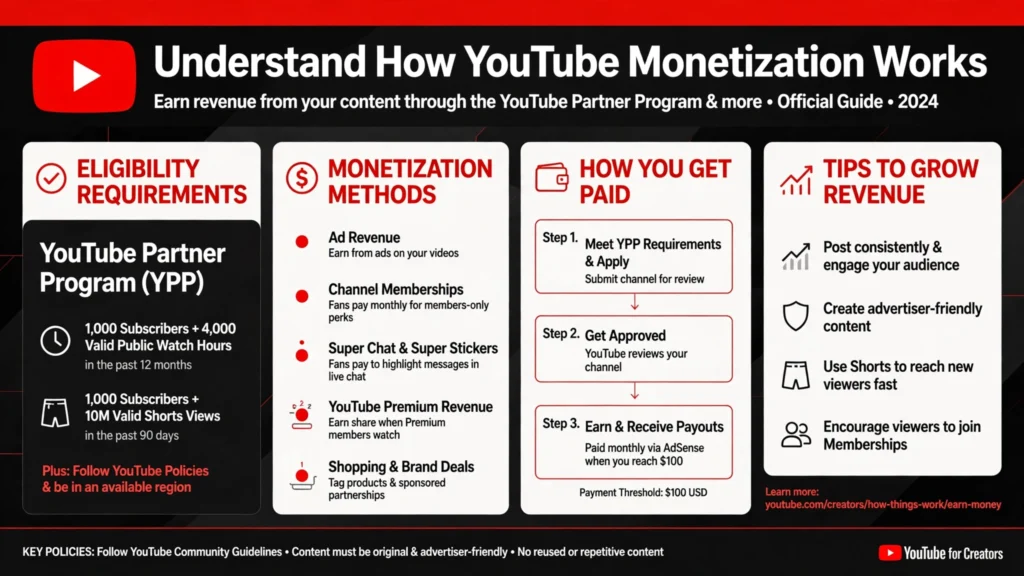
YouTube monetization means earning income from eligible content or using your channel to support other income opportunities. The YouTube Partner Program (YPP) is YouTube’s main program for eligible creators who want access to platform monetization features.
Depending on your eligibility, country, content, and the features available to your channel, you may earn through advertising revenue, YouTube Premium revenue sharing, fan-funding features, or eligible shopping features.
Joining YPP is not the only way to make money through a YouTube audience. Creators may also explore affiliate marketing, sponsorships, digital products, or services, provided they follow applicable laws and YouTube’s rules.
It is important to distinguish between earning money directly through YouTube and earning money through a business that YouTube helps you promote. These methods have different requirements, and neither guarantees a particular income.
 2. Meet YouTube’s Monetization Requirements
 2. Meet YouTube’s Monetization Requirements
YouTube has different eligibility requirements for different earning features. Requirements can vary by country or region, so creators should check the Earn section of YouTube Studio and the official YouTube Help pages for their own accounts.
Standard eligibility for advertising revenue in 2026
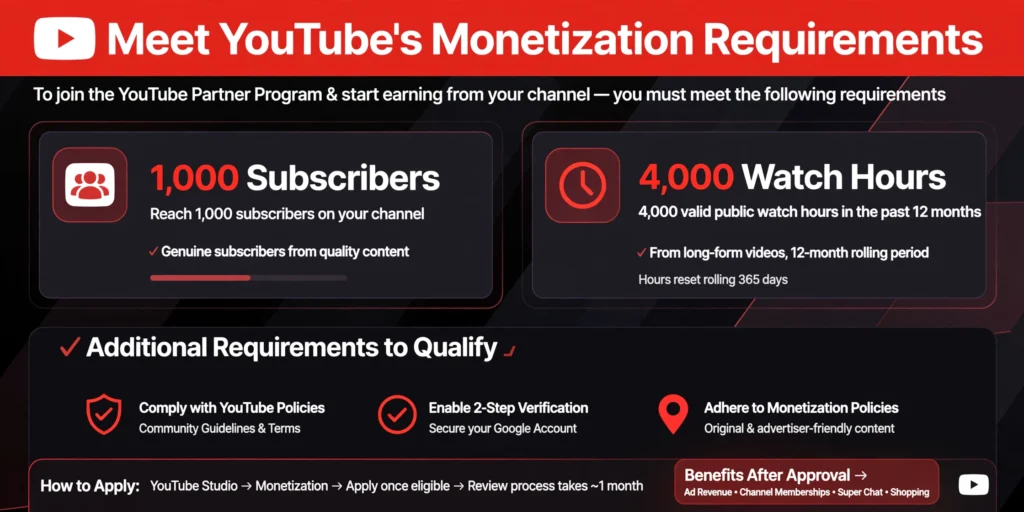
Under the standard requirements published for 2026, creators generally need to meet one of these two routes to qualify to apply for advertising revenue sharing:
– Long-form video route: 1,000 subscribers and 4,000 valid public watch hours during the previous 12 months.
– Shorts route: 1,000 subscribers and 10 million valid public Shorts views during the previous 90 days.
These are alternative routes, not requirements that must both be completed. Creators also need to meet YouTube’s other eligibility conditions and pass a channel review.
Meeting the numbers does not guarantee approval. YouTube reviews the channel to determine whether its content follows monetization policies and other applicable requirements.
What about the 500-subscriber threshold?
Some eligible countries offer an expanded version of YPP that can provide earlier access to selected earning features. Under the published expanded-program requirements, creators generally need:
– 500 subscribers.
– At least three valid public uploads during the previous 90 days.
– Either 3,000 valid public watch hours during the previous 12 months or 3 million valid public Shorts views during the previous 90 days.
This lower threshold is not available in every country and does not automatically unlock advertising revenue. It can provide access to certain features, subject to their individual eligibility rules.
Do not assume that every channel can use the expanded-program threshold simply because YPP is available in its country. Check the official country list and your YouTube Studio account.
Other requirements to know
Depending on your circumstances, YPP eligibility also requires you to:
– Live in a country or region where the relevant program is available.
– Follow YouTube’s channel monetization policies.
– Have no active Community Guidelines strikes when applying.
– Enable two-step verification on your Google Account.
– Have access to YouTube’s advanced features.
– Link an active AdSense for YouTube account or set one up through YouTube Studio as required.
Some monetization features have additional requirements, such as age restrictions, country availability, or acceptance of separate terms. If you are under 18, a parent or legal guardian who meets Google’s requirements may need to handle payments through AdSense for YouTube.
An announced change for 2027
YouTube has announced that, starting February 1, 2027, new creators applying for advertising and YouTube Premium revenue sharing will face updated entry thresholds. The announcement specifies 1,000 subscribers plus either 8,000 qualified watch hours in the previous 365 days or 20 million qualified Shorts views in the previous 90 days.
The announcement also says that these changes will not affect creators already in YPP in the same way as new applicants. Because policies can be updated, check the official announcement and YouTube Studio before applying or republishing this guide after the change takes effect.
3. Choose a Topic for Your YouTube Channel
 3. Choose a Topic for Your YouTube Channel
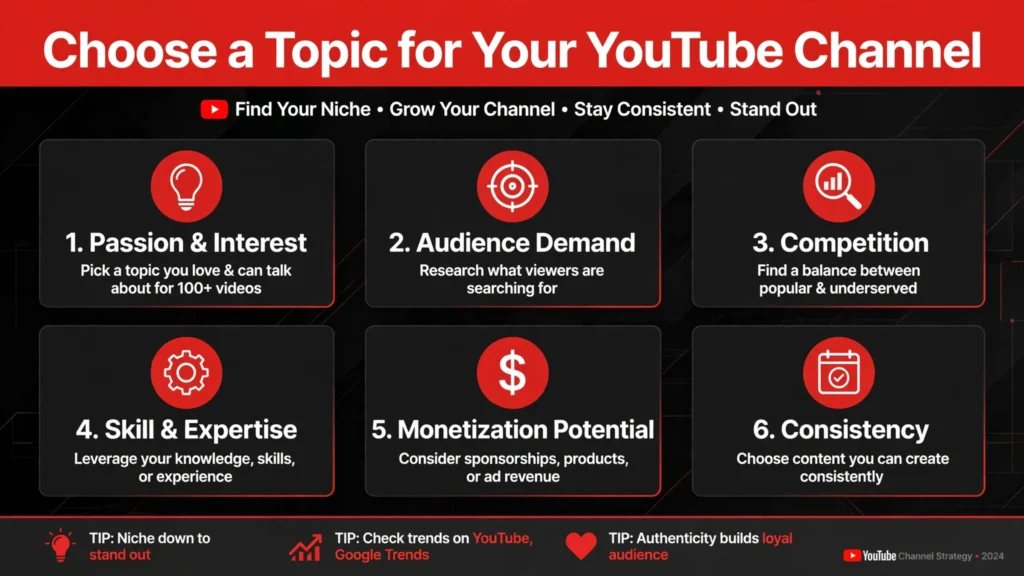
Before you start uploading, decide what your channel will focus on. A clear topic makes it easier to understand your audience and develop related video ideas.
You do not have to choose a topic that is popular with everyone. Instead, look for an area that interests you, that you can create content about consistently, and that viewers may find useful or entertaining.
Some possible channel topics include:
– Educational tutorials and study tips.
– Technology explanations and software tutorials.
– Art, drawing, crafts, and creative projects.
– Cooking demonstrations and recipes.
– Gaming commentary and guides.
– Product comparisons and practical reviews.
– Travel experiences and cultural discoveries.
– Personal development and skill-building.
– Home organization and do-it-yourself projects.
Consider your knowledge, interests, available resources, and the questions people ask about the topic. A focused channel can help viewers understand what to expect, although creators can explore related subjects when they make sense for the same audience.
For example, a drawing channel could include sketching tutorials, colored-pencil techniques, material reviews, and demonstrations of completed artwork. These topics connect naturally and can attract viewers interested in learning to draw.
4. Research Video Ideas Before Recording
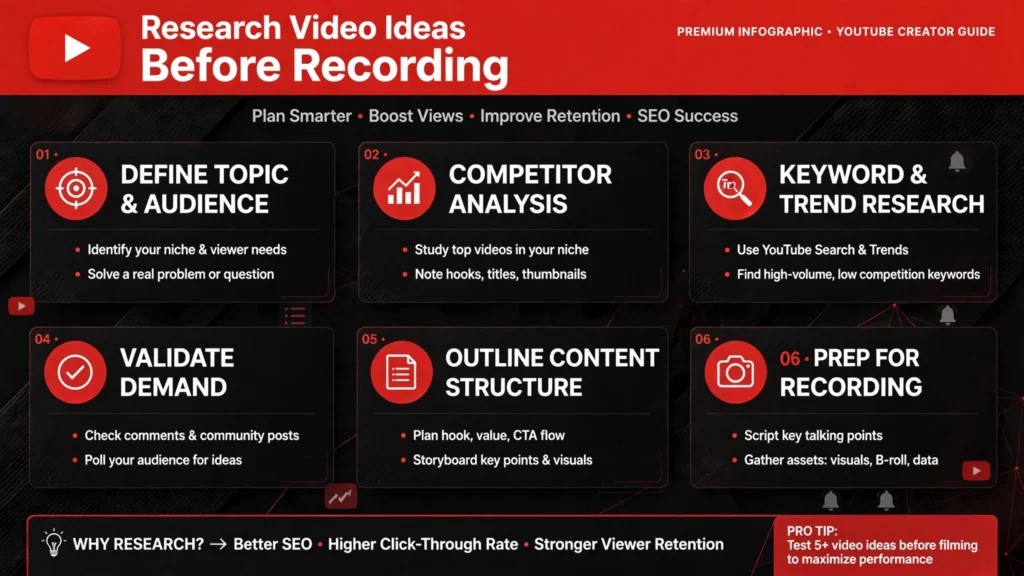 4. Research Video Ideas Before Recording
Good video ideas begin with understanding what viewers want to learn, solve, or experience. Instead of guessing what people might watch, look for real questions and recurring interests.
You can research ideas by:
– Using YouTube search suggestions to discover common search phrases.
– Reading questions in comments on videos related to your topic.
– Exploring discussions in relevant online communities.
– Reviewing YouTube Analytics once your channel has enough data.
– Studying successful videos in your niche to identify topics you can approach differently.
Research should inspire your own work, not lead you to copy another creator’s scripts, footage, thumbnails, or distinctive presentation.
Try to make each video answer one clear question or deliver one main benefit. For example, “How to Blend Colored Pencils Smoothly” communicates a more specific purpose than “My Art Video.”
Before recording, write down the main points you want to cover. A simple outline can help you stay organized and avoid unnecessary repetition.
5. Start Creating Videos With Equipment You Already Have
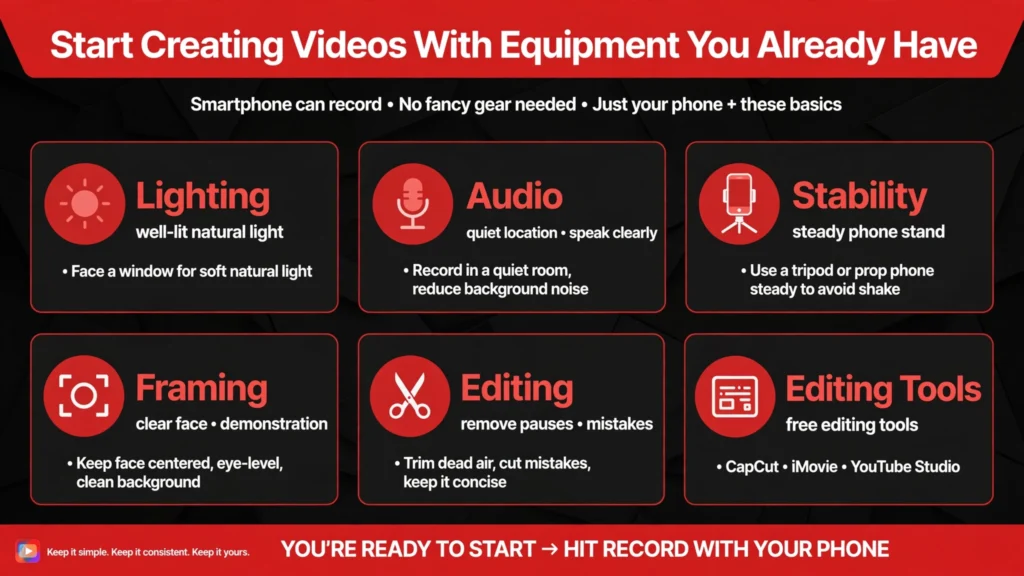 5. Start Creating Videos With Equipment You Already Have
You do not need professional equipment to begin learning video creation. A smartphone can record useful videos when you pay attention to lighting, sound, framing, and stability.
Start with these basics:
Lighting: Record in a well-lit space. Natural light can work well when it illuminates your subject clearly.
Audio: Choose a quiet location and speak clearly. If you are demonstrating something without speaking, make sure the process is easy to see and consider adding helpful explanations.
Stability: Keep your phone steady using a stable surface or an appropriate phone stand.
Framing: Position the camera so viewers can clearly see your face, demonstration, artwork, or other subject.
Editing: Remove unnecessary pauses, confusing sections, and mistakes that distract from the main point.
Free editing tools may be sufficient for basic trimming, captions, and simple transitions. Choose tools that work with your device and learn only the features you need at first.
The goal is not to make every video look expensive. It is to make the content clear, useful, and enjoyable to watch.
6. Create Videos That Give Viewers a Reason to Watch
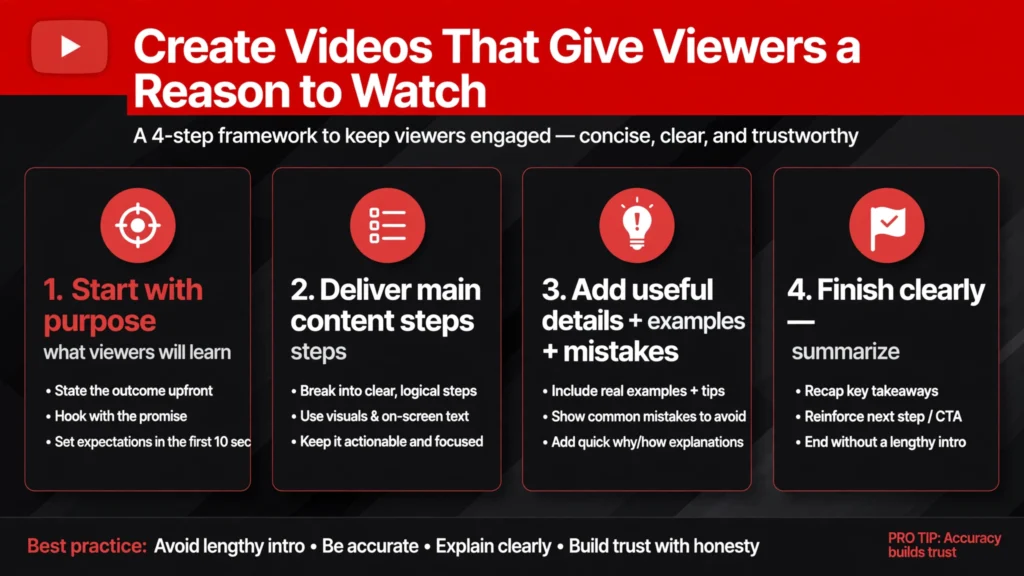 6. Create Videos That Give Viewers a Reason to Watch
A successful video should deliver on the expectation created by its title and thumbnail. If viewers click because they expect a tutorial, they should receive a clear tutorial rather than a long introduction unrelated to the subject.
A simple structure works well for many beginner videos:
1. Start with the purpose. Explain what viewers will learn or see.
2. Deliver the main content. Present the steps, information, demonstration, or story in a logical order.
3. Add useful details. Include examples, explanations, or common mistakes where relevant.
4. Finish clearly. Summarize the main point or suggest a related video.
Avoid lengthy introductions that delay the useful part of the video. You can introduce yourself briefly when it helps, but viewers should quickly understand why the video is worth their time.
Also, avoid making claims that the video cannot support. Accurate explanations build trust and reduce the risk of misleading your audience.
7. Use YouTube Shorts and Long-Form Videos Strategically
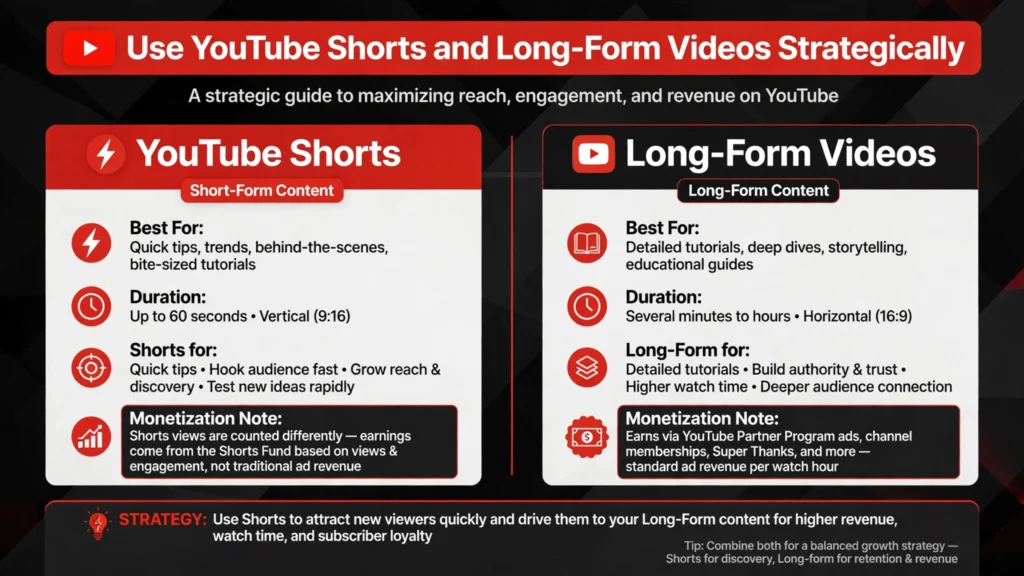 7. Use YouTube Shorts and Long-Form Videos Strategically
YouTube Shorts and long-form videos can serve different purposes.
Shorts are useful for concise demonstrations, quick tips, brief explanations, creative reveals, and other ideas that work in a short format. Long-form videos provide more room for detailed tutorials, comparisons, lessons, and in-depth discussions.
You can experiment with both formats if they suit your topic. For example, a creator who teaches drawing could post a short clip showing one technique and a longer video explaining the full process.
However, Shorts views and long-form watch hours are counted differently for monetization eligibility. Watch time from the Shorts Feed does not count toward the 4,000 valid public watch-hour requirement for the long-form route.
For eligibility purposes, only qualifying public watch hours and valid public Shorts views count. Watch time from private, unlisted, or deleted videos generally does not count toward the public watch-hour requirement, and views or watch time gained through advertising campaigns do not count toward these thresholds.
Creators should also understand that the Shorts-view figures used for YPP eligibility are not necessarily the same as the eligible engaged views used in calculating Shorts revenue sharing.
For Shorts advertising revenue sharing, creators must accept the applicable Shorts Monetization Module. Only eligible views after accepting the module can qualify for revenue sharing; earlier views are not made eligible retroactively.
Always review the latest official Shorts monetization rules before relying on Shorts as an income source.
8. Improve Your Titles, Thumbnails, and Descriptions
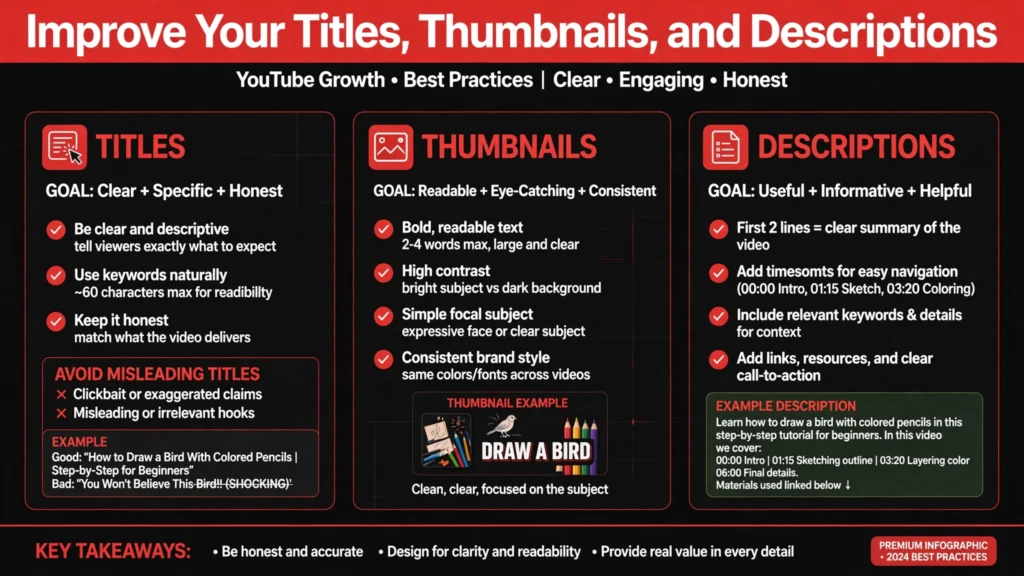 Your video title, thumbnail, and description help viewers understand what the content offers. They can also help YouTube and potential viewers interpret the subject of your video.
Write clear titles
Use a title that accurately describes the video and communicates its main benefit. Include relevant search phrases naturally when they fit.
For example:
– “How to Draw a Bird With Colored Pencils”
– “Beginner’s Guide to Editing Videos on a Phone”
– “Five Common Mistakes When Learning to Draw”
Avoid misleading titles that promise results the video does not deliver. Sensational wording may attract clicks in the short term but can disappoint viewers and damage trust.
Create readable thumbnails
A thumbnail should communicate the subject quickly. Use a clear image, readable text if needed, and a layout that remains understandable on a small screen.
You do not need to add many words or visual effects. A simple image that accurately represents the video can work well.
Write useful descriptions
Explain what viewers will find in the video. Add relevant details, useful links, and chapters when appropriate. Avoid stuffing the description with repeated keywords or unrelated phrases.
Tags may help in limited cases, such as clarifying common misspellings, but they are not a substitute for useful content, a clear title, or an appealing thumbnail.
9. Build an Audience by Learning From Analytics
 9. Build an Audience by Learning From Analytics
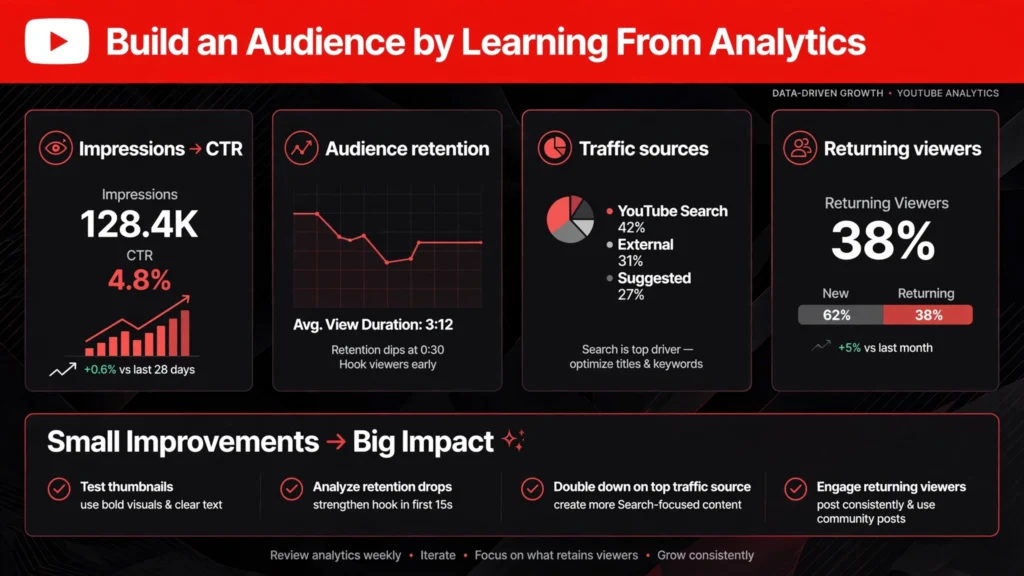
YouTube Analytics helps creators understand how viewers discover and watch their videos. Rather than judging a channel only by its subscriber count, review several indicators over time.
Impressions and click-through rate: These can help you understand how often people see your thumbnail and how often they choose to watch after seeing it.
Audience retention: This shows where viewers continue watching or leave the video. Use it to identify sections that may need clearer explanations or better pacing.
Traffic sources: These indicate how viewers find your videos, such as YouTube Search, suggested videos, external websites, or other sources.
Returning viewers: This can help you understand whether people come back for more of your content.
Do not assume that one video’s performance predicts the future of your channel. A video may take time to find its audience, and different topics can perform differently.
Use analytics to make small, informed improvements. For example, if viewers leave during a lengthy introduction, try reaching the main point sooner in your next video.
10. Best Ways How to Earn Money on YouTube
 10. Best Ways How to Earn Money on YouTube
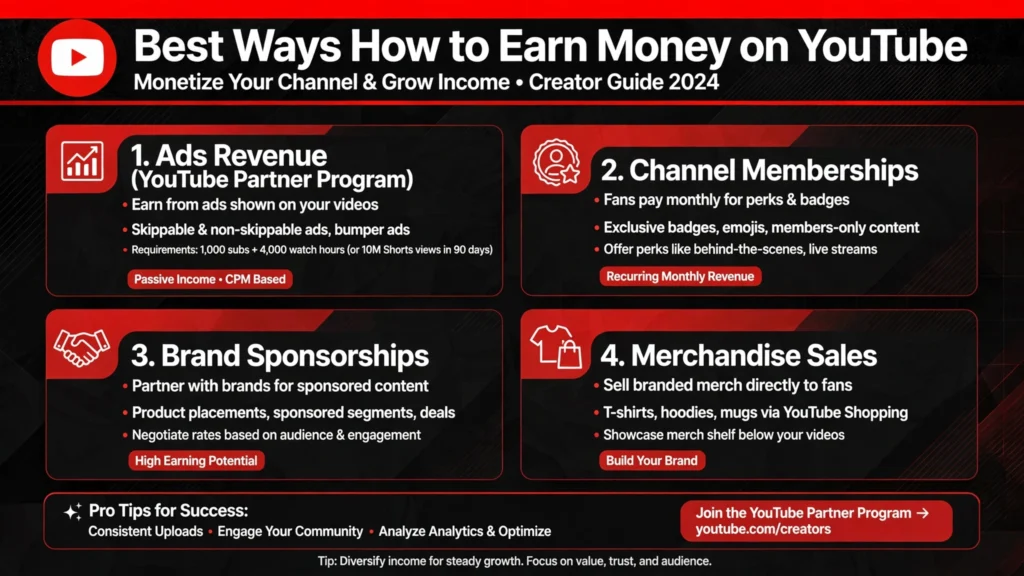
YouTube offers several possible income sources, but availability and eligibility vary. It is wise to understand the differences before building a plan around any single method.
Advertising revenue
Eligible creators accepted into YPP may earn a share of revenue from ads shown on qualifying content. The amount varies according to factors such as audience location, advertiser demand, subject matter, video format, and eligible monetized views.
There is no universal payment rate per view. Two videos with similar view counts can generate different amounts of revenue.
YouTube Premium revenue
Creators may receive a share of eligible YouTube Premium subscription revenue when Premium subscribers watch their content, subject to YouTube’s terms and calculation methods.
This is not a fixed payment for each subscriber or video. Earnings depend on eligible viewing and the applicable revenue-sharing system.
Channel memberships and fan-funding features
Eligible creators may be able to offer channel memberships or features such as Super Chat, Super Stickers, and Super Thanks. These allow qualifying viewers to support creators through YouTube’s built-in features.
Each feature has its own requirements, country restrictions, age conditions, and terms. Reaching a subscriber threshold does not automatically make every feature available.
Affiliate marketing
Affiliate marketing involves recommending products or services through tracked links. A creator may receive a commission when a viewer completes a qualifying purchase or action.
Choose products that are relevant to your audience and describe them honestly. Clearly disclose affiliate relationships where required by law or platform rules, and never present paid recommendations as independent opinions.
Affiliate marketing may be possible without receiving YouTube ad revenue, but you must follow the affiliate program’s conditions and applicable disclosure rules.
Sponsorships and brand partnerships
A brand may pay a creator to introduce, demonstrate, or review a product or service. Brands generally consider factors such as audience relevance, content quality, trust, engagement, and the suitability of the channel for their campaign.
You do not need to assume that a huge subscriber count is the only measure of value. A focused audience may be relevant to particular brands, although sponsorships are never guaranteed.
Use YouTube’s paid-promotion disclosure setting when applicable and follow advertising disclosure laws in the relevant jurisdictions.
Selling products or services
A channel can also help promote original artwork, digital products, educational resources, merchandise, or legitimate services. YouTube may offer built-in shopping features to eligible creators, but those features have their own requirements.
Creators can also direct interested viewers to an external website or store, provided the links and promotional content comply with YouTube’s policies.
Choose products or services that genuinely relate to your content and that you can deliver responsibly.
11. Can AI-Generated Content Be Monetized?
 11. Can AI-Generated Content Be Monetized?
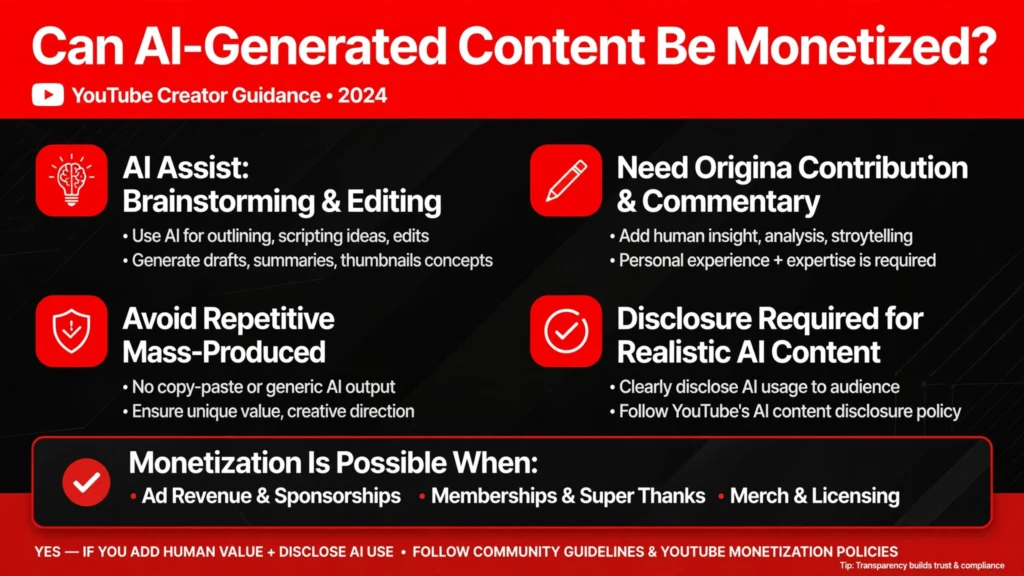
Artificial intelligence can assist with brainstorming, outlining, editing, captions, and other parts of the creative process. Using AI does not automatically make a channel eligible or ineligible for monetization.
The important question is whether the finished content follows YouTube’s policies and provides meaningful value to viewers.
Videos that are repetitive, mass-produced, or lack meaningful original contribution may be ineligible for monetization under YouTube’s inauthentic-content policy. Reusing another creator’s material can also create monetization problems, even when permission has been obtained, if the content does not meet YouTube’s reused-content requirements.
Creators should add their own explanation, research, commentary, demonstrations, storytelling, or other meaningful contributions. Simply generating large numbers of nearly identical videos is not a reliable monetization strategy.
YouTube may also require disclosure when realistic content has been meaningfully altered or generated using AI, particularly when it could mislead viewers about real people, events, or situations.
The safest approach is to use AI as a tool while remaining responsible for accuracy, originality, transparency, and the value of the finished video.
12. Avoid Common Monetization Mistakes
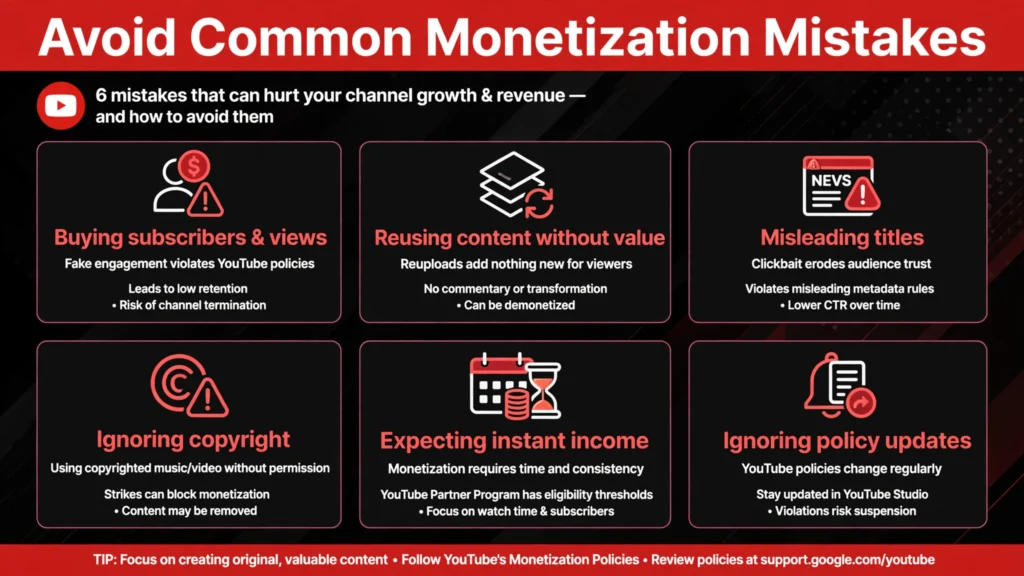 12. Avoid Common Monetization Mistakes
Beginners can lose time and damage their channel’s credibility by focusing on shortcuts rather than sustainable content creation.
Buying subscribers or views: Artificial engagement can violate YouTube’s rules, and invalid traffic may be excluded from monetization calculations.
Reusing content without meaningful original value: Other people’s footage, music, images, or videos may create copyright or reused-content issues. Permission alone does not guarantee that a channel meets monetization requirements.
Publishing misleading content: Titles, thumbnails, and claims should accurately represent what viewers will receive.
Ignoring copyright: Use original material or content you have the appropriate rights to use. Review the terms of any music, footage, image, or other asset before including it in a video.
Expecting instant income: A channel may need substantial time to develop an audience. There is no guaranteed timeline for reaching the eligibility thresholds or receiving approval.
Ignoring policy updates: YouTube can change its eligibility requirements, monetization terms, and feature availability. Review the official guidance periodically.
These mistakes are avoidable when creators prioritize trust, originality, and a clear understanding of the platform’s rules.
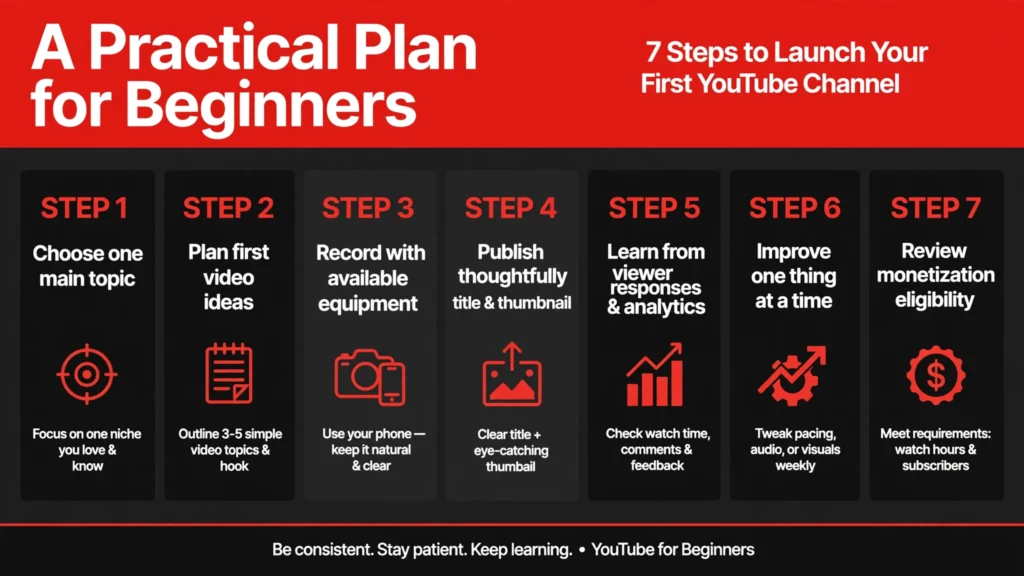
13. A Practical Plan for Beginners
If you are starting from zero, you do not need to master every part of YouTube immediately. Begin with a manageable routine and improve as you gain experience.
Step 1: Choose one main topic
Select a subject you can create content about consistently. Think about what you enjoy, what you can demonstrate or explain, and what viewers may want to learn.
Step 2: Plan your first video ideas
Write down several specific questions or topics within your chosen niche. Make sure each idea offers a clear benefit or an interesting experience.
Step 3: Record with available equipment
Start with your phone or other equipment you already have. Focus on clear sound, adequate lighting, stable footage, and useful information.
Step 4: Publish thoughtfully
Choose an accurate title, create a readable thumbnail, and write a helpful description. Check your video before publishing to catch mistakes and confirm that you have the necessary rights to its content.
Step 5: Learn from viewer responses
Review comments and analytics when available. Look for repeated questions and opportunities to make future videos more helpful.
Step 6: Improve one thing at a time
You might improve your introductions, audio, editing, explanations, or thumbnails. Small improvements can help you learn without making the process unnecessarily complicated.
Step 7: Review monetization eligibility
Check the Earn section of YouTube Studio to see your current progress and available options. Read the relevant official requirements before applying.
Consistency can help you develop your skills, but uploading more videos is not a guarantee of success. Prioritize quality, audience needs, and a sustainable routine.
14. How Long Does It Take to Earn Money on YouTube?
 14. How Long Does It Take to Earn Money on YouTube?
There is no fixed timeline for earning money on YouTube. Some creators build an audience relatively quickly, while others need much longer or never reach the requirements for advertising revenue.
Your progress may depend on the subject you choose, the usefulness of your content, audience interest, competition, presentation, and how viewers respond to your videos.
It is better to focus on what you can control: making original videos, improving your skills, understanding your audience, and following the rules. Avoid anyone promising guaranteed subscribers, instant monetization, or a fixed income in exchange for shortcuts.
If you explore affiliate marketing, sponsorships, or selling products, remember that these methods also depend on audience trust, demand, and the terms of the relevant programs.
15. Final Thoughts
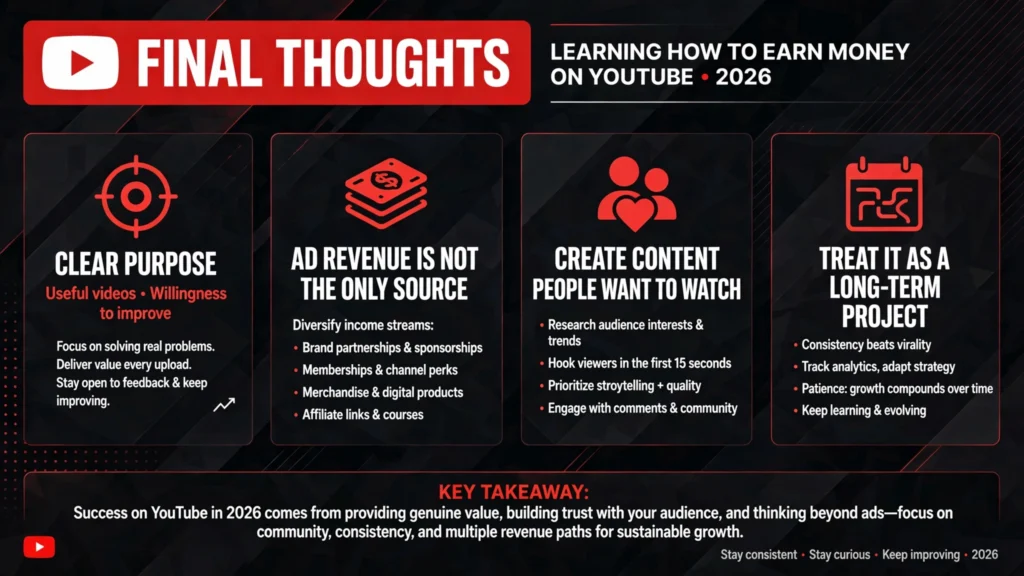
Learning how to earn money on YouTube in 2026 begins with understanding the platform and choosing a content direction you can develop over time. You do not need expensive equipment to start, but you do need a clear purpose, useful videos, and a willingness to improve.
Advertising revenue is one possible income source, not the only one. Eligible creators may also explore YouTube Premium revenue sharing, fan-funding features, affiliate marketing, sponsorships, and products or services that suit their audience.
The most important step is to create content that people genuinely want to watch. Research your ideas, present them clearly, respect copyright, and check YouTube’s current eligibility requirements before making financial plans.
YouTube can create opportunities, but income is not guaranteed. Treat it as a long-term learning and creative project, use reliable information, and make decisions based on your own progress rather than someone else’s promises.
Official YouTube Resources
For the latest eligibility requirements and monetization rules, consult these official resources:
– “YouTube Partner Program overview and eligibility” (https://support.google.com/youtube/answer/72851)
– “Overview of the expanded YouTube Partner Program” (https://support.google.com/youtube/answer/13429240)
– “YouTube channel monetization policies” (https://support.google.com/youtube/answer/1311392)
– “YouTube Shorts monetization policies” (https://support.google.com/youtube/answer/12504220)
– “How to earn money on YouTube” (https://support.google.com/youtube/answer/72857)
– “Official announcement of YouTube Partner Program changes for 2027” (https://blog.youtube/news-and-events/youtube-partner-program-updates-2027-new-opportunities-earn/)
Eligibility, payment terms, and feature availability can vary by country and may change. Verify the current official requirements before applying for monetization.

















Leave a Comment
Your email address will not be published. Required fields are marked with *