
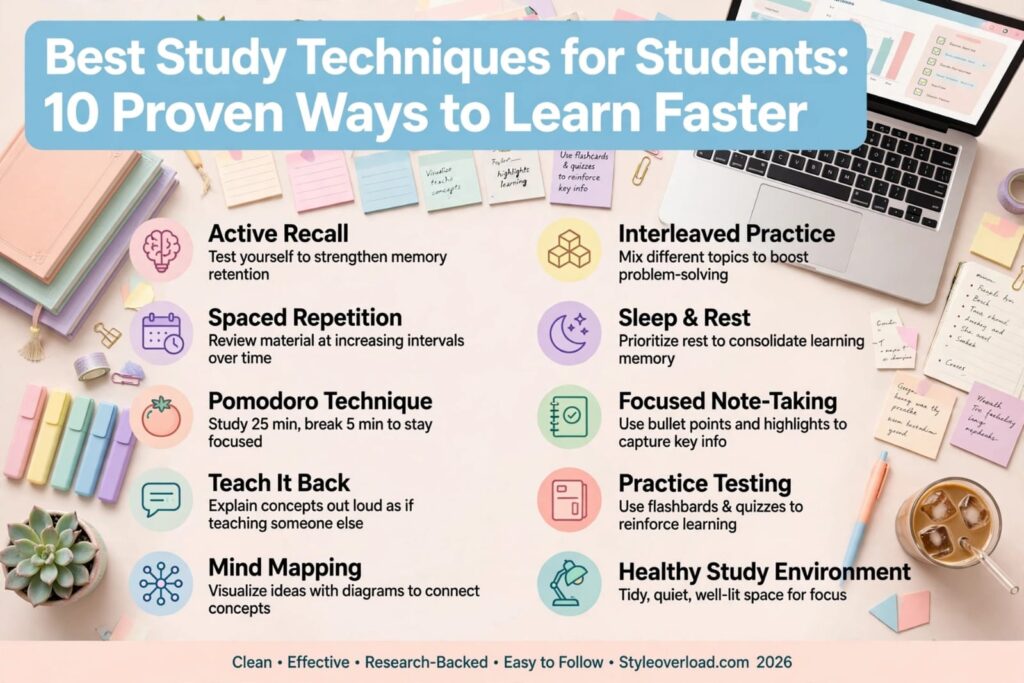
Best Study Techniques for Students: 10 Proven Ways to Learn Faster Have you ever spent an entire evening studying for an exam, only to discover the next morning that you can barely remember what you read? It is a frustrating experience, especially when you have worked hard and sacrificed your free time to prepare. The
Best Study Techniques for Students: 10 Proven Ways to Learn Faster
Have you ever spent an entire evening studying for an exam, only to discover the next morning that you can barely remember what you read? It is a frustrating experience, especially when you have worked hard and sacrificed your free time to prepare.
The problem is not always how long you study. Sometimes, it is how you study.
Rereading textbooks, highlighting entire pages, and memorizing notes at the last minute can make information feel familiar without ensuring that you can recall or apply it later. More effective approaches involve actively retrieving information, revisiting it over time, and practicing the skills you will need during an exam.
The best study techniques for students are not complicated tricks or shortcuts. They are practical methods that help you understand difficult concepts, remember important information, and make better use of your available study time.
Whether you are in school, attending university, or preparing for competitive exams, these ten techniques can help you build a more effective study routine.
 1. Use Active Recall to Strengthen Your Memory
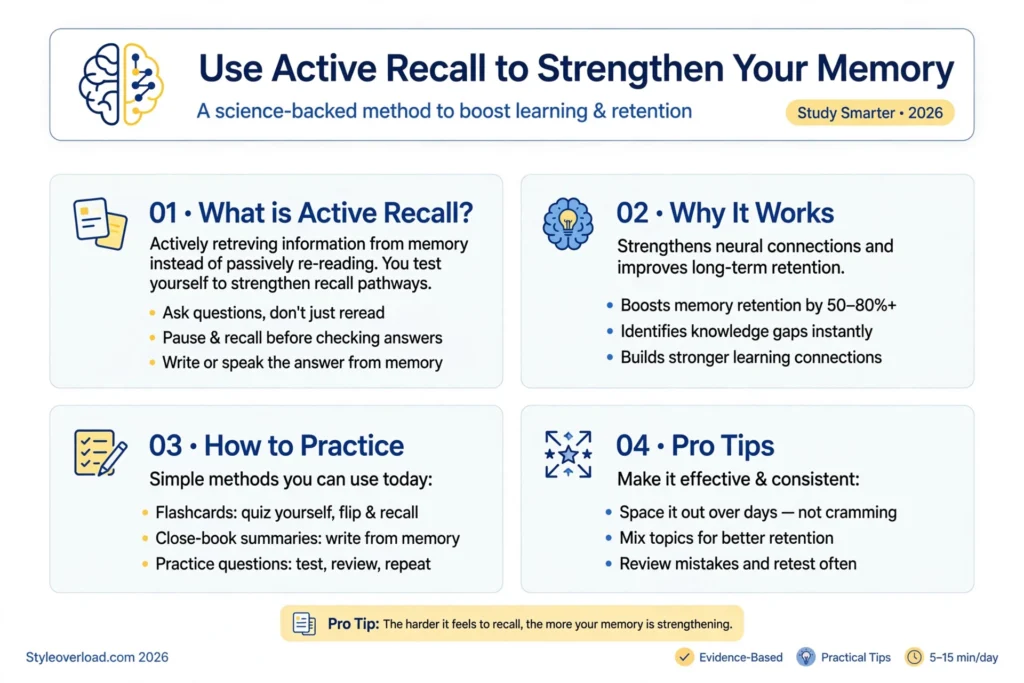 1. Use Active Recall to Strengthen Your Memory
Active recall means trying to remember information without looking at your notes or textbook. Instead of reading the same paragraph several times, you close the book and test what you can explain from memory.
This approach encourages you to retrieve information rather than simply recognize it on the page. Research on learning has found that retrieval practice can improve long-term retention compared with repeated studying alone.
How to use active recall
Read a short section of your textbook and make sure you understand its main idea.
Close the book or cover your notes.
Write down the important points you remember.
Answer questions about the topic without checking the answers.
Reopen your materials, identify missing details, and correct mistakes.
Test yourself again later.
Example: If you are studying the human digestive system, close your textbook and try to describe the journey food takes through the body. Include the main organs and their functions. Then check your explanation against your notes.
You can also use flashcards, blank-page exercises, or questions you create yourself.
Common mistake: Looking at the answer too quickly. Give yourself a genuine opportunity to retrieve the information before checking your notes. If you get something wrong, treat it as useful feedback rather than a reason to give up.
2. Use Spaced Repetition Instead of Cramming
Spaced repetition involves reviewing information across several study sessions rather than trying to learn everything in one sitting.
When you revisit a topic after an interval, you have to work a little to retrieve what you learned previously. This can help strengthen long-term retention. Spacing is particularly useful for subjects that require remembering information over weeks or months.
How to space your revision
Review new material after your initial study session.
Revisit it again after a short interval.
Increase the gaps between reviews when you can recall the material successfully.
Return to difficult information sooner than material you already remember well.
There is no single review schedule that works perfectly for every student or subject. The intervals should reflect how difficult the material is and when you need to use it.
Example: Suppose you learn 20 new biology terms on Monday. You test yourself on Tuesday, review them again later in the week, and return to them the following week. If you repeatedly forget five terms, give those terms additional practice instead of spending equal time on all 20.
A calendar or flashcard app can help you organize these reviews.
Common mistake: Reviewing only the information that already feels easy. Give extra attention to concepts you repeatedly forget, and make sure you can explain them rather than simply recognize their definitions.
3. Test Yourself With Practice Questions
Practice testing is a way to check what you know and identify what still needs work. It overlaps with active recall, but its emphasis is on measuring your understanding and using the results to guide your next study session.
Practice tests can reveal weaknesses that are easy to overlook when you are reading familiar material. They also help you become comfortable with answering questions under different conditions.
Make practice testing part of your routine
Study the topic before attempting a test.
Answer questions without using your notes when appropriate.
Mark your answers honestly.
Review incorrect answers and identify why they were wrong.
Revisit weak areas before testing yourself again.
Example: After studying algebra, complete ten questions covering the concepts you learned. If you can solve simple equations but struggle with equations containing fractions, spend your next session practicing that specific skill.
You do not need to wait until the end of a chapter to test yourself. Short quizzes after individual topics can help you identify problems early.
Remember that a low score on a practice quiz is not a final judgment of your ability. It is information about what to study next.
4. Explain Difficult Concepts in Your Own Words
Understanding a topic means more than remembering its definition. You should also be able to explain what it means, why it matters, and how it connects to other ideas.
One useful approach is self-explanation: describe a concept in your own words and explain the reasoning behind it. This can help expose gaps in your understanding that memorizing a textbook passage might hide.
Try the teach-it-back method
After learning something new, imagine that you are explaining it to a younger student who has never encountered the subject.
Describe the main idea using simple language.
Explain why it works or how it happens.
Connect it to something familiar.
Identify any part you cannot explain clearly.
Review that part and try again.
Example: When studying gravity, do not simply memorize its definition. Explain how gravity keeps the Moon in orbit around Earth and why objects fall toward the ground. If you cannot explain the connection, return to the relevant lesson.
You can speak aloud, write a short explanation, or teach a friend. The goal is to make your thinking visible.
Common mistake: Assuming that a simple explanation is automatically a complete one. Use your own words, but check your explanation against reliable learning materials to ensure that it remains accurate.
5. Mix Different Types of Problems With Interleaving
Interleaving means practicing different but related types of questions within the same study session instead of completing a large block of identical questions before moving to the next type.
This technique is particularly useful when you must recognize which method applies to a problem. It encourages you to distinguish between similar concepts rather than automatically repeating the last procedure you practiced.
How to practice interleaving
First, learn the basic methods separately so you understand how each one works. Once you have a reasonable grasp of them, mix the question types and decide which approach each question requires.
Example: A mathematics student might practice linear equations, fractions, and percentages in separate introductory exercises. Later, the student mixes these problem types in one worksheet. Before solving each question, they must identify the appropriate method.
This is useful for exam preparation because questions do not always appear in the same order as your textbook chapters.
Common mistake: Mixing unfamiliar material too early. If you do not understand the individual methods yet, begin with guided practice and introduce interleaving as your knowledge develops.
 6. Use Focused Study Sessions and Sensible Breaks
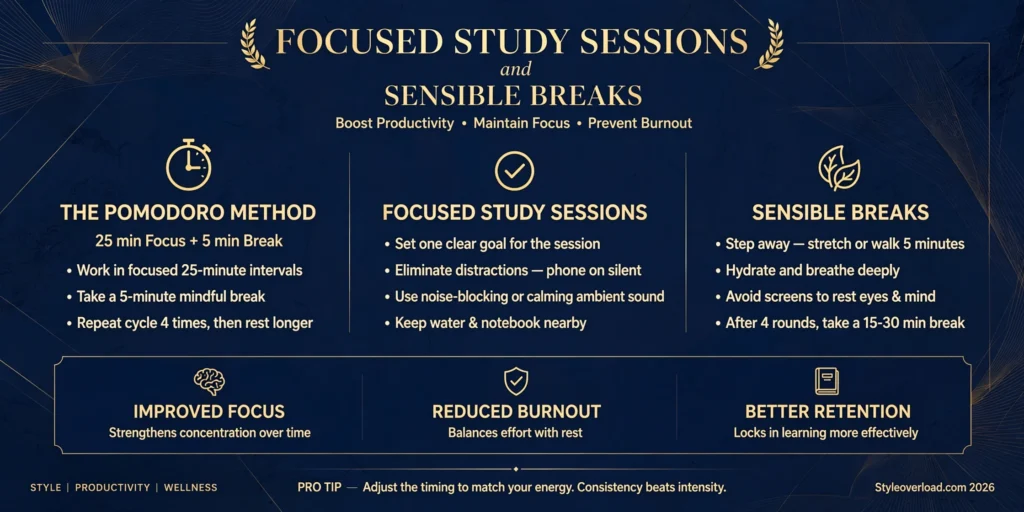 6. Use Focused Study Sessions and Sensible Breaks
A study session is more productive when you have a clear task and give it your attention. Working continuously for hours is not always necessary, and concentration can become harder to maintain during long periods of demanding work.
The Pomodoro Technique offers one simple structure: study for 25 minutes, take a five-minute break, and repeat if the schedule suits your needs. After several rounds, take a longer break.
The exact timing is a productivity choice, not a scientifically guaranteed formula. Some students work better with longer blocks, particularly when writing essays or solving complex problems.
Example: Set a timer for 25 minutes and use that period to solve five chemistry questions. During the break, stand up, stretch, or get a drink of water. Afterward, check your answers before starting another session.
Choose a specific outcome for each block, such as finishing a set of questions or understanding one difficult concept.
Avoid using every break to scroll through social media. A quick check of messages can easily turn a short break into a much longer interruption.
7. Create a Study Environment That Reduces Distractions
Your surroundings can make it easier or harder to focus. Notifications, background conversations, and unrelated browser tabs repeatedly pull your attention away from the task.
You do not need a perfect desk or an expensive study setup. You need a space where you can work comfortably with fewer interruptions.
Make your study space work for you
Keep the materials for your current subject within reach.
Silence nonessential notifications.
Close tabs and applications unrelated to your task.
Choose a quieter location when possible.
Tell others when you need uninterrupted study time.
If your home is noisy, consider a library or another suitable shared study space.
Example: If you are preparing for a history exam, place your textbook, notebook, and practice questions on your desk. Put your phone out of reach and spend the next 30 minutes answering questions about the topic you studied.
If you cannot control your environment, use practical alternatives such as studying during quieter hours or wearing comfortable noise-reducing headphones when safe and appropriate.
The aim is not to eliminate every possible distraction. It is to make focused work easier to begin and maintain.
8. Use Past Papers and Exam-Style Questions Strategically
Practice questions and past papers help you apply knowledge in the format you may encounter during an assessment. They can also reveal whether you can work within time limits and interpret questions correctly.
Although this overlaps with practice testing, past papers have an additional purpose: they help you understand the demands of a particular exam.
Get more value from past papers
Learn the relevant material before attempting a full paper.
Choose questions that match your course or exam syllabus.
Work without notes when simulating exam conditions.
Check your answers against an appropriate marking scheme or reliable answer guide.
Record the mistakes you made and why they happened.
Practice the weakest areas before attempting another paper.
Example: A student preparing for an English examination completes a past paper and discovers that the main difficulty is finishing the reading section on time. The student then practices reading comprehension with a timer and reviews how to allocate time across questions.
If you are studying for an exam that changes its syllabus regularly, check that your practice papers are relevant to the current requirements.
Do not simply complete paper after paper without reviewing your answers. Understanding why an answer was incorrect is an important part of the learning process.
 9. Use Mind Maps and Visual Organization Where Appropriate
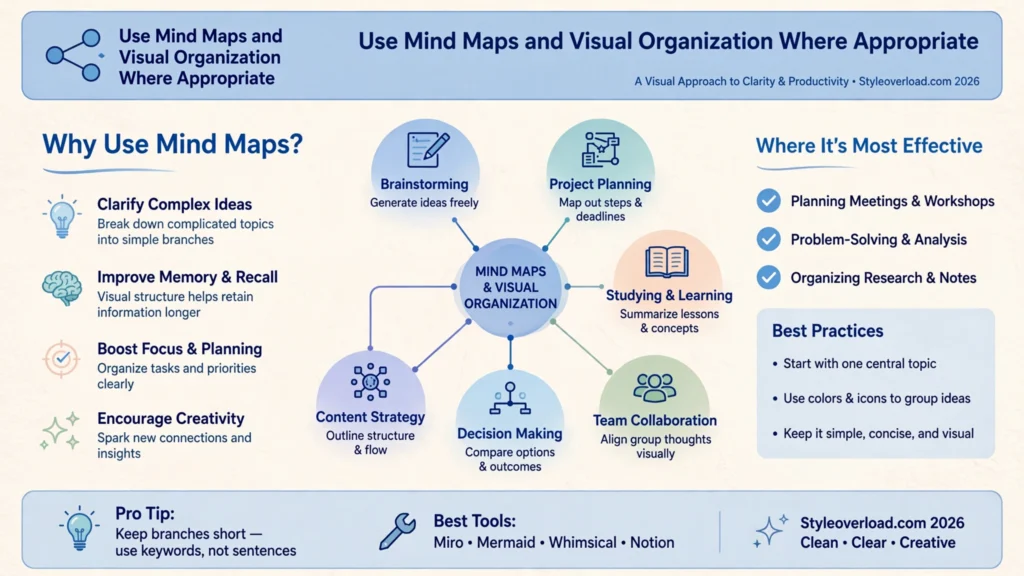 9. Use Mind Maps and Visual Organization Where Appropriate
Mind maps, diagrams, flowcharts, and labeled drawings can help organize information and show how different ideas connect. They are especially useful when studying processes, relationships, classifications, or complex systems.
Visual organization is not automatically better than written notes. Its value depends on the subject and how you use it.
Build a useful mind map
Write the central topic in the middle of a page.
Add branches for the main concepts.
Include short keywords, relationships, and relevant examples.
Use arrows to show sequences or connections.
After creating the map, cover your notes and try to recreate its main structure from memory.
Example: When studying the causes of World War I, create branches for alliances, militarism, imperial competition, and nationalism. Add brief explanations and show how these factors relate to the events that followed.
For biology, a labeled diagram may be more useful than a mind map. For a historical sequence, a timeline may be clearer. Choose the format that makes the relationships easiest to understand.
Common mistake: Spending more time decorating notes than learning the material. Keep visuals simple, accurate, and focused on the information you need to understand.
10. Plan Realistic Study Sessions and Review Your Progress
Even effective study methods can be difficult to maintain without a workable plan. A realistic schedule helps you decide what to study, when to revisit it, and which tasks deserve priority.
Instead of writing a vague goal such as “study science,” define a task you can complete and check.
Create a study plan you can follow
List upcoming assignments, tests, and important deadlines.
Break large subjects into smaller topics.
Schedule difficult or urgent tasks when you can concentrate.
Allow time for practice questions and spaced revision.
At the end of each session, record what you completed and what remains unclear.
Review your plan weekly and adjust it when necessary.
Example: Rather than planning to study biology for three hours, set a goal to review cell structure, draw a labeled cell from memory, and answer ten related questions. If you struggle with the diagram, add a short review to your next study session.
Keep some flexibility in your timetable. Unexpected responsibilities, difficult chapters, and fatigue can affect how much you complete on a particular day.
The best plan is not the most ambitious one. It is one that helps you make steady progress without leaving you constantly behind.
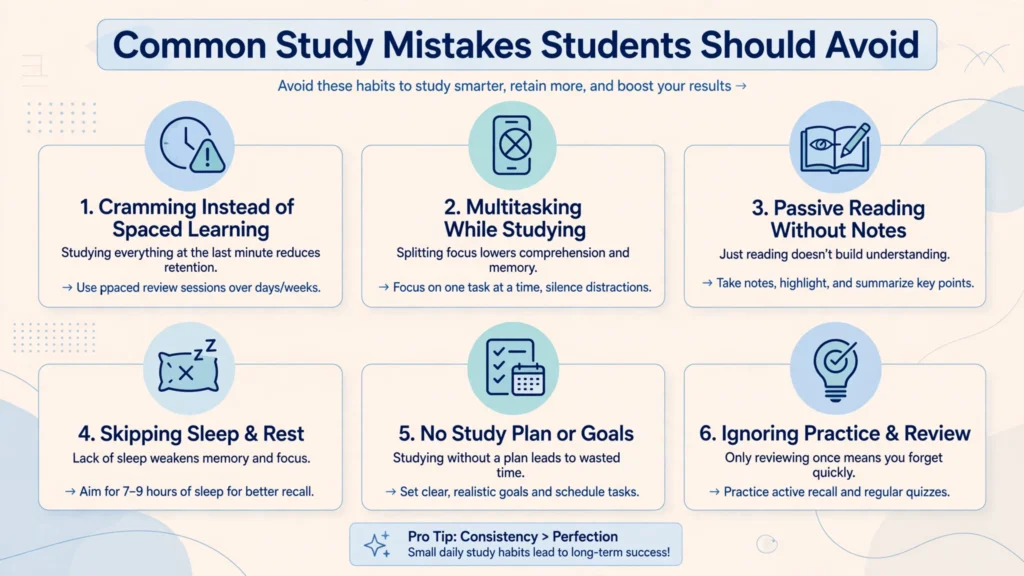
Common Study Mistakes Students Should Avoid
 Common Study Mistakes Students Should Avoid
Even a good timetable can fail if your daily habits work against your goals. Watch out for these common problems:
Rereading without testing yourself: Reading may help you understand new material, but add retrieval practice to check what you can remember.
Cramming at the last minute: Begin reviewing early enough to revisit material across multiple sessions.
Highlighting entire pages: Mark only important ideas, then use questions or summaries to check your understanding.
Ignoring mistakes: Review incorrect answers to discover whether you misunderstood a concept or applied the wrong method.
Creating unrealistic schedules: Plan around your actual responsibilities rather than an idealized day.
Sacrificing sleep to study longer: Adequate sleep supports attention and learning. An all-night session may leave you less prepared to concentrate the next day.
You do not need to adopt every technique at once. Start with the methods most relevant to your current difficulties and build from there.
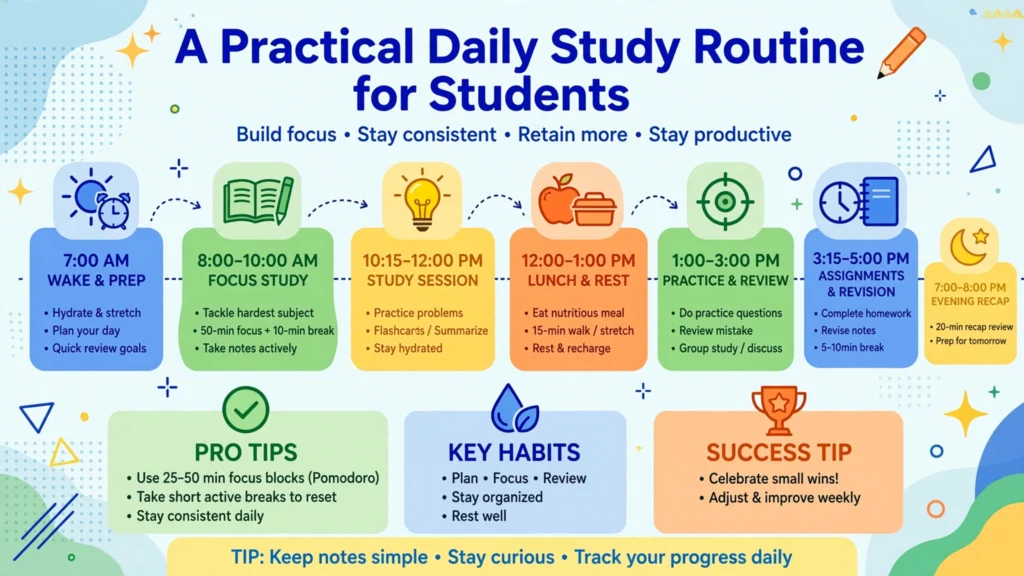
A Practical Daily Study Routine for Students
 A Practical Daily Study Routine for Students
Here is an example of a 90-minute study session. Adjust the timing to suit your age, workload, subject, and concentration.
| Time | Activity |
|---|---|
| 0–5 minutes | Set one clear goal and prepare your materials. |
| 5–25 minutes | Learn or review a topic. |
| 25–30 minutes | Take a short break. |
| 30–50 minutes | Practice active recall and answer questions. |
| 50–55 minutes | Take another short break. |
| 55–75 minutes | Solve mixed problems or exam-style questions. |
| 75–90 minutes | Check mistakes, summarize weak areas, and plan your next review. |
On another day, revisit the same topic using spaced repetition. You can also replace one block with essay writing, language practice, or a longer problem-solving task when needed.
This routine is a starting point, not a rule. If you have only 30 minutes available, use that time for one focused task rather than abandoning your plan altogether.
Frequently Asked Questions
1. What are the most effective study techniques for students?
Active recall, spaced practice, and practice testing have particularly strong research support for improving learning and retention. Explaining concepts, interleaving problems, and using suitable visual aids can complement these methods.
2. How can I memorize information faster?
Focus on understanding the material, testing yourself without notes, and reviewing it across multiple sessions. Flashcards can help with definitions and facts, while practice questions are useful for applying knowledge. The best approach depends on what you need to learn.
3. How many hours should students study each day?
There is no single number that suits every student. Study time depends on your age, course difficulty, deadlines, current understanding, and other responsibilities. Focus on achievable learning goals and the quality of your practice rather than hours alone.
4. Is studying at night better than studying in the morning?
Neither is universally better. Your concentration, sleep schedule, responsibilities, and personal preferences matter. Choose a time when you can focus consistently, and avoid sacrificing adequate sleep to extend your study sessions.
Conclusion: Make Your Next Study Session More Effective
Effective studying is not about filling every free hour with textbooks. It is about choosing methods that help you understand information, retrieve it when needed, and apply it to real questions.
Start with active recall and spaced repetition, use practice questions to identify weak areas, and organize your time around realistic goals. Add other techniques when they suit your subject and learning needs.
Your next step: Choose one topic you are currently studying, close your notes, and spend five minutes writing down everything you can remember. Check what you missed and schedule a short review for another day. That simple change can be the beginning of a more effective study routine.
For more research on learning, visit Wikipedia.




















Leave a Comment
Your email address will not be published. Required fields are marked with *