
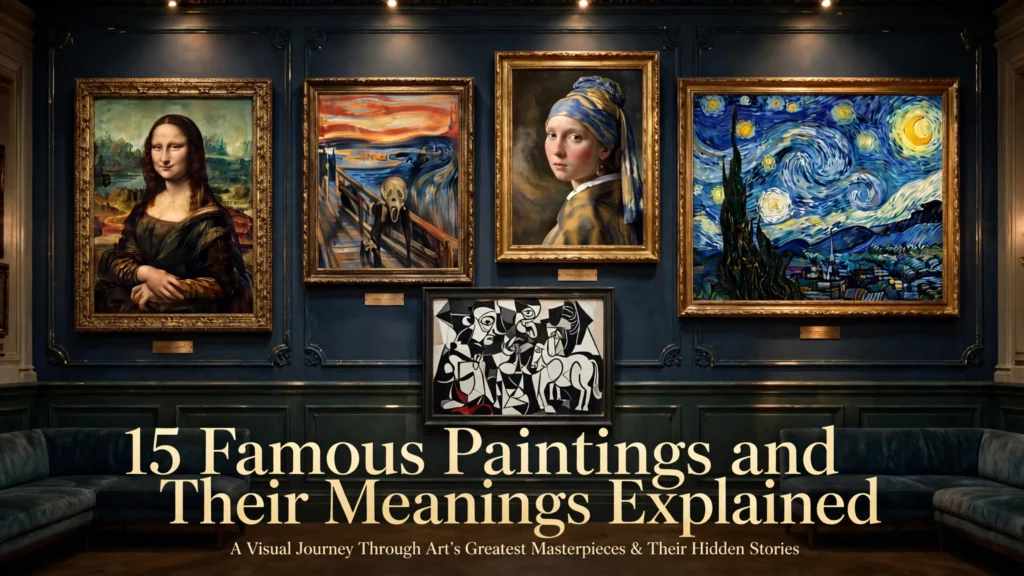
Discover 15 famous paintings and their meanings, from the Mona Lisa to The Starry Night. Explore the stories, symbolism, history, and artistic details behind these iconic masterpieces.
15 Famous Paintings and Their Meanings Explained
A woman turns toward the viewer with an expression that seems to change depending on where you look. A night sky swirls above a quiet village. A group of people stands beneath a storm of broken shapes, their faces caught in anguish. These scenes are more than recognizable images: each offers clues about the artist’s world, the ideas of its time, and the questions that still interest viewers today.
Understanding famous paintings and their meanings involves more than discovering a secret message hidden in the paint. Some artworks have a clear historical purpose. Others draw on mythology, religion, politics, or ordinary life. In many cases, art historians agree on the basic facts but continue to debate what particular details might represent.
This guide explores 15 celebrated artworks from different countries and artistic traditions. For each one, we will look at what is visible, what reliable historical evidence tells us, and which interpretations deserve caution. The goal is not to force a single explanation onto every painting, but to make looking at art more rewarding.
What Gives a Famous Painting Its Meaning?
A painting’s meaning often develops from several sources working together.
Historical context: The period in which an artwork was created can explain its subject, intended audience, and political or religious references.
Composition: The arrangement of figures, objects, light, color, and empty space influences what viewers notice first.
Symbolism: An object, gesture, color, or figure may carry a meaning familiar to the artist’s original audience.
Documented intentions: Letters, commissions, historical records, and artists’ statements can provide evidence about why a work was made.
Later interpretations: Viewers and scholars may discover new ways to understand an artwork as social values and historical knowledge change.
Not every painting contains a hidden code. Sometimes its significance lies in how it depicts a familiar subject, experiments with technique, or challenges the artistic conventions of its time. Keeping facts separate from interpretations helps us appreciate an artwork without turning speculation into history.
15 Famous Paintings and Their Meanings
1. Mona Lisa — Leonardo da Vinci

Leonardo da Vinci, Mona Lisa, c. 1503–1519. Oil on poplar panel. Musée du Louvre, Paris.
Few paintings invite as much curiosity as Leonardo da Vinci’s Mona Lisa. The portrait shows a woman seated before a distant landscape, her hands resting calmly in the foreground. Her expression appears composed, yet the slight curve of her mouth has encouraged centuries of discussion about what she might be feeling.
Leonardo worked on the painting over an extended period during the Italian Renaissance, when artists were exploring more naturalistic ways to represent human beings and the world around them. His technique, known as sfumato, blends tones and edges gradually rather than outlining every feature sharply. This creates subtle transitions around the face and mouth.
What does the Mona Lisa mean?
The strongest starting point is portraiture itself. The painting presents an individual as psychologically complex rather than simply recording her appearance. The soft landscape, relaxed pose, and carefully modeled face contribute to that effect.
The sitter is widely identified as Lisa Gherardini, a Florentine woman, although the painting’s history and identification have been discussed by scholars. Her smile is not proof of a particular emotion, secret, or message. Its ambiguity partly comes from Leonardo’s technique and from the way people interpret facial expressions.
Another important detail is the relationship between the figure and the landscape. The winding paths, distant water, and uneven horizon create depth, giving the portrait a world that seems to extend far beyond the sitter.
The painting is held by the Louvre in Paris. Its fame is not based only on the smile; it also reflects Leonardo’s technical skill, the portrait’s history, and its extraordinary place in popular culture.
Image suggestion
Alt text: Leonardo da Vinci’s Mona Lisa seated before a distant landscape.
Caption: Mona Lisa demonstrates Leonardo’s subtle modeling of facial features and atmospheric landscape.
Rights: Use the museum’s image only under the rights and reproduction terms provided with the image.
2. The Starry Night — Vincent van Gogh

Vincent van Gogh, The Starry Night, June 1889. Oil on canvas. Museum of Modern Art, New York.
In The Starry Night, the sky seems alive. Bright stars glow above a village, a crescent moon shines in the upper right, and sweeping blue forms move across the darkness. A tall, flame-like cypress rises from the foreground, linking the land to the restless sky.
Van Gogh painted the work while staying at the Saint-Paul-de-Mausole asylum in Saint-Rémy, southern France. The view from his window informed the composition, but the painting is not a straightforward record of a single moment. He transformed observed details through bold color, expressive brushwork, and an imaginative arrangement.
What does The Starry Night mean?
The painting is often interpreted as a meeting between the natural world and the artist’s emotional imagination. Its moving sky can suggest energy, wonder, uncertainty, or spiritual longing. These are plausible readings rather than a definitive statement of Van Gogh’s intention.
The village, with its small church and quiet buildings, contrasts with the enormous sky. The cypress tree provides another strong vertical form, while the curling lines guide the eye around the canvas. This contrast gives the scene a sense of movement that a literal night landscape might not possess.
It is tempting to treat every swirling shape as a direct illustration of Van Gogh’s mental health. That approach is too simplistic. His letters and artistic choices offer important context, but a painting cannot be used by itself to diagnose its creator or explain every visual decision.
MoMA’s collection notes that the painting draws on the view from Van Gogh’s window while departing from direct observation. It remains a key example of how landscape painting could express mood as well as place.

Image suggestion
Search: MoMA — The Starry Night
Alt text: Van Gogh’s Starry Night with swirling blue skies, bright stars, a village, and a dark cypress tree.
Caption: Van Gogh transforms a recognizable landscape into an expressive vision of the night sky.
Rights: Check MoMA’s image-use terms before downloading or reproducing the image.
3. Girl with a Pearl Earring — Johannes Vermeer

Johannes Vermeer, Girl with a Pearl Earring, c. 1665. Oil on canvas. Mauritshuis, The Hague.
A young figure turns her head toward the viewer, her lips slightly parted. A blue-and-yellow turban wraps around her head, while a large pearl catches the light against a dark background. Vermeer gives the face a soft, lifelike quality without filling it with excessive detail.
Although the painting is often called a portrait, the Mauritshuis explains that it is better understood as a tronie: a study of an imagined figure or character rather than a formal portrait intended to record a particular person’s identity. The sitter’s identity remains unknown.
What does Girl with a Pearl Earring mean?
Part of the painting’s appeal lies in its openness. The figure’s glance invites the viewer to imagine a story, but the artwork does not provide enough information to establish who she is or what she is thinking.
The turban gives the figure an exoticized appearance from the perspective of seventeenth-century Dutch painting. The pearl draws attention through its brightness and apparent simplicity. Interestingly, the museum notes that it is probably not a real pearl: Vermeer suggested its shape with only a few strokes of paint.
The contrast between the dark background and the illuminated face makes the figure seem to emerge into the viewer’s space. Her expression feels immediate, although the image remains carefully constructed.
Rather than inventing a biography for the girl, it is more accurate to see the painting as a demonstration of Vermeer’s skill with light, texture, and the expressive possibilities of a single glance.
Image suggestion
Alt text: Vermeer’s Girl with a Pearl Earring wearing a blue and yellow headscarf.
Caption: Vermeer uses light, color, and a direct glance to give an imagined figure a compelling presence.
Rights: Consult the Mauritshuis image-use and reproduction information.
4. The Persistence of Memory — Salvador Dalí

Salvador Dalí, The Persistence of Memory, 1931. Oil on canvas. Museum of Modern Art, New York.
Soft watches droop over a ledge and a bare branch in an otherwise strange landscape. Ants gather on a closed watch, while a pale, dreamlike form lies across the center of the scene. In the distance, golden cliffs evoke the coast of Catalonia, the region where Dalí grew up.
Created during the rise of Surrealism, the painting challenges the stable, rational world associated with conventional realism. Dalí rendered the objects with extraordinary precision, even as he made them behave in impossible ways.
What does The Persistence of Memory mean?
The melting clocks are commonly understood as an image of time losing its ordinary authority. Clocks usually organize life into measurable units, but here their forms become soft and unreliable. Dalí himself referred to the limp watches as the “camembert of time,” linking their shape to overripe cheese. MoMA’s interpretation also connects the ants with decay and the strange central form with an altered version of Dalí’s own face.
These details support readings involving time, memory, decay, and the unstable boundary between reality and dreams. Yet the painting is not a straightforward illustration of one philosophical theory. Its unsettling effect comes partly from the clash between recognizable objects and impossible surroundings.
A useful detail is its size: the original canvas is relatively small, measuring about 24 by 33 centimeters. Its enormous cultural presence contrasts with its compact physical scale.
The work is now part of MoMA’s collection in New York.
Image suggestion
Search: MoMA — The Persistence of Memory
Alt text: Dalí’s Persistence of Memory showing soft clocks draped over objects in a barren landscape.
Caption: Dalí turns familiar timepieces into an unsettling Surrealist dreamscape.
Rights: MoMA identifies copyright restrictions for this work; obtain permission or use an authorized image.
5. The Scream — Edvard Munch

Edvard Munch, The Scream, 1893 version. Tempera and crayon on cardboard. National Museum, Oslo.
A figure stands on a bridge, hands pressed against the sides of its head. Behind it, two people continue walking, apparently unaffected. The sky burns with orange and red, and the landscape bends into long, restless curves.
Munch explored anxiety, vulnerability, love, and death throughout his work. The Scream belongs to that wider artistic project. It is one of several versions of the motif produced in different media.
What does The Scream mean?
The painting is widely understood as an image of intense psychological distress. Its distorted forms make the surrounding world seem to echo the central figure’s inner experience. The bridge creates a strong diagonal, while the contrasting figures in the background make the central person’s isolation more striking.
Munch’s own account of the idea behind the image describes a walk at sunset, a blood-red sky, and a sense of an immense, unending scream passing through nature. This background supports the interpretation that the work presents anxiety as an experience that seems to overwhelm both body and surroundings.
Still, the figure’s identity and the exact cause of its distress are not specified. The image should not be reduced to a clinical illustration of a particular disorder. Its power comes from making a difficult emotional experience visible without providing a simple explanation.
The motif has become an enduring visual shorthand for fear and overwhelm, but its significance is broader than a reaction to one frightening event.
Image suggestion
Alt text: Edvard Munch’s The Scream with a distressed figure beneath a red-orange sky.
Caption: Munch uses distorted lines and intense color to express overwhelming distress.
Rights: Confirm the specific version and image license before use; multiple versions exist.
6. Under the Wave off Kanagawa (The Great Wave) — Katsushika Hokusai

Katsushika Hokusai, Under the Wave off Kanagawa, c. 1830–1832. Woodblock print with ink and color on paper. The Metropolitan Museum of Art, New York.
A huge wave curls above three narrow boats, its foamy tips resembling claws. Far behind it, Mount Fuji appears small and calm, enclosed by the hollow of the wave. The image is a woodblock print, not an oil painting, and belongs to Hokusai’s series Thirty-six Views of Mount Fuji.
Its composition depends on scale and perspective. The towering water fills much of the scene, while the sacred and culturally significant mountain appears distant and vulnerable. Hokusai also used Prussian blue, an imported pigment that helped give the print its strong tonal contrasts.
What does The Great Wave mean?
The print can be read as a portrayal of human vulnerability in the face of nature’s power. The boats and their occupants appear tiny beside the wave, while Mount Fuji—usually a stable landmark—seems almost swallowed by the composition.
However, the work is not necessarily a simple warning about disaster. It is also a landscape image built around visual rhythm, careful design, and the relationship between a famous mountain and the sea. The series repeatedly presents Fuji from different viewpoints, making the mountain a unifying presence even when it appears small.
The Met describes how Hokusai uses perspective to make Fuji seem like a small triangle within the crest of the wave. The museum also identifies the work’s medium as woodblock printing, an important distinction when discussing its production and circulation.
Image suggestion
Alt text: Hokusai’s Great Wave curling above fishing boats with Mount Fuji in the distance.
Caption: Hokusai balances the immense wave against the distant form of Mount Fuji.
Rights: The Met lists its collection image as public domain; verify the specific image record before reuse.
7. Guernica — Pablo Picasso

Pablo Picasso, Guernica, 1937. Oil on canvas. Museo Reina Sofía, Madrid.
Picasso’s monumental Guernica presents a scene of fractured bodies, frightened faces, and animals caught in a space that seems to collapse around them. A mother cries out while holding her dead child. A wounded horse twists at the center, and a figure raises a lamp above the chaos.
Picasso created the painting in 1937 after the bombing of the Basque town of Guernica during the Spanish Civil War. It was intended for the Spanish Pavilion at the Paris International Exposition. The restricted palette of black, white, and gray gives the scene the harsh visual quality of news photography.
What does Guernica mean?
Its historical connection to the bombing is central. The painting condemns the violence inflicted on civilians, while its distorted bodies and compressed space communicate suffering without offering a literal battlefield report.
The bull, horse, lamp, and human figures have attracted competing interpretations. It is risky to assign each symbol a single fixed meaning, because Picasso did not provide a complete explanatory key. The painting’s force comes from the relationships between its figures and the overall atmosphere of terror.
The Museo Reina Sofía describes Guernica as both a response to a specific historical event and a broader statement against the brutality of war. It also notes the work’s complex relationship with Cubism, Surrealism, and earlier traditions of history painting.
The painting returned to Spain in 1981 after being held in New York for safekeeping during the years following the Spanish Civil War. It is now displayed at the Museo Reina Sofía in Madrid.
Image suggestion
Search: Museo Reina Sofía — Guernica
Alt text: Picasso’s Guernica showing anguished figures, a wounded horse, a bull, and a lamp.
Caption: Picasso transforms the bombing of Guernica into a monumental statement about the suffering caused by war.
Rights: Verify the museum’s reproduction policy. Picasso’s work remains copyrighted in many jurisdictions.
8. The Birth of Venus — Sandro Botticelli

Sandro Botticelli, The Birth of Venus, c. 1485. Tempera on canvas. Uffizi Galleries, Florence.
Venus stands on a large shell as the wind carries her toward shore. On the left, two airborne figures blow her across the water; on the right, a young woman waits with a flower-covered cloak. The sea, flowers, flowing hair, and delicate gestures create a scene of graceful movement.
Botticelli painted the work during the Italian Renaissance, when classical mythology became an important subject for artists and patrons. The figure of Venus draws on ancient models of idealized beauty, while the composition reflects the Renaissance interest in classical literature and visual culture.
What does The Birth of Venus mean?
Despite its familiar title, the painting depicts Venus arriving on land after her birth from the sea rather than the moment of birth itself. The Uffizi identifies the goddess as a symbol of love and beauty and explains that the wind figures carry her toward the island of Cyprus. The flowers and the waiting figure reinforce the connection with spring.
The work can be understood as a celebration of beauty, love, and the renewal of life. Its graceful poses and idealized bodies reflect a humanist interest in classical subjects, though the painting’s precise commission and original setting remain less certain than its imagery.
The Uffizi notes that a Medici commission is highly probable, but not definitively documented. That distinction matters: the painting’s classical subject is clear, while the exact circumstances behind its creation are less certain.
Image suggestion
Alt text: Botticelli’s Birth of Venus showing the goddess standing on a shell above the sea.
Caption: Botticelli presents Venus arriving on shore as an image of idealized beauty and love.
Rights: Check the Uffizi’s terms for reproducing collection images.
9. American Gothic — Grant Wood

Grant Wood, American Gothic, 1930. Oil on beaverboard. Art Institute of Chicago.
A stern-looking man stands beside a woman in front of a white farmhouse with a pointed Gothic-style window. The man holds a pitchfork, and both figures face the viewer. Their formal clothing and serious expressions give the scene a carefully controlled appearance.
Grant Wood developed the idea after seeing a small farmhouse in Eldon, Iowa. He asked his sister, Nan Wood Graham, and his dentist, Byron McKeeby, to pose as the imagined residents. The figures were not intended to be a straightforward record of a real farmer and his daughter.
What does American Gothic mean?
The painting is often associated with rural American identity, traditional values, and the image of hard-working, conservative communities. Yet its tone is not entirely straightforward. Some viewers see admiration for endurance and discipline; others detect satire in the stiff expressions and formal pose.
Wood’s own description of his idea, as summarized by the Art Institute of Chicago, presents the figures as isolated people holding on to old values. That gives the work a historical foundation while leaving room for disagreement about whether it celebrates or gently questions those values.
The title refers to the house’s Carpenter Gothic architectural window, not to a dark or supernatural subject. The pitchfork’s repeated vertical lines echo the window and the figures’ clothing, binding the composition together.
Image suggestion
Alt text: Grant Wood’s American Gothic showing a stern man with a pitchfork and a woman before a farmhouse.
Caption: Wood’s tightly arranged figures have become an enduring image of rural American identity.
Rights: Check the museum’s image licensing and credit requirements before publication.
10. The Night Watch — Rembrandt van Rijn

Rembrandt van Rijn, The Night Watch, 1642. Oil on canvas. Rijksmuseum, Amsterdam.
At first glance, The Night Watch appears to be a crowded scene of men preparing to march. A captain in black gestures toward his lieutenant, while other members of the civic guard carry weapons, move into position, or turn toward the viewer. Light catches particular faces and objects amid the darker background.
Rembrandt made the painting for an Amsterdam civic guard hall. These groups served public functions, including local defense, and commissioned large group portraits that celebrated their membership and status.
What does The Night Watch mean?
The painting expresses civic identity and collective action. Rather than lining the guards up in a static row, Rembrandt depicts them in motion. The captain’s gesture and the lieutenant’s bright clothing guide the viewer through the composition, while the varied poses create a sense of activity.
The small girl illuminated near the center has often attracted attention. She carries a chicken, and the bird’s claws are associated with the emblem of the civic guard company. The figure functions as a visual detail connecting the painting to the group it commemorates, although not every detail has a universally agreed symbolic meaning.
The title The Night Watch is misleading: the work’s dark appearance was partly caused by layers of aged varnish, and the scene is not simply a night patrol. The Rijksmuseum identifies the painting more fully as the civic guardsmen under the command of Captain Frans Banninck Cocq and Lieutenant Willem van Ruytenburch.
Image suggestion
Search: Rijksmuseum — The Night Watch
Alt text: Rembrandt’s Night Watch showing Amsterdam civic guards gathering and moving through a dramatic scene.
Caption: Rembrandt transforms a civic group portrait into a scene of movement and collective identity.
Rights: Follow the Rijksmuseum’s image download, attribution, and reuse terms.
11. The Kiss — Gustav Klimt

Gustav Klimt, The Kiss, 1907–1908. Oil and gold leaf on canvas. Belvedere, Vienna.
Two figures embrace on a patch of flowers, their bodies almost disappearing beneath elaborate gold and patterned robes. The man’s face bends toward the woman’s cheek, while she closes her eyes and rests against him. Gold dominates the composition, making the couple appear separate from ordinary surroundings.
Klimt created the painting during his celebrated Golden Period, when he combined painterly techniques with decorative patterns and metallic materials. His approach reflects the influence of Art Nouveau and the Vienna Secession, a movement that challenged traditional academic ideas about art.
What does The Kiss mean?
The painting is widely interpreted as an image of intimacy, love, and emotional connection. The couple’s closeness is emphasized by their interlocking forms, while the surrounding gold creates a dreamlike atmosphere. Their patterned garments differ: the man’s robe features more rectangular forms, while the woman’s includes rounded and floral shapes.
These patterns help distinguish the figures visually, but it would be misleading to assign a fixed psychological meaning to every shape. The overall design matters more than a supposed secret code.
The Belvedere describes the work as an allegorical representation of lovers and highlights Klimt’s use of gold, silver, and ornament. The painting has become a widely recognized image of romantic affection, although its appeal extends beyond a single modern idea of love.
Image suggestion
Search: Belvedere Museum — The Kiss
Alt text: Klimt’s The Kiss depicting two lovers embracing in gold and patterned robes.
Caption: Klimt combines intimate human figures with decorative gold to create an image of romantic closeness.
Rights: Check the Belvedere’s image licensing and reproduction conditions.
12. Nighthawks — Edward Hopper

Edward Hopper, Nighthawks, 1942. Oil on canvas. Art Institute of Chicago.
A brightly lit diner sits on a dark city corner. Three customers occupy the counter, accompanied by a server, but no one appears to be engaged in an animated conversation. The wide glass window exposes the interior while leaving the viewer outside, separated from the people by a broad, unbroken pane.
Hopper painted Nighthawks in 1942, during a period when American cities were changing rapidly. The scene has been associated with urban isolation, although the painting does not identify a specific event or explain what the figures are thinking.
What does Nighthawks mean?
The contrast between bright interior light and the empty street creates a feeling of separation. The customers share a space but remain psychologically distant from one another. The absence of a visible entrance adds to the impression that the diner is difficult to enter, even though it is brightly illuminated.
Hopper explained that the idea was inspired by a restaurant on Greenwich Avenue in New York. The Art Institute of Chicago also emphasizes how the simplified shapes and fluorescent light give the scene its distinctive atmosphere.
The painting is often discussed as an image of loneliness in modern city life. That interpretation is persuasive, but not exclusive: it can also be read as a study of artificial light, architectural geometry, or a quiet moment in an ordinary city.
Its meaning emerges from what Hopper leaves unexplained. The people are visible, yet their stories remain private.
Image suggestion
Alt text: Edward Hopper’s Nighthawks showing customers inside a brightly lit diner on a dark city street.
Caption: Hopper uses light, glass, and empty space to create an atmosphere of urban isolation.
Rights: Check the Art Institute’s image-use conditions before reproducing the work.
13. The Arnolfini Portrait — Jan van Eyck

Jan van Eyck, The Arnolfini Portrait, 1434. Oil on oak panel. The National Gallery, London.
A richly dressed man and woman stand in a domestic interior, surrounded by carefully rendered objects. A small dog stands near their feet, a chandelier hangs above them, and a convex mirror reflects the room from an unusual angle. The scene demonstrates the precision of early Netherlandish oil painting.
Van Eyck’s ability to depict textures and reflections gives the room an extraordinary sense of physical detail. The painting’s inscription, including the artist’s name and the date 1434, adds to its historical importance.
What does The Arnolfini Portrait mean?
The painting’s precise purpose remains debated. It has traditionally been interpreted as a marriage portrait, partly because of the couple’s formal clothing, joined hands, and the apparent importance of the domestic setting. Other scholars have questioned whether it depicts a marriage ceremony at all.
The mirror is particularly intriguing. It reflects two additional figures near the room’s entrance, while its surrounding frame contains small scenes from the Passion of Christ. The dog may suggest fidelity, but such interpretations should be treated as possibilities rather than a definitive symbolic dictionary.
The National Gallery’s research and interpretation of the painting have helped establish how much information can be drawn from its objects, inscription, and visual construction. Yet those details do not settle every question about the sitters or the occasion.
The painting’s value lies partly in this combination of precise observation and historical uncertainty. Its everyday objects invite close inspection, while its original purpose remains open to discussion.
Image suggestion
Alt text: Jan van Eyck’s Arnolfini Portrait showing a couple, a small dog, a chandelier, and a convex mirror.
Caption: Van Eyck’s detailed domestic interior invites questions about marriage, identity, and social status.
Rights: Check the National Gallery’s image and reproduction terms.
14. Las Meninas — Diego Velázquez

Diego Velázquez, Las Meninas, 1656. Oil on canvas. Museo del Prado, Madrid.
At the center of this large painting stands the young Infanta Margarita, surrounded by attendants, a dog, and other figures in a royal room. Velázquez himself appears at the left, standing before a large canvas. At the back of the room, a mirror reflects the figures of King Philip IV and Queen Mariana of Spain.
The composition seems to capture a moment during a royal visit, but the relationships between the people and the unseen scene beyond the canvas are deliberately difficult to resolve.
What does Las Meninas mean?
The painting raises questions about looking, representation, and the position of the artist. The mirror may suggest that the king and queen stand where the viewer is positioned, but the exact relationship between the reflected figures, the painter, and the people in the room has long been debated.
Velázquez’s inclusion of himself is significant. He presents the artist as part of the royal environment, rather than simply as an invisible observer outside it. The large canvas also draws attention to painting as a process of making and seeing.
It would be too simple to call Las Meninas a painting with one hidden message. Its structure supports several related interpretations about royal authority, artistic status, and the act of viewing. The Museo del Prado’s historical and technical information provides a foundation for examining those possibilities.
One distinctive feature is the use of reflected space. The mirror expands the implied world of the painting beyond the room we can see, making the viewer wonder who occupies the space in front of the figures.
Image suggestion
Search: Museo del Prado — Las Meninas
Alt text: Velázquez’s Las Meninas showing the Spanish Infanta, her attendants, the painter, and a mirror.
Caption: Velázquez makes the viewer part of a complex scene about royal presence and artistic observation.
Rights: Check the Prado’s official image-reuse policy before downloading the artwork.
15. Water Lilies — Claude Monet

Claude Monet, Water Lilies series, principally created from the 1890s through the 1920s. Oil on canvas. Works in the series are held in several collections, including the Musée de l’Orangerie, Paris.
Monet’s Water Lilies is not a single painting but a series of works inspired by the pond in his garden at Giverny, France. Floating leaves and blossoms occupy the surface, while reflections of sky, trees, and changing light blur the boundary between water and atmosphere.
Monet returned to this subject over many years. Rather than presenting a conventional landscape with a clearly defined horizon, he increasingly focused on the shifting colors and reflections visible on the pond.
What do Water Lilies mean?
The series invites attention to time, perception, and the changing natural world. Water, plants, sky, and reflections become intertwined, so viewers cannot always distinguish where one element ends and another begins.
It is tempting to assign the entire series one emotional message, such as peace or escape. A quieter reading is that Monet was exploring how vision changes with light, weather, and the observer’s position. The paintings reward sustained looking because the relationships between colors and shapes shift across the surface.
The larger decorative panels, including those displayed at the Musée de l’Orangerie, were designed to surround viewers with expansive views of water and vegetation. Their scale changes the experience from looking at a distant landscape to standing within an enveloping visual environment.
The series is significant not because every flower carries a secret meaning, but because Monet made an ordinary pond the subject of sustained artistic investigation. It also demonstrates how modern painting could move away from precise outlines and toward the sensations of light and color.
Image suggestion
Alt text: Monet’s Water Lilies showing floating flowers and soft reflections across a pond.
Caption: Monet explores the changing effects of light and reflection through repeated views of his garden pond.
Rights: Select a specific work and collection record, then check its image rights before reuse.
How to Interpret a Painting Without Misunderstanding It
You do not need formal art-history training to develop a thoughtful interpretation. A few simple habits can help you move beyond a painting’s first impression.
Begin with what you can actually see
Before searching for symbolism, describe the visible details. Who or what appears in the scene? Where does the light fall? Which colors dominate? What is placed in the foreground, and what remains in the background?
This first step helps separate observation from interpretation. For example, in The Great Wave, it is a fact that the wave dominates the composition and Mount Fuji appears small. Whether this represents humanity’s weakness or simply creates dramatic scale is a further interpretation.
Find out when and why the work was created
Historical context can change how you understand an image. A religious painting made for a church, a civic portrait commissioned by a militia, and a modern anti-war painting were created for different audiences and purposes.
Museum collection pages are useful starting points because they often provide the date, medium, provenance, and curatorial explanation. When a painting’s original purpose is uncertain, look for sources that acknowledge the debate.
Treat symbols as clues, not universal rules
A flower, mirror, animal, or color may carry cultural significance, but its meaning depends on the setting. A dog may suggest fidelity in one painting, serve as a family companion in another, or appear simply because the artist wanted it there.
Avoid assuming that every object must encode a secret message. Symbolism is strongest when supported by historical context, repeated artistic conventions, or documentary evidence.
Compare interpretations and check the evidence
When scholars disagree, ask what evidence supports each explanation. An artist’s letter, a documented commission, or a contemporary description may provide stronger evidence than a modern theory based on a single detail.
A useful distinction is to separate three levels of understanding:
Established fact: The artist, date, medium, or documented historical event.
Evidence-based interpretation: A reading supported by composition, context, or scholarly research.
Personal response: What the artwork makes you feel or think.
All three can enrich your experience, but they are not interchangeable. A personal response does not have to be wrong simply because it differs from a scholar’s interpretation; it should simply be presented as a response rather than a historical fact.
Conclusion
The meanings behind famous paintings are rarely exhausted by a single explanation. Some works document identifiable events or reflect clearly established traditions. Others use ambiguous expressions, unusual compositions, or dreamlike imagery that leave room for continued debate.
Looking carefully at a painting can reveal how an artist arranged a scene, responded to the world around them, or experimented with the possibilities of visual expression. Research then adds another layer, connecting what we see with the people, places, and ideas that shaped the work.
The most rewarding approach is to stay curious without assuming that every detail hides a secret. A painting can have a documented history and still invite different interpretations. That balance between evidence and imagination is part of what keeps these artworks meaningful to new generations of viewers.
Sources and Further Reading
The following institutional resources provide collection information, historical context, and curatorial interpretations for the paintings discussed. Use the specific artwork pages where available rather than relying only on general museum homepages.
Vincent van Gogh, The Starry Night — Museum of Modern Art. Official collection page.
MoMAJohannes Vermeer, Girl with a Pearl Earring — Mauritshuis. Official collection page.
MauritshuisSalvador Dalí, The Persistence of Memory — Museum of Modern Art. Official collection page.




















1 Comment
william
October 29, 2026, 4:24 amamzing article
REPLY