
Discover effective digital marketing strategies for beginners in 2026. Learn how to use SEO, social media, content marketing, email campaigns, and analytics to grow your online presence and attract more customers.
Digital Marketing Strategies for Beginners: A Practical Step-by-Step Guide
Digital marketing can seem complicated when you are just getting started. You hear people talking about SEO, social media algorithms, email campaigns, paid advertising, and website analytics, and it can feel as though you need to master everything before you can make progress.
The truth is much simpler: you do not need to use every marketing channel at once. You need to understand your audience, choose the right ways to reach them, create something useful, and learn from the results.
Whether you are starting a blog, running a small business, working as a freelancer, or building an online brand, the right digital marketing strategies can help you connect with potential customers and grow your online presence over time.
For example, a beginner blogger might use search engine optimization to attract readers from Google, share useful posts on social media, and build an email list. A local business owner might focus on Google Business Profile, customer reviews, and targeted advertising. Both are using digital marketing, but their priorities are different.
This guide explains the main digital marketing channels, how to choose the ones that fit your goals, which free tools can help, and how to build a practical 30-day plan without spending a fortune.
By the end, you will have a clear starting point instead of a long list of marketing tasks that feel impossible to manage.
What Is Digital Marketing?
Digital marketing is the process of promoting a product, service, website, or brand through online channels. These channels include search engines, websites, social media platforms, email, online advertisements, and video-sharing platforms.
Unlike traditional marketing methods such as printed flyers, billboards, or newspaper advertisements, digital marketing can make it easier to reach specific audiences, measure their responses, and adjust campaigns based on the results.
Imagine that you have launched a website selling handmade candles. You could write blog posts about choosing scented candles, publish short videos showing how your products are made, collect email addresses from interested visitors, and run advertisements targeting people searching for gifts.
Each activity serves a different purpose, but together they help potential customers discover your brand and decide whether to buy from you.
How Does Digital Marketing Work?
Most digital marketing campaigns follow a similar process:
1. Define your goal
Decide whether you want website traffic, email subscribers, enquiries, sales, or greater brand awareness.
2. Understand your audience
Identify the people you want to reach, what they need, and which online platforms they use.
3. Choose your marketing channels
Use relevant channels such as SEO, content marketing, social media, email, or paid advertisements
4. Give people a useful next step
Invite them to read another article, subscribe to a newsletter, request a quote, or purchase a product. 5. Measure and improve
Review what happened, identify opportunities, and improve your next campaign.
The important point is that digital marketing is not simply about publishing content or collecting likes. It is about helping the right people move from discovering your brand to taking an action that matters.
 Organic vs. Paid Digital Marketing
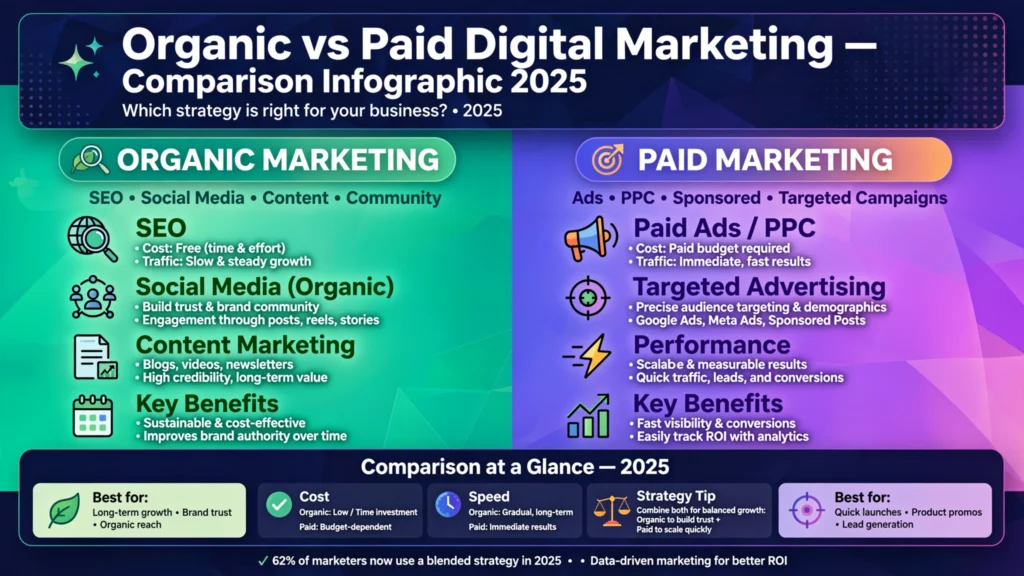 Organic vs. Paid Digital Marketing
Before exploring individual channels, it helps to understand the difference between organic and paid marketing.
| Organic marketing | Paid marketing |
|---|---|
| Uses unpaid search visibility, social posts, and other non-ad placements | Uses advertising budgets to purchase placements or reach |
| Often requires consistent effort over time | Can generate exposure soon after a campaign launches |
| May build lasting traffic and audience relationships | Traffic can fall when advertising stops |
| Requires time, content, and ongoing optimization | Requires money, campaign management, and performance monitoring |
Neither approach is automatically better. Organic marketing can be useful when you want to build long-term visibility with limited cash. Paid marketing can help you test an offer or reach a defined audience more quickly.
Many businesses combine the two. For example, a freelancer might publish educational articles to attract search traffic while running a small advertising campaign for a service that already converts interested visitors into enquiries.
The best choice depends on your budget, audience, timeline, and business goals.
8 Essential Digital Marketing Strategies for Beginners
You do not have to master all eight strategies immediately. Think of them as different tools for different situations. Start with the channels that match your audience and expand as you learn.
1. Search Engine Optimization (SEO)
Search engine optimization, commonly called SEO, helps search engines understand your website and helps people discover relevant pages through unpaid search results.
Suppose someone searches for “how to start a food blog.” If your article provides a clear, useful answer and search engines can discover and understand it, the page may appear in relevant results.
SEO is especially useful for bloggers, online stores, service providers, and businesses that want to attract people actively searching for information or solutions.
Google’s SEO Starter Guide explains the fundamental practices for making content easier to discover and understand.

How beginners can start with SEO
Research search topics. Begin with questions your audience is likely to ask. A beginner fitness blogger, for instance, might explore “home workouts for beginners” or “how to create a weekly workout routine.”
Understand search intent. Search intent means the reason behind a query. Someone searching for “what is email marketing” probably wants an explanation, while someone searching for “best email marketing software” may be comparing products.
Create helpful content. Answer the main question directly, explain the details, and include examples that make the advice easier to apply. Avoid rewriting competing articles without adding anything useful.
Optimize your page. Write a descriptive page title, use a clear main heading, organize sections with relevant subheadings, and create a readable URL. Include your primary keyword naturally where it fits.
Make your website easy to use. Check that pages work on mobile devices, load reasonably quickly, and have clear navigation. Link related articles together when those links help readers.
Use Google Search Console. This free service helps website owners monitor search visibility, impressions, clicks, and queries associated with their pages.
A practical SEO example
Imagine you publish an article titled “How to Start a Blog With No Experience.” Instead of focusing only on the phrase “start a blog,” you could answer related questions about choosing a topic, selecting a domain, setting up WordPress, and publishing the first post.
You could then link to relevant articles on your website that explain each step in greater detail.
One important limitation: SEO is not an instant traffic source. Results depend on many factors, including competition, content quality, technical accessibility, and how search engines evaluate the page. Google notes that changes can take weeks or even months to show their full effect, and no particular ranking is guaranteed.
2. Content Marketing
 2. Content Marketing
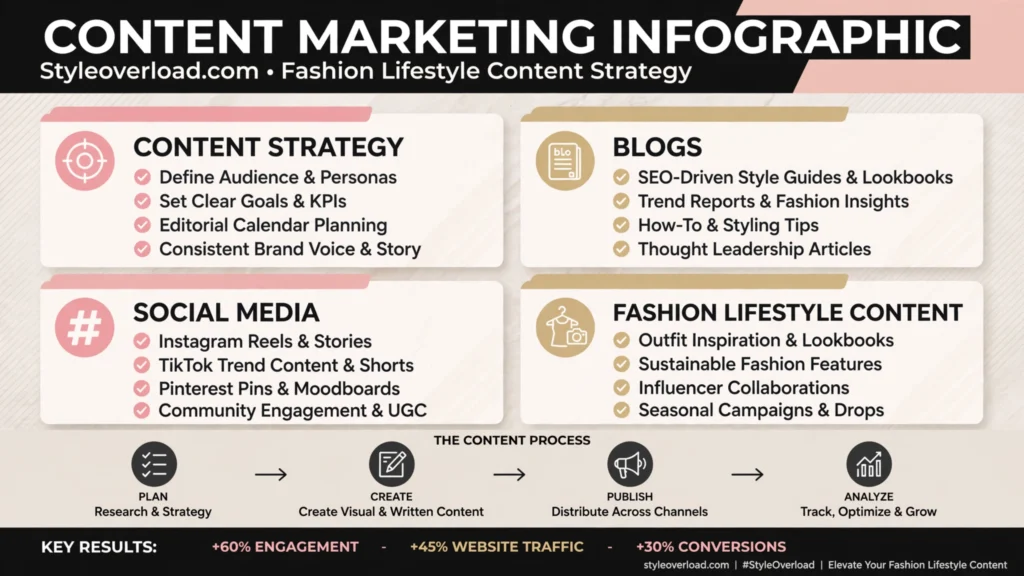
Content marketing involves creating and distributing useful information to attract and engage a specific audience. That information can take the form of blog articles, tutorials, checklists, videos, newsletters, comparison guides, or downloadable resources.
The purpose is not simply to produce more content. It is to help people solve problems while building a relationship with your brand.
For example, a small company selling gardening supplies could publish a seasonal planting guide, a beginner’s guide to composting, and a checklist for caring for indoor plants. These resources can introduce the company to people who need gardening advice before they are ready to buy anything.
How to create a simple content strategy
Start by choosing three to five topics closely related to your audience and your main goal. These become your content pillars.
A digital marketing blog might use the following pillars:
SEO and website growth.
Social media marketing.
Beginner-friendly digital tools.
Content creation and blogging.
Email marketing and audience building.
Next, create a list of questions people ask within each pillar. Turn those questions into specific articles or videos rather than publishing random topics without a clear connection.
Give each piece of content a purpose. An educational article might attract new visitors, a comparison guide might help readers choose a tool, and an email newsletter might encourage existing subscribers to return.
You should also update older content when information changes. A guide that recommends outdated features or contains broken links may lose value for readers.
Beginner tip: Aim for a manageable publishing schedule. One genuinely useful article every week can be a better starting point than publishing daily posts that are rushed, repetitive, or difficult to maintain.
Content marketing takes time, and publishing an article does not guarantee traffic. Its value grows when the material answers real questions, reaches the intended audience, and supports a wider marketing plan.
3. Social Media Marketing
 3. Social Media Marketing
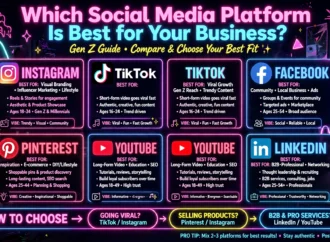
Social media marketing uses platforms such as Instagram, Facebook, LinkedIn, TikTok, Pinterest, and YouTube to share content, interact with audiences, and introduce people to a brand.
It can be particularly useful when your audience discovers ideas through visual content, community discussions, professional networks, or short videos.
However, you do not need an account on every platform. Managing too many channels can spread your time and attention too thinly.
How to choose the right platform
Consider where your audience already spends time and what kind of content you can produce consistently.
Instagram: Useful for visual brands, product demonstrations, behind-the-scenes content, and short videos.
Facebook: Can help businesses engage with relevant communities and existing audiences.
LinkedIn: Often useful for freelancers, consultants, B2B companies, and professional content.
Pinterest: Can suit visual discovery in areas such as recipes, home decor, fashion, crafts, and planning.
TikTok: Can help creators test short-form videos and discover audiences interested in particular topics.
YouTube: Useful for tutorials, reviews, demonstrations, and searchable video content.
These are general tendencies, not guarantees. Audience behavior varies by country, age group, niche, and platform.
A simple social media routine
Choose one primary platform and a secondary platform only if you have enough time. Create a weekly schedule that includes educational posts, practical tips, product or service explanations, and occasional questions that encourage conversation.
For a beginner blogger, one article could become a short video explaining its main lesson, a carousel summarizing the key steps, and a social post linking to the full guide.
Reply to relevant comments, observe which topics generate meaningful conversations, and adjust your content accordingly.
Do not judge every post by likes alone. Saves, shares, qualified website visits, enquiries, and purchases may be more valuable depending on your goal.
Common mistake: Buying followers or using irrelevant engagement schemes can make your audience numbers look larger without creating genuine interest in your content or business.
4. Email Marketing
 4. Email Marketing
Email marketing lets you communicate directly with people who have chosen to receive messages from you. It can be used to send newsletters, educational resources, product announcements, welcome messages, and relevant offers.
Unlike relying entirely on social media distribution, an email list gives you a channel for communicating with subscribers through their inboxes. However, delivery is not guaranteed, and you still need to earn attention with useful messages.
How beginners can build an email list
Start with a clear reason for people to subscribe. Instead of displaying a generic “Join our newsletter” message everywhere, offer something relevant, such as a weekly blogging tip, a beginner’s checklist, or a short email course.
Place your signup form where readers can understand its value, such as below a relevant article or on a dedicated landing page.
Then create a welcome email that explains what subscribers can expect. Keep your regular messages useful and reasonably consistent. Include a clear next step when appropriate, such as reading a guide or exploring a product.
Always obtain appropriate permission, make unsubscribing straightforward, and follow the privacy and email-marketing rules that apply to your audience and business.
What should you measure?
Track subscriber growth, delivery and bounce information, clicks, unsubscribes, and meaningful conversions. Open rates can be affected by privacy features and automated email activity, so avoid treating them as a perfect measure of human attention.
For example, a blogger could send a weekly email featuring one new article and three practical tips. A small online store might send a welcome series that explains its products before presenting a relevant offer.
Email marketing can help build repeat engagement, but it requires a genuinely interested list and content people want to receive.
5. Pay-Per-Click (PPC) Advertising
Pay-per-click advertising allows businesses to pay for advertising placements and, in PPC models, typically pay when someone clicks an ad. Google Ads is a well-known example, while social platforms offer their own advertising systems with different pricing models.
PPC can help you reach potential customers without waiting for organic search visibility to develop. It is particularly useful when you have a specific offer, a clear audience, and a website or landing page designed to turn visitors into customers.
For example, a freelance web designer might advertise a service for small businesses looking for WordPress website design. The ad could direct interested people to a page explaining the service, pricing approach, and how to request a quote.
How to start a PPC campaign
Choose one goal. Decide whether you want qualified leads, product sales, bookings, or another measurable result.
Define your audience. Consider location, search terms, interests, and other targeting options relevant to the platform.
Create a focused offer. Explain what you provide and why it is useful. Avoid vague claims that do not help people decide.
Build a relevant landing page. Make sure the page matches the advertisement and provides a clear next step.
Set a controlled budget. Decide how much you can afford to spend while testing, and establish a limit before launching.
Measure the outcome. Track clicks, conversions, cost per conversion, and, where possible, the revenue or value generated.
Google provides an overview of its advertising platform and explains that costs depend on factors such as industry, audience, and selected keywords. You can explore its official Google Ads information.
What beginners should know about PPC
Advertising costs can rise quickly if your targeting is too broad or your landing page fails to convert visitors. A high click-through rate does not necessarily mean a campaign is profitable.
Suppose an ad generates 100 clicks, but nobody submits an enquiry. The campaign has attracted attention, but something may be wrong with the offer, targeting, landing page, or measurement setup.
Start with a small, affordable experiment rather than spending heavily before you understand your conversion process.
6. Affiliate Marketing
 6. Affiliate Marketing
Affiliate marketing involves promoting another company’s products or services through a tracked referral link. When a qualifying purchase or other action occurs, the affiliate may receive a commission under the program’s terms.
It can be relevant for bloggers, content creators, niche websites, and publishers who want to monetize useful content without creating their own products.
Imagine you run a blog about beginner photography. You could publish a guide to choosing a first camera, explain the differences between lenses, and link to relevant products through an affiliate program.
If a reader buys through an eligible referral link, you may earn a commission. The amount and eligibility depend on the specific program.
How to approach affiliate marketing responsibly
Choose products that genuinely fit your topic and audience.
Explain important benefits, limitations, and alternatives.
Use affiliate links where they naturally help the reader.
Disclose commercial relationships clearly and prominently.
Check the program’s commission structure, payment requirements, and operating terms.
Avoid recommending a product solely because it offers a higher commission.
Affiliate marketing is not a guaranteed income source. You need relevant visitors, useful recommendations, and reader trust before it can become meaningful.
If you publish affiliate content, consult the applicable rules in your country and the markets you target. In the United States, the Federal Trade Commission explains how to disclose material connections in its Endorsement Guides resources.
7. Video Marketing
 7. Video Marketing
Video marketing uses recorded or live video to explain ideas, demonstrate products, answer questions, or build relationships with an audience.
It can make complex topics easier to understand because viewers can see a process instead of reading about every step. Video can also give potential customers a clearer idea of how a product or service works.
For example, a WordPress blogger could create a screen-recorded tutorial showing how to install a plugin, configure a setting, or publish a first blog post.
How to begin with video marketing
Start with one question your audience frequently asks. Create a short, focused video that answers it without unnecessary introductions.
Use a clear title, understandable audio, and captions when possible. Show the process or example that makes the lesson useful. Finish by directing viewers to a relevant resource, such as a detailed blog article.
You do not need expensive equipment to begin. A smartphone, basic lighting, and a quiet recording environment may be enough for simple tutorials.
You can also repurpose existing content. A detailed blog post might become a short explainer video, several social clips, and an email tip.
One limitation to remember: Video creation can take more time than writing a short article. Choose a format you can maintain and evaluate success according to your goal. A small number of relevant viewers who become customers may be more valuable than a large number of viewers who have no interest in your offer.
8. Analytics and Conversion Optimization
Analytics helps you understand what people do after encountering your marketing. Conversion optimization uses those insights to improve the likelihood that visitors complete a desired action.
A conversion might be a purchase, contact-form submission, newsletter signup, booking, or another action that matters to your goals.
Without measurement, you may keep producing content or running advertisements without knowing which activities are actually helping.
Google Analytics can measure website activity and audience interactions. Its beginner’s guide to Analytics explains how to set up an account, understand reports, and measure important actions.
Important digital marketing metrics explained
| Metric | What it means | Why it matters |
|---|---|---|
| Impressions | How often content or an ad was shown | Helps you understand visibility |
| Clicks | How often people clicked | Shows whether content attracted action |
| Click-through rate (CTR) | Clicks divided by impressions, expressed as a percentage | Helps evaluate how often impressions lead to clicks |
| Engagement | Interactions such as comments, shares, or saves, depending on the platform | Indicates how people respond to content |
| Conversion rate | Conversions divided by the relevant number of visits or interactions, expressed as a percentage | Shows how often people complete the desired action |
| Cost per click (CPC) | Advertising spend divided by clicks | Helps assess traffic acquisition costs |
| Cost per conversion | Advertising spend divided by conversions | Helps evaluate the cost of acquiring a result |
| Return on investment (ROI) | Profit attributable to an investment relative to its cost | Helps assess financial performance |
The exact definition of a metric can vary by platform and reporting setup. For example, an email platform’s click rate and a website’s session-based conversion rate may use different denominators.
A simple example of conversion optimization
Imagine that 500 people visit a service page in a month, and 10 submit an enquiry.
The conversion rate is:
Now imagine you make the service description clearer, add genuine customer testimonials, and make the contact button easier to find. In a later comparable period, 15 out of 500 visitors submit an enquiry.
The new conversion rate is 3%.
This hypothetical example illustrates how to calculate and compare conversion rates. It does not mean those changes will always produce that improvement; other factors may affect the results.
To improve conversions, test one meaningful change at a time when practical, check whether your tracking works, and compare similar periods. Avoid drawing firm conclusions from tiny samples.
Practical Digital Marketing Strategies for Beginners
 Practical Digital Marketing Strategies for Beginners
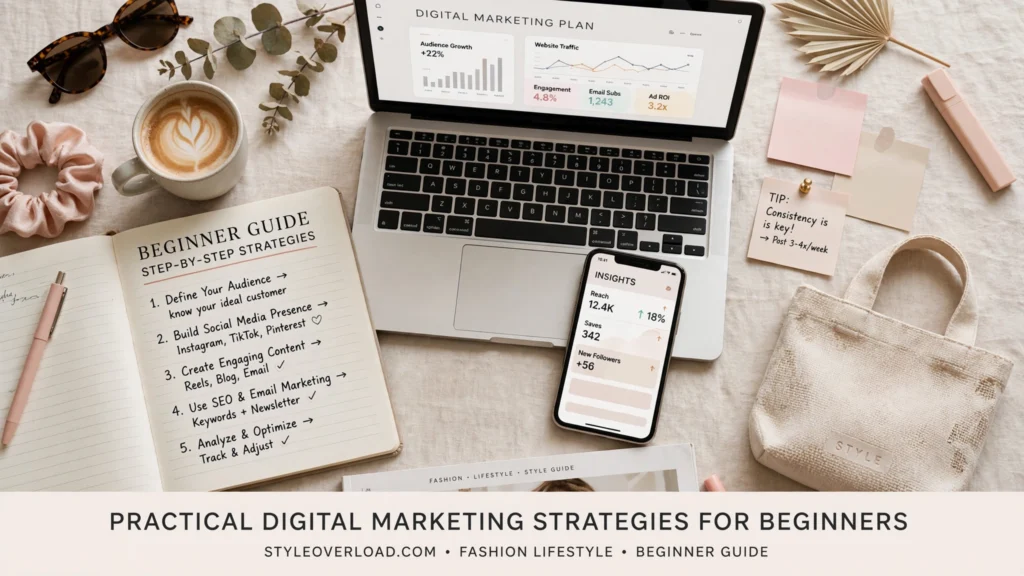
Understanding the different channels is useful, but the real challenge is deciding what to do first. The following strategies help you turn general knowledge into a manageable routine.
1. Start with one clear marketing goal
Choose a goal that you can measure and that supports your wider purpose.
Examples include:
A blogger wants more relevant visitors to three important articles.
A freelancer wants qualified enquiries for a specific service.
A small online store wants more completed purchases.
A creator wants to grow an email list of genuinely interested readers.
Avoid setting vague goals such as “become popular online.” Popularity may not lead to the outcome you need.
A more useful goal would be: “Over the next 30 days, publish four useful articles, improve the calls to action on two existing pages, and measure search impressions and email signups.”
This is a goal you can act on, even if the final results depend on factors outside your control.
2. Research your audience before creating content
You do not need an expensive research platform to learn what people care about.
Begin with customer questions, comments on relevant social posts, online community discussions, search suggestions, competitor content, and feedback from people who use similar products or services.
Look for recurring problems rather than collecting random topic ideas.
For instance, a beginner blogger may discover that readers are confused about choosing a niche, buying a domain, and publishing their first article. Those problems can become a connected series of useful guides.
Treat audience research as a starting point, not proof of market demand. Validate important assumptions by observing actual questions, enquiries, signups, and customer behavior.
3. Create content that answers a specific question
A strong article or video has a clear purpose. Readers should understand what they will learn and be able to apply the information afterward.
Before publishing, ask yourself:
Does the content answer the main question early enough?
Have I explained important concepts in simple language?
Are the examples relevant and realistic?
Have I included practical steps rather than general encouragement?
Are claims accurate and supported where necessary?
Does the page help the reader decide what to do next?
Google recommends prioritizing helpful, reliable, people-first content rather than producing material primarily to attract search visits. Its guidance also emphasizes originality, accuracy, and a satisfying experience for readers.
For a new website, this means developing a recognizable subject focus and publishing content that genuinely serves its intended audience, rather than producing large quantities of unrelated articles.
4. Use a content distribution routine
Publishing content is only one part of marketing. You also need to help the right people discover it.
After publishing a useful article, consider sharing a short summary on a relevant social platform, including it in your newsletter, linking to it from related pages, or turning one of its main lessons into a short video.
Choose distribution methods that fit your audience and respect each platform’s rules. Do not spam unrelated groups or send unsolicited promotional messages.
A single strong article can support several smaller pieces of content, allowing you to spend more time improving useful material rather than constantly starting from scratch.
5. Build your own audience relationships
Where appropriate, give visitors a reason to return. An email newsletter, helpful resource library, or consistent educational series can encourage ongoing engagement.
For a blogger, a simple weekly email with a new article and a few practical tips may be enough to begin.
For a service provider, a short educational email sequence might explain a common problem, discuss available solutions, and invite readers to request a consultation.
Focus on relevance and permission. A large email list of people who do not care about your content is not necessarily more valuable than a smaller, engaged list.
6. Improve the page before increasing traffic
More visitors will not solve every marketing problem. If your website is confusing, your offer is unclear, or your signup form does not work, additional traffic may simply create more missed opportunities.
Review your important pages from a visitor’s perspective. Make the main benefit easy to understand, answer common objections, remove unnecessary distractions, and ensure that important buttons and forms work on mobile devices.
Then measure whether the changes help.
7. Review results on a consistent schedule
Set aside a short period each week to review your progress.
Ask yourself:
Which pages or posts attracted relevant visitors?
Which search queries generated impressions or clicks?
Did visitors subscribe, enquire, or purchase?
Which content generated meaningful engagement?
What should I improve, stop, or test next?
You do not need to change your entire strategy after one disappointing day. Look for meaningful patterns and allow enough time for a channel to produce useful evidence.
A Step-by-Step 30-Day Digital Marketing Plan
If you are starting from zero, use the following four-week plan as a practical framework. It is designed for a beginner with limited time and a small or nonexistent marketing budget.
Week 1
Days 1–7
Set up your foundation
Define your audience and one main goal.
Research 10 relevant audience questions.
Choose one primary marketing channel.
Check your website, contact details, and main landing page.
Install or configure the measurement tools you need.
Week 2
Days 8–14
Create useful content
Publish one or two focused articles or other relevant resources.
Optimize page titles, headings, links, and mobile readability.
Create a useful call to action.
Share the content through an appropriate channel.
Week 3
Days 15–21
Promote and engage
Repurpose your content into a few relevant social posts.
Reply to genuine questions and comments.
Create a simple email signup option if appropriate.
Improve one important page based on early feedback.
Week 4
Days 22–30
Measure and plan your next steps
Review available traffic and engagement data.
Check important forms and conversion tracking.
Identify which content deserves improvement.
Record lessons and select the next month’s priorities.
The plan is a starting framework, not a promise of traffic or sales within 30 days. New websites may need much longer to build search visibility, while some paid campaigns can produce earlier signals.
Your goal during the first month is to establish a repeatable process, understand your audience, and begin collecting useful evidence.
Realistic Examples: How Beginners Can Apply These Strategies
The best digital marketing plan depends on what you are trying to achieve. Here are two hypothetical examples showing how the same basic principles can work for different goals.
Example 1: Growing a beginner blog
Imagine you run a WordPress blog covering blogging, technology, and digital marketing.
Your goal is to attract relevant readers and gradually build an audience.
You could begin by choosing a focused group of topics, such as SEO for beginners, blogging tools, and content creation. Next, publish detailed guides answering specific questions people ask about those subjects.
Use Google Search Console to monitor whether your pages receive impressions and clicks. Share article summaries on one relevant social platform and invite interested readers to subscribe to your newsletter.
Once you have published several related articles, add internal links between them. For example, an article about SEO basics could link to a more detailed guide about keyword research.
Your early success measures might include:
Search impressions and clicks.
Relevant website visits.
Newsletter subscriptions.
Engagement with important articles.
Growth in returning readers over time.
You do not need to earn money immediately for the process to be useful. Your first objective is to create valuable content, establish a consistent publishing routine, and learn which topics attract the right readers.
Example 2: Marketing a small service business
 Example 2: Marketing a small service business
Imagine you are a freelance graphic designer who creates social media designs for small businesses.
Your immediate goal is to receive relevant enquiries rather than attract as many website visitors as possible.
Start with a clear service page that explains what you offer, who it is for, and how a potential customer can contact you. Include a portfolio of genuine work and transparent information about your process.
Share useful design tips on a platform where your intended customers are active. Publish a short guide about common design mistakes, and link to your service page when appropriate.
You might also test a small paid search campaign for relevant service-related searches once your website and enquiry tracking are ready.
Track qualified enquiries, conversion rate, cost per enquiry, and the number of enquiries that become paying customers.
These examples illustrate a key principle: choose marketing activities according to the result you want, not according to which platform is currently popular.
Free and Beginner-Friendly Digital Marketing Tools
You can learn the basics of digital marketing without purchasing an expensive software subscription. Several tools provide useful free features, although their availability, limits, and terms can change.
1. Google Search Console
Best for: SEO monitoring
Helps you examine search impressions, clicks, queries, indexing information, and certain website issues. It does not guarantee rankings or show every search query. Some reports have limitations, and data can take time to appear.
2. Google Analytics
Best for: Website performance
Helps you understand website traffic, interactions, and important actions. Initial setup and conversion configuration can take some learning, and incorrect tracking can lead to misleading reports.
3. Google Trends
Best for: Exploring topic interest
Lets you compare relative search interest across topics, locations, and periods. Its numbers are normalized rather than direct search-volume counts, so it should not be treated as a precise keyword-volume tool.
4. Canva
Best for: Visual content creation
Provides tools for designing social posts, presentations, simple graphics, and marketing materials. Free access includes limitations; some templates, assets, and advanced features require payment.
5. Mailchimp
Best for: Email marketing
Offers email marketing and audience-management features. Available features and subscriber or sending limits depend on the current plan, so check the pricing page before choosing it for a growing list.
6. Google Keyword Planner
Best for: Keyword ideas and advertising research
Helps users discover keyword ideas and review search estimates for advertising planning. Access and the detail shown in estimates can depend on account and campaign circumstances. Its estimates are not a guarantee of organic search performance.
Which tools should you use first?
Avoid signing up for every tool at once. A beginner blogger can start with Google Search Console, Google Analytics, Google Trends, and a basic design tool.
A service business may benefit more from website analytics, a simple contact-form system, a customer-management spreadsheet, and one relevant social platform.
Choose tools based on the decisions you need to make. Software is useful when it helps you understand performance or complete work more efficiently, not simply because it has a long feature list.
Common Digital Marketing Mistakes and How to Avoid Them
Beginners often spend considerable time on activities that look productive but do not support their main goal. Recognizing these mistakes early can save time and money.
1. Trying to use every marketing channel
Maintaining a blog, five social accounts, a podcast, a newsletter, and multiple advertising campaigns can quickly become overwhelming.
Better approach: Choose one primary channel and one supporting channel. Expand when you have a reliable routine and evidence that additional channels are worthwhile.
2. Publishing without understanding the audience
Content may be well written but still fail to attract the people you want if it addresses the wrong questions.
Better approach: Research audience needs before planning content. Use customer questions, relevant discussions, search data, and real feedback to guide your choices.
3. Expecting immediate SEO results
A newly published page may take time to be discovered, indexed, and evaluated. Competition and other factors also influence search visibility.
Better approach: Publish useful content consistently, improve existing pages, check technical accessibility, and review search performance over a realistic period.
4. Focusing on followers instead of meaningful results
A growing follower count can feel encouraging, but it does not necessarily mean more enquiries, sales, or returning readers.
Better approach: Choose metrics that match your objective. Measure qualified leads for a service business, for example, rather than judging success by likes alone.
5. Spending money before validating an offer
Advertising can bring visitors to your website, but it cannot automatically make an unclear offer appealing.
Better approach: Check your landing page, explain your value clearly, test your enquiry or purchase process, and establish reliable conversion tracking before increasing your advertising budget.
6. Ignoring mobile users
A page that looks attractive on a desktop can be frustrating on a phone if the text is difficult to read, buttons are hard to tap, or forms do not work correctly.
Better approach: Test your important pages on a mobile device. Check navigation, readability, loading behavior, and the complete conversion process.
7. Using misleading claims or copying competitors
Copied content, fabricated testimonials, exaggerated product claims, and undisclosed commercial relationships can damage trust.
Better approach: Create original material, verify factual claims, use genuine evidence, and disclose affiliate relationships or other relevant commercial connections.
8. Failing to measure conversions
You might know that people are visiting your website without knowing whether they are subscribing, making purchases, or requesting information.
Better approach: Define important actions and configure tracking for them. Check that the tracking works before relying on its results.
9. Changing the strategy too frequently
Abandoning a channel after a few days makes it difficult to learn whether it could work.
Better approach: Establish a reasonable review period, define what success would look like, and make changes based on evidence rather than daily fluctuations.
10. Treating AI-generated content as finished work
AI tools can assist with brainstorming, outlines, and editing, but they may produce inaccurate claims, generic examples, or outdated information.
Better approach: Verify important facts, add meaningful original insight, check sources, edit for your audience, and take responsibility for what you publish. Google’s guidance emphasizes usefulness and originality rather than content volume alone.
How Much Does Digital Marketing Cost?
Digital marketing costs vary widely. You can begin with free tools and your own time, or invest in hosting, software, design, professional services, and advertising.
There is no single budget that suits every beginner.
| Expense | Possible starting approach | What to consider |
|---|---|---|
| SEO and content | Research and write content yourself | Time, quality, and the cost of improving existing pages |
| Social media | Create and publish content yourself | Time, design needs, and content frequency |
| Email marketing | Start with a free or entry-level plan if suitable | Subscriber limits and future pricing |
| Website | Use an existing website or a basic hosting setup | Domain, hosting, maintenance, and security |
| Paid advertising | Begin with a small, predefined test budget | Competition, cost per click, and conversion tracking |
| Analytics | Use suitable free analytics tools | Setup, privacy requirements, and accurate measurement |
Free tools do not make marketing completely cost-free. You still invest time in planning, producing content, learning the tools, and improving your website.
Paid tools can save time or provide advanced features, but they are not automatically necessary. Buy them when a clear need justifies the expense.
How long does digital marketing take to work?
The timeline depends on the channel and the outcome you want.
Paid advertising: Can generate impressions and clicks soon after launch, but profitable results are not guaranteed.
Social media: Engagement may appear quickly, while building a consistent, relevant audience can take much longer.
Email marketing: Subscribers can begin interacting with your emails once they join, but building a valuable list takes ongoing effort.
SEO and content marketing: May require weeks or months to show meaningful progress, especially for a new website in a competitive niche.
Google advises allowing time to assess the effects of SEO changes and notes that some changes can take several months.
How can you tell whether your marketing is working?
Begin by comparing performance with your goal.
If you want more search traffic, examine impressions, clicks, relevant queries, and the pages attracting visitors. If you want sales, track completed purchases and revenue. If you want enquiries, measure qualified leads rather than just visits to your contact page.
For campaigns with reliable financial data, calculate return on investment using a consistent definition:
For example, if a campaign generates $600 in attributable profit before marketing costs and the marketing investment is $200, the ROI using that definition is 200%.
Make sure you distinguish revenue from profit and account for relevant costs consistently. If you cannot reliably attribute results to a campaign, state that limitation instead of claiming a precise return.
The most important lesson is to measure progress honestly. A campaign that does not meet its target can still teach you something valuable about audience demand, messaging, pricing, or the customer journey.
Digital Marketing Checklist for Beginners
Use this checklist before publishing your next article, promoting a service, or launching a campaign.
Your pre-launch checklist
You do not need to complete every item perfectly on your first attempt. Use the checklist to identify missing essentials, take action, and improve your process as you gain experience.
Frequently Asked Questions About Digital Marketing
1. What are the best digital marketing strategies for beginners?
SEO, content marketing, social media marketing, and email marketing are useful starting points for many beginners. The right combination depends on your audience and goal. Bloggers may prioritize SEO and content, while a local service business may benefit more from a strong service page, relevant local visibility, and customer enquiries.
2. Can I learn digital marketing for free?
Yes. You can learn the fundamentals using free educational resources, practice projects, and tools such as Google Search Console, Google Analytics, and Google Trends. You may eventually want paid software or professional training, but you can begin by learning the basics and applying them to a real website or project.
3. How long does it take to see results from digital marketing?
There is no universal timeline. Advertising may generate traffic shortly after launch, while SEO, content marketing, and audience building generally require consistent effort. Results also depend on competition, budget, offer quality, and audience demand. Evaluate progress using meaningful metrics rather than expecting guaranteed results by a particular date.
4. Do I need a website to start digital marketing?
Not always. You can start by creating content on social platforms, building an email audience through an appropriate service, or promoting a business through relevant online listings. However, a website gives you more control over your content, service information, landing pages, and customer journey. The best setup depends on your business model and goals.
5. Is SEO better than paid advertising?
Neither is universally better. SEO can help attract relevant visitors from unpaid search results and may build long-term visibility, but results take time and are not guaranteed. Paid advertising can provide quicker exposure, but it requires a budget and careful performance monitoring. Many businesses combine both approaches according to their resources and objectives.
Conclusion: Start Small, Learn Consistently, and Improve
Digital marketing does not have to be complicated or expensive to get started. You can make meaningful progress by understanding your audience, choosing suitable channels, publishing genuinely useful content, and measuring what happens next.
Start with one clear goal instead of trying to master every platform. Learn the fundamentals of SEO if you run a blog, focus on audience engagement if you rely on social media, or build an email list if repeat communication matters to your business. Add paid advertising when your offer, budget, and tracking are ready.
Remember that digital marketing is an ongoing process. Your first article might attract little traffic, your first campaign might reveal weaknesses in your offer, and your first email newsletter might receive only a few responses. These outcomes are opportunities to learn, not automatic signs of failure.
Focus on providing value, checking your assumptions, and making gradual improvements. Over time, that disciplined approach can help you develop a more effective digital marketing strategy for your blog, freelance work, or small business.



















Leave a Comment
Your email address will not be published. Required fields are marked with *