
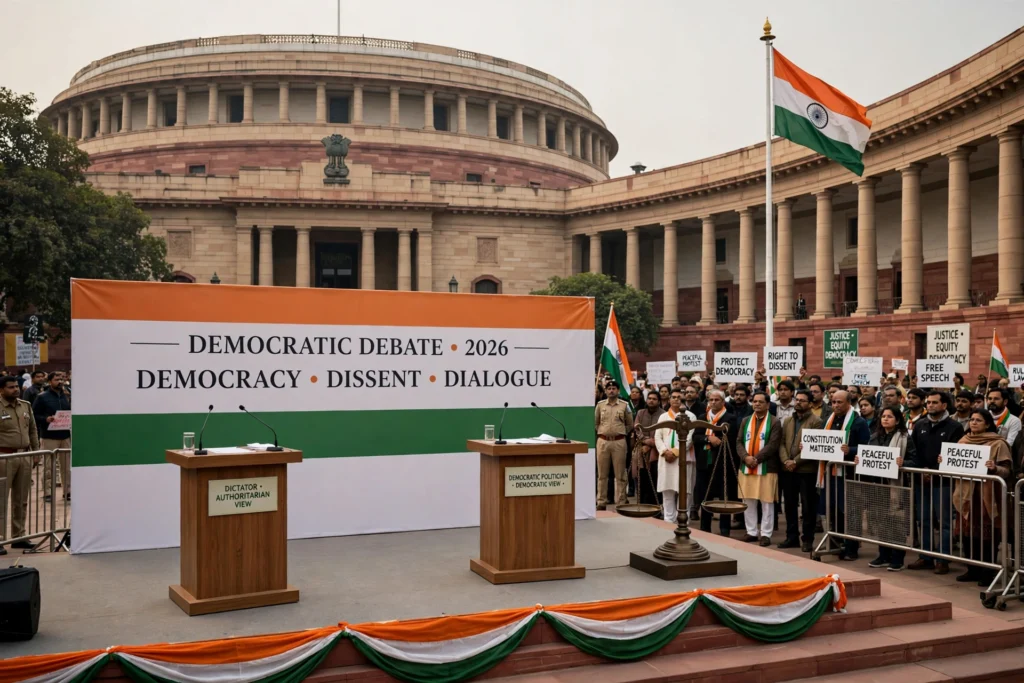
India’s political protests in 2026 have raised questions about voter registration, civil liberties, and democratic accountability. Political Analysis | Updated October 15, 2026 | Estimated reading time: 15–20 minutes India’s recent political protests have brought difficult questions about elections, civil liberties, and the limits of government power into the national spotlight. Demonstrations demanding the resignation
India’s political protests in 2026 have raised questions about voter registration, civil liberties, and democratic accountability.
Political Analysis | Updated October 15, 2026 | Estimated reading time: 15–20 minutes
India’s recent political protests have brought difficult questions about elections, civil liberties, and the limits of government power into the national spotlight. Demonstrations demanding the resignation of Chief Election Commissioner Gyanesh Kumar, reports of mass detentions, and a growing dispute over voter registration have intensified the debate about the health of Indian democracy.

At the heart of the controversy is a question that extends beyond any single political party or leader: How can citizens know whether democratic institutions are working fairly, and what happens when large sections of the public lose confidence in them?
The answer requires more than slogans. It means examining the allegations, listening to the authorities’ explanations, understanding the law, and looking at the evidence before reaching conclusions about whether political leadership is democratic or authoritarian.
This article explores the protests, the resignation demand, the detention of activists, and the broader debate over democracy and political power in India.
1. Introduction: A Political Debate That Goes Beyond the Streets
Political protests are a familiar feature of India’s democratic life. From student movements to nationwide demonstrations, citizens have repeatedly taken to the streets to challenge government decisions, demand accountability, and express dissatisfaction with public institutions.
The protests in October 2026 have placed the Election Commission of India at the centre of a particularly contentious dispute. Opposition parties and youth activists have questioned the handling of electoral-roll revisions and called for the resignation of Chief Election Commissioner Gyanesh Kumar. The Election Commission and the governing Bharatiya Janata Party (BJP) have denied allegations of wrongdoing.
The controversy has also expanded beyond electoral administration. Reports of thousands of detentions, restrictions on demonstrations, and legal challenges to protest-site restrictions have raised concerns about how the authorities balance public order with the right to peaceful assembly.
For critics of the government, these developments raise questions about accountability and institutional independence. Supporters of the government, meanwhile, argue that law enforcement must respond when demonstrations violate restrictions or threaten public order.
Understanding the dispute requires separating three issues: whether the electoral process was administered fairly, whether the response to protesters was lawful and proportionate, and whether the broader political system continues to provide meaningful checks on executive power.
2.India’s Political Protests in 2026: What Is Happening?
2.1 The Background Behind the Protests
The current controversy centres on a process known as the Special Intensive Revision (SIR) of electoral rolls. This exercise is intended to review voter registrations and identify entries that may be duplicated, outdated, or otherwise ineligible.
The process has become politically contentious because of the scale of the reported changes. According to reporting based on Election Commission data, approximately 130 million voter entries were removed during the wider revision exercise. The figures include entries associated with deceased people, individuals who had relocated, and people who could not be traced.
These figures require careful interpretation. A removed entry does not automatically represent an eligible voter being unlawfully deprived of the right to vote. At the same time, a large revision makes transparent procedures and effective opportunities to correct errors especially important.
Opposition parties argue that the exercise risks excluding eligible voters and may have political consequences. The Election Commission maintains that the process is designed to improve electoral-roll accuracy and has directed officials to enrol eligible voters who were inadvertently omitted.
The disagreement has become a wider debate about whether electoral administration can maintain public confidence when its decisions are challenged by political parties and citizens.
2.2 The Main Demands of Protesters
One of the protesters’ principal demands is the resignation of Chief Election Commissioner Gyanesh Kumar. Demonstrators and opposition leaders have called for greater transparency in the voter-roll revision process and questioned whether the Election Commission has adequately addressed concerns about potentially excluded voters.
The demonstrations have involved opposition politicians, students, youth activists, and other civil society participants. The Cockroach Janta Party, a youth movement that has attracted attention through its satirical political identity, has also played a prominent role in the protests.
The demands are not necessarily identical across all participants. Some protesters focus on electoral transparency, others on the resignation of the election chief, and still others on detentions and restrictions on public demonstrations.
This distinction matters because a broad protest movement can unite people around a common concern without every participant agreeing on every political objective.
2.3 The Government’s Response and the Public Reaction
Authorities responded to the planned demonstrations in Delhi with extensive security deployments, barricades, restrictions on gatherings, and detentions. Reuters reported that more than 2,000 people were detained in the capital on October 10, while subsequent reporting gave different figures for later operations. These totals should not be combined because they may refer to different dates, locations, and categories of detention.
The response generated criticism from opposition leaders and civil liberties advocates, who questioned whether the restrictions were necessary and proportionate. The United Nations human rights office also called on Indian authorities to respect peaceful assembly and engage in dialogue, while India’s mission in Geneva rejected the criticism as interference in domestic affairs.
Government supporters have a different perspective. They argue that authorities have a responsibility to prevent disorder, protect public infrastructure, and enforce lawful restrictions on demonstrations.
The central issue is not whether public order matters; it clearly does. The question is whether the measures used to maintain it are legally justified, proportionate to the risks, and respectful of citizens’ fundamental rights.
3. Why Are Protesters Demanding the Chief Election Commissioner’s Resignation?
3.1 Understanding the Role of India’s Chief Election Commissioner
India’s Election Commission is a constitutional body responsible for supervising and directing elections to Parliament, state legislatures, and the offices of the President and Vice-President. Its responsibilities include maintaining electoral rolls, overseeing election procedures, and enforcing applicable rules intended to support free and fair elections.
The Chief Election Commissioner leads the institution and occupies an important position in India’s democratic framework. The credibility of the office depends not only on following the law but also on public confidence that election administration is impartial.
That confidence becomes particularly important when election results are closely contested or when political parties dispute the accuracy of voter registration. Even decisions made for legitimate administrative reasons can generate controversy if the process is not sufficiently transparent or if affected citizens struggle to challenge errors.
An independent election authority must therefore demonstrate both procedural fairness and a willingness to explain its decisions.
3.2 The Allegations and Concerns Behind the Resignation Demand
The immediate dispute concerns the scale and implementation of electoral-roll revisions. Opposition parties contend that the removal of large numbers of voter entries could exclude eligible citizens and potentially influence the political balance in affected constituencies.
Some critics have also questioned whether the process disproportionately benefits the BJP. These are serious allegations, but they must be distinguished from established findings of deliberate manipulation. The Election Commission and the BJP have denied wrongdoing, while the Commission says the revision is intended to remove duplicate, deceased, or ineligible entries.
The key questions are practical as well as political. Were voters given clear information about the revisions? Could people whose names disappeared from the lists verify their status and correct mistakes? Were objections examined consistently, and were the reasons for removals adequately documented?
Answering those questions requires more than the total number of deleted entries. Researchers and investigators would need to examine the underlying records, the reasons for removal, the procedures followed, and evidence of any unequal treatment.
A demand for resignation expresses a loss of confidence in an official. Whether that demand is justified ultimately depends on the evidence, the relevant legal standards, and the findings of competent institutions.
 3.3 Can Political Pressure Undermine Electoral Independence?
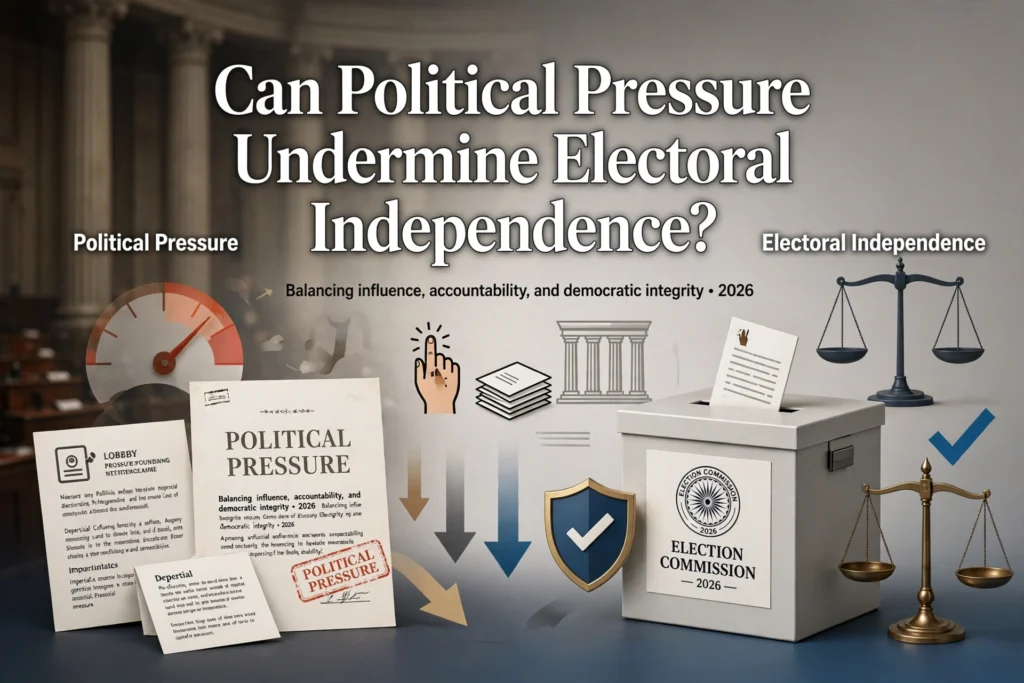 3.3 Can Political Pressure Undermine Electoral Independence?
Election authorities face pressure from several directions. Governments may want administrative decisions that support their political priorities, opposition parties may challenge decisions that disadvantage them, and voters may demand immediate explanations when their registration status changes.
Institutional independence means that electoral decisions should be based on law and evidence rather than partisan interests. It also requires safeguards that allow officials to exercise their responsibilities without improper interference.
Independence does not mean that election officials should be immune from criticism. On the contrary, public scrutiny can strengthen an institution when it encourages transparency, consistent procedures, and timely correction of errors.
The challenge is to distinguish legitimate criticism from attempts to intimidate officials or undermine public confidence without evidence. Both institutional independence and accountability are essential to a credible electoral system.
In the current controversy, independent examination of voter records, transparent explanations from the Commission, and meaningful opportunities for legal challenge would help establish which concerns are supported by evidence.
3.4 What Does Indian Law Say About Removing the Chief Election Commissioner?
The demand for resignation is a political demand, not a legal order. India’s Constitution provides specific safeguards governing the removal of the Chief Election Commissioner.
Under Article 324(5), the Chief Election Commissioner can be removed only in the same manner and on the same grounds as a judge of the Supreme Court. This creates a demanding constitutional process rather than allowing removal simply because a political party or protest movement calls for it.
Other election commissioners are protected against removal through the same direct process as the Chief Election Commissioner, although their removal is subject to a different constitutional arrangement involving the Chief Election Commissioner’s recommendation.
These safeguards are designed to reduce the risk that an election official could be removed simply for making decisions unpopular with the government of the day.
However, legal protection from arbitrary removal does not eliminate the need for public accountability. If credible evidence of serious misconduct emerges, it should be examined through the appropriate legal and constitutional mechanisms.
The distinction is important: citizens have the right to demand accountability, but a resignation demand does not itself establish wrongdoing or automatically require an official to leave office.
4. Detention of Activists: Public Order or Suppression of Dissent?
4.1 Who Are the Detained Activists and What Are the Allegations?
The October protests have involved detentions of activists, students, opposition politicians, and people attempting to reach demonstration sites in Delhi. Reuters reported that authorities detained more than 2,000 people in the capital on October 10 as security forces moved to prevent a planned rally. Later reports described further detentions and a large security deployment.
The people affected were not necessarily detained under identical circumstances. Some were reportedly stopped before reaching protest locations, while others were detained during demonstrations or attempts to move past police barricades.
That distinction matters because a person briefly detained for violating a lawful assembly restriction is in a different legal position from someone formally arrested on a criminal charge. The legal basis, duration, access to legal assistance, and subsequent proceedings must be considered separately in each case.
Reports of detentions also need to be checked against official records, statements from the people affected, and court filings wherever available. A detention figure alone cannot establish whether every individual was detained lawfully or unlawfully.
Nevertheless, when detentions occur on a large scale during a political protest, the public has a legitimate interest in knowing why people were detained, where they were taken, and whether they were released or charged.
4.2 The Legal Basis for Detentions and Arrests
Indian authorities have legal powers to regulate public gatherings and respond to credible threats to public order. Those powers may include imposing restrictions on assemblies, dispersing unlawful gatherings, and detaining or arresting individuals when the applicable legal conditions are satisfied.
But the existence of police powers does not mean that every use of those powers is automatically lawful. Authorities must act within the law, follow required procedures, and respect applicable constitutional protections.
India’s Constitution protects personal liberty and provides safeguards concerning arrest and detention. Article 21 protects life and personal liberty, while Article 22 sets out important safeguards for people who are arrested or detained, subject to specific constitutional exceptions.
The legal position depends on the circumstances. Preventive action, detention for violating an assembly order, and arrest in connection with a criminal allegation can involve different procedures and standards.
In its October 15 hearing, the Supreme Court issued notices in challenges connected with the protests and the removal of Jantar Mantar’s designation as a protest site. The Court also ordered the preservation of CCTV footage relating to alleged police excesses. These steps indicate judicial scrutiny; they should not be described as a final finding that all police action was unlawful.

The most reliable way to assess the legality of the detentions is to examine the orders issued, the grounds recorded for individual cases, the treatment of detainees, and the decisions of the courts.
4.3 Freedom of Speech, Peaceful Assembly, and the Right to Protest
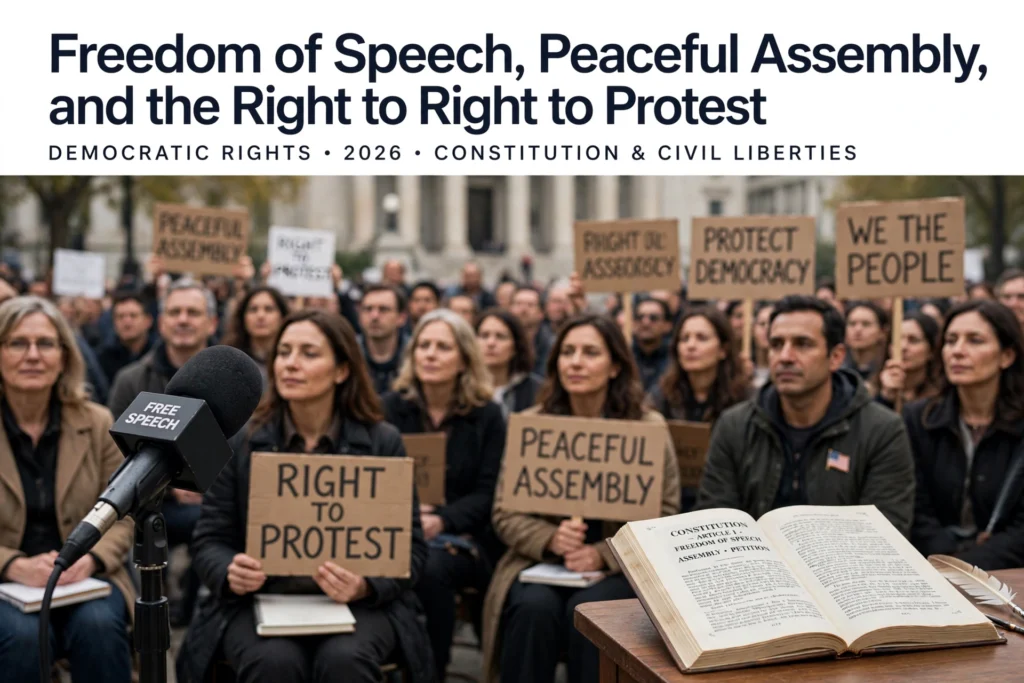 4.3 Freedom of Speech, Peaceful Assembly, and the Right to Protest
The right to protest is an important part of democratic participation. It allows citizens to challenge public decisions, question officials, and express concerns that may not receive sufficient attention through ordinary political channels.
Articles 19(1)(a) and 19(1)(b) of the Indian Constitution protect freedom of speech and expression and the right to assemble peaceably and without arms. These rights are subject to constitutionally permitted restrictions, including those related to public order and other specified interests.
This means neither side has an unlimited right to dictate the outcome. Protesters cannot assume that every form of demonstration is exempt from lawful regulation, while authorities cannot treat criticism of the government as sufficient reason to silence peaceful dissent.
The practical questions are whether restrictions are legally grounded, whether they respond to a genuine and specific need, and whether less restrictive alternatives were reasonably available.
For example, authorities may need to manage traffic or prevent violence. But if a peaceful gathering could be accommodated through reasonable arrangements, a blanket prohibition or widespread preventive detention would warrant closer examination.
The aim should be to protect public safety without unnecessarily restricting the public’s ability to express political disagreement.
4.4 Human Rights Groups, Civil Society, and International Concerns
The response to the protests has attracted attention beyond India. The United Nations human rights office expressed concern about the mass detentions and called for the right to peaceful assembly to be respected. India’s mission in Geneva rejected the criticism, arguing that reasonable restrictions on public gatherings are part of democratic governance.
Civil society organizations have also raised concerns about the treatment of activists and journalists. The CIVICUS Monitor, for example, has reported on the detentions and the broader challenges facing civic space in India. Such assessments are relevant to the debate, although their claims should be considered alongside court records, official explanations, and independent reporting.
International criticism is not, by itself, proof of a human rights violation. Governments are entitled to explain their legal position and challenge assessments they believe are inaccurate.
At the same time, dismissing all external criticism as interference does not resolve the underlying questions. Democratic governments can strengthen their credibility by making the legal basis for restrictions clear, allowing independent scrutiny, and addressing credible complaints.
Ultimately, the issue is not whether India should be free from criticism. It is whether the rights guaranteed by its own Constitution are protected consistently, including when citizens criticize those in power.
5. ‘Dictator vs. Democratic Politician’: Where Does the Debate Come From?
5.1 What Does Authoritarian Leadership Mean?
The words “dictator” and “democratic politician” are often used as political weapons. One is intended to suggest concentrated power and repression; the other implies legitimacy, public accountability, and respect for democratic rules. Neither label should replace a careful examination of how power is exercised.
A dictatorship generally involves highly concentrated political authority, with little meaningful competition for power and weak constraints on the leadership. Democratic systems, by contrast, rely on competitive elections, civil liberties, legal safeguards, and institutions capable of holding public officials accountable.
The distinction is not always as simple as whether elections take place. A country may hold regular elections while facing serious concerns about unequal political competition, pressure on independent institutions, restrictions on media, or limits on civil society.
Political scientists often describe deterioration in democratic standards as democratic backsliding. This can happen gradually, through changes that weaken checks and balances or make it harder for opponents to compete fairly.
The most useful question is therefore not simply whether a leader wins elections. It is whether political competition remains meaningful, citizens can express disagreement without unjustified punishment, and institutions can act independently of those who govern.
5.2 The Arguments Made by Critics of the Government
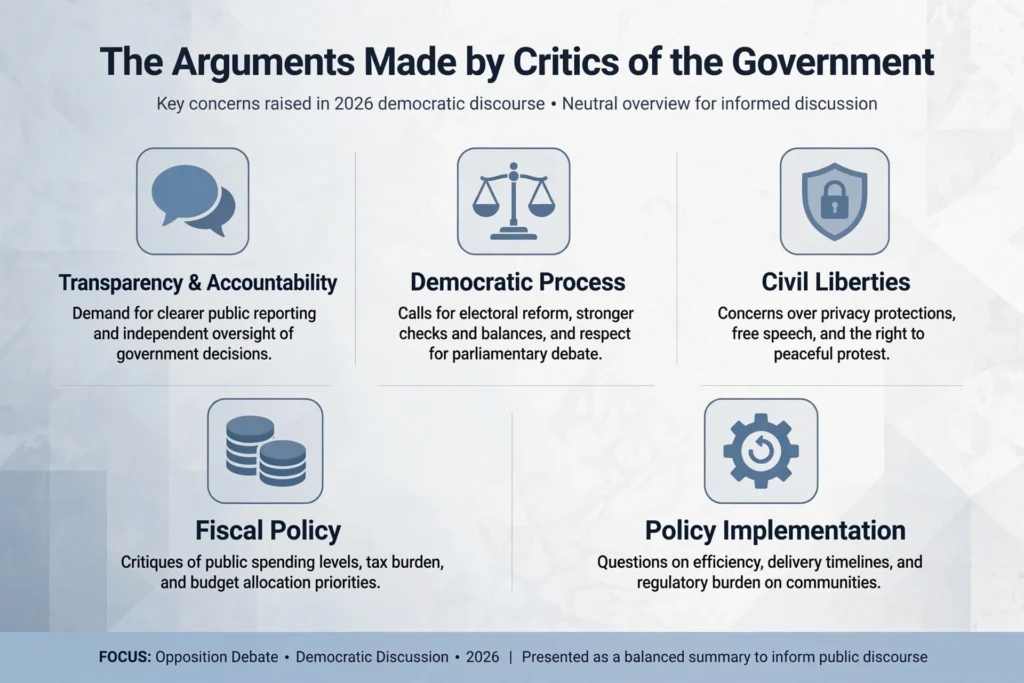 5.2 The Arguments Made by Critics of the Government
Critics of Narendra Modi’s government point to concerns about institutional independence, electoral administration, the treatment of dissent, and the use of state authority against political opponents. The current protests have intensified these arguments because they combine an electoral dispute with reports of extensive detentions.
For these critics, the key concern is not necessarily that the government has won elections. It is whether the conditions surrounding political competition remain fair and whether citizens can challenge official decisions without facing disproportionate restrictions.
The voter-roll controversy is central to this argument. If eligible citizens were wrongly removed from electoral rolls and could not effectively correct their status, that would raise serious concerns about electoral rights. If the revisions instead reflect properly documented corrections to inaccurate records, the interpretation would be different.
Likewise, detentions during protests may raise concerns about civil liberties, but the circumstances of individual cases matter. Evidence of arbitrary or disproportionate enforcement would support criticism more strongly than the mere existence of police action.
A fair assessment should therefore ask what can be demonstrated, what remains disputed, and which independent bodies are in a position to resolve the dispute.
5.3 The Arguments Made by Government Supporters
Supporters of the government argue that electoral victories provide democratic legitimacy and that strong administration can be necessary in a large and diverse country. They may point to governance, infrastructure, economic policies, national security, or welfare programmes as reasons for supporting the BJP.
On the protests, the government’s broader defence rests on the distinction between peaceful political expression and gatherings that authorities consider unlawful or disruptive. The Election Commission, meanwhile, maintains that voter-roll revisions are intended to improve accuracy, not to favour a political party.
These arguments deserve to be considered seriously. Governments have a responsibility to administer elections, maintain public order, and protect the rights of all citizens, including people who do not participate in demonstrations.
However, electoral popularity does not remove the need for legal accountability. Winning an election gives a government authority to govern within the constitutional framework; it does not give unlimited power over opposition parties, protesters, journalists, or independent institutions.
Similarly, the claim that restrictions are necessary for public order should be assessed against the actual circumstances. The relevant questions include whether a credible threat existed, whether the response was proportionate, and whether lawful alternatives were available.
A balanced assessment must consider the government’s explanations without treating them as conclusive simply because they come from public authorities.
5.4 How Can Leadership Be Evaluated Fairly?
A more reliable assessment of democratic leadership uses evidence and consistent standards rather than personal loyalty or political slogans.
Several indicators can help:
Electoral integrity: Are voter registrations accurate, and can eligible citizens challenge mistakes effectively?
Political competition: Can opposition parties organize, campaign, and criticize the government meaningfully?
Judicial independence: Can courts review government decisions and provide remedies without improper interference?
Civil liberties: Can citizens protest, publish criticism, and participate in public debate within the law?
Institutional accountability: Are allegations against officials investigated through credible and transparent procedures?
Media freedom: Can journalists investigate matters of public interest without unjustified intimidation or obstruction?
No single indicator provides a complete answer. A controversial police operation does not, by itself, establish that an entire country is a dictatorship. Equally, the existence of elections does not automatically prove that every democratic institution is functioning properly.
The strongest assessment looks at patterns over time, considers evidence from multiple sources, and distinguishes isolated incidents from systematic practices.
That approach also applies to political leaders outside India. The same standards should be used regardless of whether the government in question is popular, unpopular, left-wing, right-wing, or aligned with the observer’s own preferences.
6. Is Indian Democracy Under Pressure? Examining the Institutions
6.1 The Independence of Election Authorities
The independence of election authorities is one of the foundations of democratic government. Citizens must have confidence that voter registration, polling arrangements, and the counting of votes are governed by consistent rules rather than partisan preferences.
India’s Election Commission has a constitutional mandate, but institutional credibility also depends on how its decisions are explained and reviewed. When an administrative exercise removes millions of entries, clear information about the reasons for removal and the process for correcting errors becomes especially important.
The current controversy has placed these questions under intense public scrutiny. Opposition parties have alleged that the revisions could unfairly affect voters, while the Commission says it is seeking to maintain accurate electoral rolls.
The decisive issue is whether the procedures can withstand independent examination. Transparent records, accessible appeals, consistent treatment of voters, and timely judicial review can help establish whether the process is working fairly.
Institutional independence should not mean that an election authority operates without scrutiny. Rather, it should mean that its decisions are based on law, are open to legitimate review, and are not improperly influenced by political interests.
6.2 The Role of Parliament, Courts, and Opposition Parties
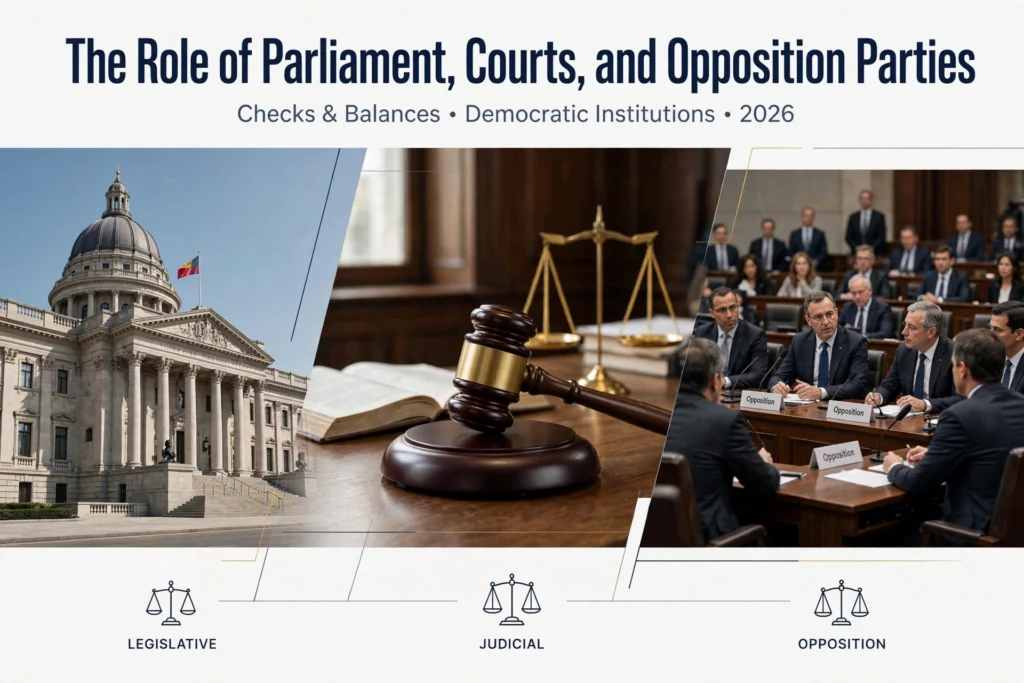 6.2 The Role of Parliament, Courts, and Opposition Parties
India’s democratic system distributes power across several institutions. Parliament makes laws and scrutinizes government policy, courts review legal disputes, and opposition parties challenge government decisions through legislative debate, public campaigning, and other lawful means.
These institutions do not always work without conflict. Political disagreement is normal, and a strong opposition may be an important source of scrutiny. The essential question is whether disagreements can be pursued through meaningful institutional processes.
The current controversy has moved into the courts. On October 15, 2026, the Supreme Court issued notices in petitions connected with the protests, including a challenge to the removal of Jantar Mantar’s designation as a protest site. It also directed that CCTV footage related to alleged police excesses be preserved.
These developments matter because they provide a legal avenue for examining disputed decisions. However, issuing notices or ordering the preservation of evidence is not the same as ruling that the allegations have been proven.
Opposition parties also have a legitimate role in raising concerns about electoral administration. Their allegations should be examined seriously, but their political claims should be assessed against evidence just as government statements should be.
Democracy is strengthened when disagreements can be investigated without requiring citizens to choose between unquestioning support for the government and unquestioning support for the opposition.
6.3 Media Freedom and the Space for Political Criticism
A free and diverse media helps citizens understand political controversies that would otherwise be difficult to investigate. Journalists can examine official records, question public officials, report on protests, and give affected people an opportunity to describe their experiences.
During the recent demonstrations, media organizations reported on detentions, restrictions, opposition demands, and the Election Commission’s position. Some journalists covering protests were themselves reportedly detained, adding to concerns about the practical conditions in which political events can be reported.
Such reports do not establish that all media coverage has been restricted or that every journalist has been treated unlawfully. They do, however, make transparency around press access and police conduct an important issue.
Media freedom also comes with responsibilities. News organizations should verify claims, distinguish eyewitness accounts from official statements, correct errors, and avoid presenting speculation as fact. Political misinformation can spread rapidly during periods of unrest.
The healthiest media environment is one in which journalists can scrutinize powerful institutions while remaining accountable for the accuracy of their reporting.
6.4 Comparing Democratic Principles With Political Practice
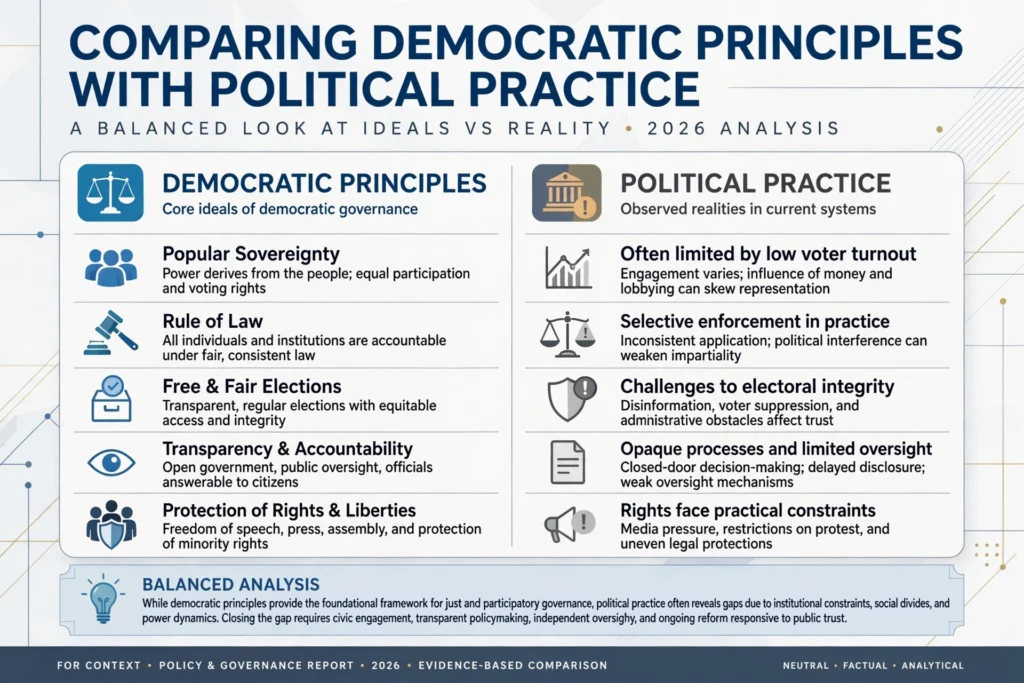 6.4 Comparing Democratic Principles With Political Practice
India’s constitutional framework establishes democratic institutions, protects fundamental rights, and provides mechanisms for challenging government decisions. The important question is how these principles operate in practice, particularly during moments of political conflict.
The current controversy offers several areas for examination. Electoral-roll revisions can be assessed through registration records and appeals. Detentions can be evaluated through legal orders, individual cases, and judicial review. Restrictions on protest sites can be compared with constitutional protections and the practical availability of alternative locations.
These are more reliable tests than broad political labels. A government may defend a decision as necessary for public order, while critics may regard the same decision as an attempt to limit dissent. Independent evidence is needed to determine which interpretation is better supported.
It is also important to consider whether problems are corrected when they are identified. An institution that investigates complaints transparently and provides effective remedies demonstrates a different pattern from one that repeatedly ignores credible evidence of misconduct.
The current proceedings may help clarify some of these issues, but their eventual significance will depend on the evidence and the decisions that follow.
7. The Role of Political Parties, Social Media, and Public Opinion
7.1 How Political Parties Shape the Protest Narrative
Political parties rarely interpret major controversies in exactly the same way. Opposition parties may describe the protests as a defence of democratic rights, while government supporters may frame them as politically motivated attempts to discredit institutions.
Both sides have incentives to present events in ways that strengthen their political positions. Opposition parties may emphasize alleged failures in electoral administration, while the ruling party may highlight administrative explanations and the importance of public order.
This does not mean that all competing claims are equally accurate. Political motivation is a reason to examine evidence carefully, not a reason to dismiss every claim made by a politician.
The role of journalism and independent institutions is to establish which assertions are supported by records and which remain unproven. Readers should pay particular attention to whether a statement is a documented fact, an allegation, an interpretation, or a prediction.
When political debate becomes highly polarized, that distinction is often lost. Recovering it is essential to informed public discussion.
7.2 Social Media, Viral Claims, and Political Polarization
Social media can help protesters organize, share eyewitness accounts, and bring attention to events that receive limited coverage elsewhere. Videos and photographs from demonstrations can also provide valuable evidence of what happened at a particular time and place.
However, a viral post does not automatically provide a complete or accurate account. A video may lack context, a photograph may come from a different event, and an allegation repeated by thousands of accounts may still be unverified.
The scale of the voter-roll controversy makes careful interpretation especially important. The number of entries removed should not be confused with the number of eligible voters wrongly excluded. Likewise, a reported detention figure should be checked for its date, location, and definition.
Readers can improve their understanding by checking the original source, comparing reputable news reports, consulting official documents, and looking for subsequent corrections or court findings.
Social media is most useful when it expands access to information. It becomes harmful when speed, outrage, or partisan loyalty replaces verification.
7.3 Why Citizens Disagree About Democracy and Leadership
People judge political leadership through different experiences and priorities. Some place the greatest importance on economic growth, welfare programmes, infrastructure, or national security. Others focus on civil liberties, minority rights, electoral transparency, or the independence of public institutions.
These priorities can lead people to reach different conclusions about the same government. A supporter may regard a leader as effective because of policies they value, while a critic may believe that the same leader’s record raises concerns about institutional accountability.
Political identity can intensify these disagreements. People are often more willing to accept information that supports their existing beliefs and more likely to distrust information that challenges them.
A useful response is not to assume that everyone who disagrees is ignorant or dishonest. Instead, citizens can ask what evidence would change their minds and whether they apply the same standards to politicians they support and oppose.
Democracy requires more than the ability to cast a vote. It also benefits from a public culture in which disagreement can occur without turning every political dispute into a battle between enemies.
8. Historical Context: Protests and Democratic Dissent in India
8.1 A Brief History of Major Political Protest Movements
Political protest has played an important role in India’s modern history. The independence movement mobilized millions of people against British colonial rule, while later movements challenged corruption, government decisions, and perceived abuses of power.
One major example was the Emergency imposed from 1975 to 1977, when civil liberties were severely restricted, political opponents were detained, and press freedom was curtailed. The period remains an important reference point in debates about executive power and constitutional safeguards.
In 1977, the government called a general election, and voters rejected Indira Gandhi’s Congress government. The election demonstrated the importance of public participation and electoral competition in determining political authority.
More recent movements have taken different forms. The anti-corruption movement of 2011 brought large demonstrations over public accountability, while the farmers’ protests of 2020–2021 mobilized people against three agricultural laws that were subsequently repealed.
These events differed in their causes, participants, and outcomes. They nevertheless show that public protest has repeatedly provided a way for citizens to challenge decisions and bring political issues to national attention.
8.2 What Past Movements Reveal About Democratic Accountability
History shows that demonstrations can influence political debate, but they do not always lead directly to policy change. Outcomes depend on the scale and organization of the movement, the public’s response, the government’s decisions, and the availability of legal or institutional remedies.
The Emergency offers a warning about the dangers of concentrating power and weakening civil liberties. The subsequent election, meanwhile, illustrates how electoral competition can provide a mechanism for holding governments accountable.
The farmers’ movement provides a different lesson. Sustained mobilization, negotiation, public pressure, and political calculations all contributed to a process that ended with the repeal of the disputed laws.
These examples should not be treated as direct predictions about the current protests. Different legal questions and political circumstances require different responses.
Their broader lesson is that accountability can take several forms: public protest, parliamentary scrutiny, independent journalism, court proceedings, and elections. A resilient democracy makes space for these mechanisms rather than relying 8.3 What Makes the Current Situation Similar or Different?
The present protests share some features with earlier movements, including demands for accountability and concerns about the exercise of state power. The participation of youth activists and opposition groups also reflects the role of organized citizens in bringing political grievances into public view.
However, the current dispute is particularly focused on electoral administration and voter registration. That makes the accuracy of records, the accessibility of appeals, and the independence of the Election Commission central to the debate.
Another important difference is the role of digital communication. Social media can spread information quickly and coordinate demonstrations across locations, but it can also amplify inaccurate claims and intensify political polarization.
The Supreme Court’s involvement adds an institutional dimension. Its proceedings may help determine the legality of specific restrictions and clarify the rights of protesters, although the final outcomes remain dependent on the cases and evidence before it.
Historical comparisons can illuminate the stakes, but they should not be used to declare in advance that the current situation must end in the same way as an earlier movement.
9. What Could Happen Next? Possible Political and Legal Outcomes
9.1 Possible Outcomes of the Resignation Demand
The demand for Chief Election Commissioner Gyanesh Kumar’s resignation could develop along several paths. Protesters and opposition parties may continue demonstrations, pursue formal complaints, seek judicial intervention, or press for greater transparency in electoral-roll revisions.
The Commission could also respond by publishing additional explanations, clarifying procedures, and strengthening the process through which eligible voters can check their registration status and challenge errors. Whether such steps occur, and whether they satisfy critics, remains uncertain.
A resignation is not the only possible outcome of the controversy. Independent scrutiny of the electoral-roll revision, effective remedies for wrongly excluded voters, and clearer procedures could address some concerns without requiring the election chief to leave office.
Conversely, if credible evidence of serious misconduct emerges, it could intensify calls for formal accountability through the appropriate constitutional and legal processes.
The political consequences will depend partly on the evidence and partly on how institutions respond. Public trust is more likely to improve when disputed decisions are explained clearly and legitimate complaints receive meaningful answers.
9.2 What Could Happen to the Detained Activists?
The legal outcomes for detained activists will depend on the circumstances of each case. Some people detained during demonstrations may be released without charges, while others may face proceedings related to alleged violations of assembly restrictions or other offences.
It is important not to assume that every detained person faces the same allegations or that detention itself establishes guilt. The relevant legal documents, police records, and court decisions are needed to determine the status of individual cases.
The Supreme Court’s October 15 proceedings have brought additional scrutiny to the protest restrictions and allegations of police excesses. Its direction to preserve relevant CCTV footage could help ensure that evidence remains available for examination. However, this procedural step is not a final judgment on the conduct of the authorities.
For activists, journalists, and other affected people, access to legal assistance, information about their cases, and the ability to challenge unlawful detention are important safeguards.
For the authorities, transparent procedures and clear explanations of the legal grounds for detention can help distinguish legitimate enforcement from arbitrary action.
9.3 Could the Protests Influence Public Trust and Future Elections?
Political protests can affect public opinion, but their long-term impact is difficult to predict. Some citizens may become more concerned about electoral transparency, while others may regard the demonstrations as partisan opposition to a legitimate administrative exercise.
The controversy could encourage more voters to check their registration status and demand clearer information about changes to electoral rolls. It could also lead political parties to place greater emphasis on electoral integrity in campaigns and public debates.
Future elections may provide an opportunity for voters to express their views on the controversy, but it would be premature to assume that the protests will benefit any particular party. Electoral outcomes depend on many factors, including local issues, candidates, economic conditions, political alliances, and public confidence.
The broader consequence may be a renewed debate about how democratic institutions communicate with the public. Even when officials believe that their decisions are legally sound, inadequate explanations can leave room for suspicion and political conflict.
Ultimately, trust is not maintained through official statements alone. It grows when people can examine the evidence, understand the rules, challenge errors, and see that the same standards apply to everyone.
10. What Should a Healthy Democracy Protect?
10.1 Accountability Without Political Intimidation
Public officials exercise authority on behalf of citizens and should be prepared to explain important decisions. This is particularly true of institutions responsible for elections, law enforcement, and the protection of constitutional rights.
Accountability, however, should not become a justification for threats or intimidation. Officials must be able to perform their duties within the law, while citizens and political parties must remain free to criticize decisions and seek legitimate remedies.
The same standard applies to both sides. Allegations of misconduct should be investigated fairly, and officials should not be declared guilty simply because they are unpopular. Equally, allegations should not be dismissed solely because they challenge powerful institutions.
In the election commission controversy, accountability could involve transparent explanations of voter-roll changes, independent examination of disputed cases, and effective procedures for correcting errors.
A democracy is stronger when public scrutiny leads to evidence-based answers rather than personal attacks or automatic defences of political leaders.
10.2 Public Order Without Unnecessary Restrictions on Dissent
Maintaining public order is a legitimate responsibility of the state. Authorities must protect people from violence, keep essential services functioning, and respond to genuine threats.
But public order should not become a broad justification for preventing peaceful political expression. Restrictions should have a clear legal basis and be proportionate to the circumstances, with reasonable alternatives considered where possible.
The October protests have raised questions about access to Jantar Mantar, a prominent location for demonstrations in Delhi. On October 15, the Supreme Court agreed to examine challenges to the site’s removal from its designated protest status and sought responses from the authorities.
The outcome of that dispute could help clarify how designated protest spaces should be managed. The underlying principle is broader: citizens need practical opportunities to express political views, not merely a theoretical right to do so.
A balanced approach protects peaceful demonstrators while allowing authorities to address genuine risks. Neither unrestricted gatherings in every location nor blanket restrictions on dissent provide a satisfactory answer in every circumstance.
10.3 The Importance of Independent Institutions and Equal Application of the Law
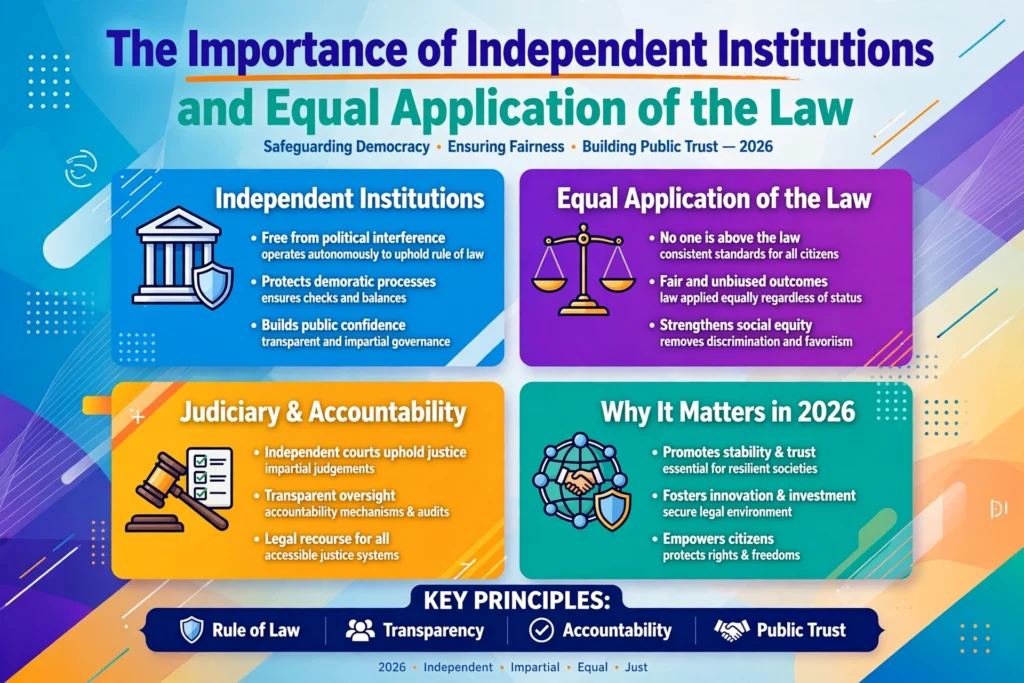 10.3 The Importance of Independent Institutions and Equal Application of the Law
Democracy depends on institutions that can carry out their responsibilities without improper political interference. Election authorities, courts, legislatures, law enforcement agencies, and independent media each play different roles in holding power accountable.
Institutional independence does not mean that these bodies should never be questioned. It means their decisions should be guided by law, evidence, and established procedures rather than the personal interests of political leaders.
Equal application of the law is equally important. The same principles governing public officials should apply to opposition politicians, activists, journalists, and ordinary citizens. Political affiliation should not determine whether a person’s rights are respected or a complaint is taken seriously.
When institutions are challenged, the appropriate response is to examine the evidence and use legitimate mechanisms for review. Where errors or abuses are established, remedies should follow.
This approach helps protect both democratic authority and individual rights. It also provides a common standard that citizens with opposing political views can use to evaluate government conduct.
11. Conclusion: Democracy Is Tested by How Power Responds to Criticism
India’s October 2026 protests have brought several connected issues into focus: the integrity of electoral-roll revisions, demands for the resignation of Chief Election Commissioner Gyanesh Kumar, the detention of demonstrators, and the boundaries of state authority.
The allegations surrounding voter registration remain a central point of dispute. Opposition parties and activists have raised concerns about the exclusion of eligible voters, while the Election Commission maintains that the revisions are intended to improve the accuracy of electoral rolls. Determining the merits of those claims requires evidence, transparent procedures, and effective opportunities for review.
The detentions and restrictions on demonstrations raise a separate but equally important question: how should authorities maintain public order while protecting peaceful political expression? The ongoing legal scrutiny makes it important to distinguish the allegations being examined from conclusions that courts have actually reached.
The debate over whether a political leader is a dictator or a democratic politician is unlikely to be resolved by slogans. A more useful assessment considers whether elections are competitive, institutions are independent, citizens can criticize the government, and legal safeguards operate effectively.
Electoral victories matter in a democracy, but they do not eliminate the need for accountability. Similarly, public protests can expose genuine concerns, but the claims made by protesters must also be open to examination.
The strength of a democracy is not measured simply by how often its leaders win elections. It is also measured by whether citizens can question those leaders, whether institutions can examine uncomfortable allegations, and whether the law protects people even when their opinions challenge those in power.
1 comment


















1 Comment
Kaleem
October 17, 2026, 8:50 amWow nice Article
REPLY