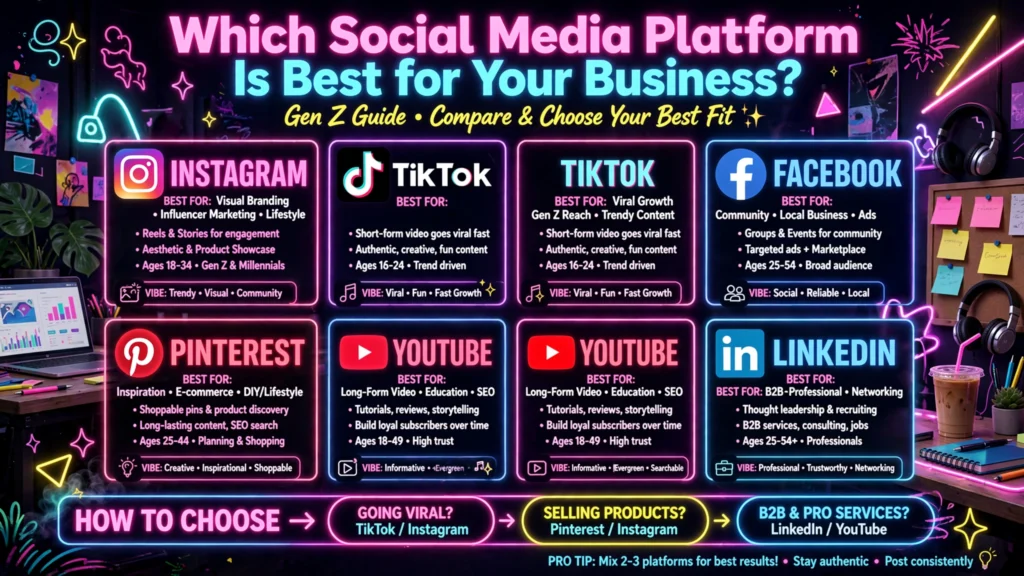
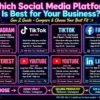
Which Social Media Platform Is Best for Your Business? Choosing the best social media platform for business depends on your target audience, marketing goals, budget, and the type of content you can create consistently. The truth is that no single platform is best for every business. A local restaurant may benefit from Facebook and Instagram,
Which Social Media Platform Is Best for Your Business?
Choosing the best social media platform for business depends on your target audience, marketing goals, budget, and the type of content you can create consistently.
The truth is that no single platform is best for every business. A local restaurant may benefit from Facebook and Instagram, a business consultant may find more relevant opportunities on LinkedIn, and an educational company may get better results from YouTube. The right choice depends on who your customers are, what you sell, and how you can consistently create useful content.
In this guide, you’ll compare the major social media platforms, discover which channels suit different business types, and learn how to choose the best option without wasting time or money.
Why Choosing the Right Social Media Platform Matters
Social media marketing is not simply about collecting followers or publishing posts. It is about connecting your business with people who may need your products, services, or expertise.
Choosing suitable platforms helps you concentrate your resources where they are most useful.
Reach the People Most Likely to Become Customers
Your ideal customers may use several social networks, but their behavior differs from platform to platform. Some watch product demonstrations, others look for professional advice, and many use social media to discover local businesses or recommendations.
Before creating an account, consider where your customers search for information, what content they enjoy, and how they make purchasing decisions.
For example, a wedding photographer might prioritize Instagram for displaying a portfolio, while a business software consultant might use LinkedIn to share industry insights and connect with potential clients.
Match Your Marketing Goals to the Right Channel
Different platforms support different marketing activities. Video platforms can help explain complex products, professional networks can support business-to-business relationships, and visual networks can showcase products and creative work.
Define your main goal before choosing a channel. Are you trying to increase brand awareness, generate leads, attract website visitors, make sales, or improve customer relationships? Your answer will help narrow the options.
Make Better Use of Your Time and Budget
Managing multiple accounts requires planning, content creation, customer interaction, and performance analysis. Spreading your resources across too many platforms can make it difficult to maintain quality.
A focused strategy allows you to learn what your audience responds to before expanding to additional channels.
Which Social Media Platform Is Best for Your Business?
The following platforms offer different opportunities. The best fit depends on your audience, business model, content capabilities, and marketing objectives.
1. Facebook: Best for Community Engagement and Local Businesses

Facebook can be a useful option for local businesses, retailers, service providers, and organizations that want to build relationships with a community.
Businesses can use Pages, posts, videos, Groups where appropriate, and advertising tools to communicate with customers. Local businesses may also use Facebook to announce promotions, share updates, answer questions, and promote events.
Best for: Restaurants, neighborhood shops, home services, community organizations, and businesses serving established customer groups.
Main strengths:
Multiple ways to share updates, videos, images, and links.
Community features that can support customer interaction.
Advertising tools for businesses seeking more targeted reach.
Limitations: Organic visibility varies, and maintaining an active presence takes time. A Facebook Page alone does not guarantee customer inquiries or sales.
Practical example: A neighborhood bakery could publish photos of daily products, share holiday opening hours, and answer customer questions through its Page.
Official resource: Meta for Business.
2. Instagram: Best for Visual Brands and Product Discovery

Instagram is particularly useful when customers benefit from seeing a product, service, design, or finished result before making a decision.
Businesses can use photos, Reels, Stories, carousels, and eligible shopping features to present products and communicate their brand identity. The platform also offers opportunities for creator collaborations.
Best for: Fashion labels, beauty businesses, travel companies, restaurants, home decor brands, and other visually oriented businesses.
Main strengths:
Visual storytelling through photos and video.
Opportunities to demonstrate products and share customer content.
Formats suited to tutorials, behind-the-scenes posts, and product launches.
Limitations: Creating strong visual content consistently can require time, photography skills, or video editing. Features and selling options vary by country and account eligibility.
Practical example: A handmade jewelry business could create short videos showing how products are made, carousel posts explaining materials, and Stories answering common customer questions.
Official resource: Instagram for Business.
3. TikTok: Best for Short-Form Video and Discovery

TikTok is worth considering if your business can communicate useful or entertaining ideas through short videos. Content can include demonstrations, tutorials, answers to common questions, and behind-the-scenes clips.
Businesses do not always need expensive production equipment. A clear explanation, relevant idea, and well-presented video can be a practical starting point.
Best for: Consumer brands, beauty businesses, creators, food businesses, and companies whose products or expertise can be demonstrated visually.
Main strengths:
Video-led storytelling and product demonstrations.
Opportunities for content discovery beyond an existing follower base.
A format that supports informal, educational, and entertaining content.
Limitations: Results can be unpredictable, trends change quickly, and video creation requires regular effort. Audience suitability and platform availability should be checked for your market.
Practical example: A small skincare business could make videos explaining how to use a product, discussing common skincare mistakes, and answering customer questions without making unsupported medical claims.
Official resource: TikTok for Business.
4. LinkedIn: Best for B2B Marketing and Professional Services

LinkedIn is a strong candidate for businesses that sell to other businesses or depend on professional relationships. It provides a space to demonstrate expertise, discuss industry challenges, build professional connections, and share company updates.
Rather than focusing entirely on promotional posts, businesses can explain problems they solve and share practical knowledge relevant to potential customers.
Best for: Consultants, recruitment agencies, software companies, marketing agencies, trainers, and professional service providers.
Main strengths:
Professional networking and industry conversations.
Opportunities to demonstrate expertise through posts and articles.
Tools for business-oriented advertising and lead generation.
Limitations: It may be less suitable as a primary channel for businesses whose customers rarely use professional networks to discover products. Meaningful relationships and leads can take time to develop.
Practical example: An accounting firm could publish explanations of common bookkeeping mistakes, share tax-planning reminders relevant to its clients, and discuss its services when appropriate.
Official resource: LinkedIn Marketing Solutions.
5. YouTube: Best for Tutorials and Educational Content

YouTube is a good option for businesses that can teach, explain, demonstrate, or review something in depth. Videos can help potential customers understand a product before buying or learn how a service solves a particular problem.
Businesses can publish tutorials, product demonstrations, customer education videos, interviews, and YouTube Shorts. Useful videos may also be discovered through YouTube search, although visibility depends on relevance, competition, and viewer response.
Best for: Online educators, software companies, coaches, home improvement businesses, product brands, and professional service providers.
Main strengths:
Supports detailed demonstrations and educational content.
Provides opportunities to build trust through consistent, useful videos.
Videos can continue attracting viewers after publication.
Limitations: Research, scripting, recording, editing, and thumbnail creation can take considerable time. Results may develop slowly, especially in competitive topics.
Practical example: A software company could publish tutorials showing how to use its product, answer common customer questions, and create comparison videos that help prospective buyers make informed decisions.
Official resource: YouTube Creators.
6. Pinterest: Best for Visual Inspiration and Website Discovery

Pinterest works differently from platforms built mainly around conversations and follower relationships. People often use it to discover ideas, save inspiration, and plan future projects or purchases.
Businesses can publish Pins that link to relevant blog posts, product pages, recipes, tutorials, and other useful resources. Pinterest also provides business accounts with analytics and advertising tools.

Best for: Bloggers, online stores, home decor businesses, travel publishers, recipe websites, fashion brands, and craft businesses.
Main strengths:
Visual content can connect with people planning a purchase or project.
Pins can direct interested users to a website.
Content can remain discoverable beyond its original publication date.
Limitations: Results depend on the topic, image quality, search relevance, and audience behavior. Pinterest may be less useful for businesses whose customers do not seek visual inspiration.
Practical example: A travel blogger could create Pins featuring destination guides that lead readers to detailed articles on the website.
Official resource: Pinterest Business.
7. X: Best for Real-Time Conversations and Industry Updates

X can be useful for businesses that need to respond quickly to industry news, join public discussions, share updates, or communicate with customers.
Its fast-moving environment suits organizations that have something relevant to contribute regularly. Professional accounts also provide business-oriented profile and promotional features.
Best for: Technology companies, media organizations, industry commentators, public-facing brands, and businesses with active online communities.
Main strengths:
Timely communication about news, launches, and updates.
Opportunities to join conversations with customers and industry professionals.
A useful format for concise insights and links to longer content.
Limitations: Conversations move quickly, and effective participation requires attention. A business may struggle to gain value from X if its target customers are not active there or if it cannot respond consistently.
Practical example: A software company could share product updates, explain service interruptions, and respond to questions about its latest features.
Official resource: X resources for small businesses.
Social Media Platforms Comparison for Businesses
Use this table to narrow your options before committing to a marketing strategy.
| Platform | Best suited to | Main content formats | Potential business goal |
|---|---|---|---|
| Local businesses and communities | Posts, images, video, Groups | Community engagement and awareness | |
| Visual and lifestyle brands | Reels, Stories, photos, carousels | Product discovery and engagement | |
| TikTok | Video-led consumer brands | Short-form video | Discovery and awareness |
| B2B companies and professionals | Posts, articles, video | Professional authority and leads | |
| YouTube | Educators and product-focused businesses | Tutorials, reviews, Shorts | Customer education and discovery |
| Bloggers and visual businesses | Images, Pins, video | Website traffic and inspiration | |
| X | News-focused brands and active communities | Short posts, images, video | Timely communication and discussion |
These are general recommendations, not performance guarantees. A platform that works well for one business may deliver limited value for another in the same industry.
How to Choose the Best Social Media Platform for Your Business
A useful decision should start with your customers and resources, not the number of platforms available.
Step 1: Identify Your Target Audience
Describe the people most likely to buy from you. Consider their needs, interests, location, purchasing habits, and the questions they ask before making a decision.
Then investigate which platforms they use to discover products, learn about services, or compare options. Your existing customer feedback, website analytics, and conversations with potential buyers can help.
Step 2: Define One Primary Marketing Goal
Choose the outcome that matters most to your business right now.
Brand awareness: Introduce your business to new people.
Website traffic: Bring interested visitors to your website.
Lead generation: Encourage potential customers to inquire or sign up.
Sales: Help customers discover and purchase your products.
Customer retention: Support existing customers and strengthen relationships.
Your goal influences your platform choice and the metrics you should monitor.
Step 3: Match Your Content to the Platform
Be realistic about what you can produce consistently.
If you enjoy teaching through detailed demonstrations, YouTube may be a good fit. If you have strong photography and design skills, Instagram or Pinterest may be more practical. If you can explain professional problems clearly, LinkedIn may suit your expertise.
You do not need expensive equipment to begin. A smartphone, a clear message, and useful information can be enough for many types of content.
Step 4: Consider Your Budget and Available Time
List the resources you can commit each week. Include time for creating content, responding to customers, reviewing results, and improving future posts.
Also consider whether you can manage the channel yourself or need help with design, editing, or advertising. Paid promotion is optional when starting; it should support a clear objective rather than replace a useful content strategy.
Step 5: Test Your Shortlist and Measure Results
Choose one primary platform and, if resources allow, one supporting platform. Establish a manageable publishing schedule and track performance over a reasonable test period.
Look for signs that your content reaches relevant people and encourages useful actions, such as website visits, inquiries, or purchases. Use what you learn to improve your approach rather than judging success by follower growth alone.
Which Social Media Platforms Are Best for Different Types of Businesses?
Your business model can help narrow the decision further.
Local Businesses and Retail Shops
Start by evaluating Facebook and Instagram. Facebook may be useful for local community engagement and updates, while Instagram can showcase products, services, and the people behind the business.
For a local shop, restaurant, or service provider, a complete Google Business Profile can also support visibility in Google Search and Maps. It is a complementary business listing, not a social media platform.
E-Commerce and Online Stores
Consider Instagram and TikTok if your products are easy to demonstrate visually. Pinterest may be useful for products associated with inspiration or planning, while YouTube can help explain product features and comparisons.
Choose based on how customers discover and evaluate your products, not simply on which platform is popular.
B2B Companies and Consultants
LinkedIn is a sensible starting point for many B2B businesses. Publish practical insights about customer problems, industry developments, and solutions your business provides.
YouTube can complement this approach when demonstrations, detailed explanations, or educational videos help buyers evaluate your expertise.
Freelancers and Personal Brands
Choose the platform that makes your skills easiest to demonstrate. Designers and photographers may prefer Instagram, business consultants may prioritize LinkedIn, and educators may benefit from YouTube.
Your portfolio, clear service descriptions, and relevant examples should make it easy for potential clients to understand what you offer.
Bloggers and Content Creators
Pinterest, YouTube, Instagram, and Facebook may all be worth evaluating, depending on your content and audience.
For a website-focused blog, prioritize platforms that can send relevant visitors to your articles. Measure actual referral traffic and engagement rather than assuming that social engagement automatically improves Google rankings.
Should Your Business Use One Social Media Platform or Several?
For most beginners, starting with one primary platform is a manageable approach. It lets you learn what your audience values without creating an unnecessarily demanding publishing schedule.
Once you understand what works, consider adding a second platform that serves a different purpose. For example, a consultant might use LinkedIn to start professional conversations and YouTube to publish detailed educational videos.
You can also repurpose ideas without copying the exact same post everywhere. Turn a blog article into a short video, extract key points for a carousel, or use a longer tutorial to answer frequently asked questions.
The goal is to adapt content to each platform’s audience and format while maintaining a consistent message.
Common Social Media Marketing Mistakes to Avoid
Avoid these mistakes when choosing and managing your business accounts:
Joining every platform at once: This can spread your time and resources too thin.
Copying competitors without understanding their audience: Their goals, budgets, and customer base may differ from yours.
Publishing without a clear purpose: Each post should inform, entertain, answer a question, or support a relevant business goal.
Chasing followers instead of customers: A smaller, relevant audience can be more valuable than a large, disengaged one.
Ignoring comments and messages: Unanswered questions can undermine customer confidence.
Giving up too early: Use a consistent testing period and review the quality of your content before deciding a channel is unsuitable.
How to Measure Social Media Marketing Success
Track metrics that connect your marketing activity to your actual goals.
Awareness and Engagement
Monitor reach, impressions, meaningful interactions, and video views where relevant. These indicators help you understand whether people are seeing and responding to your content.
Website Traffic and Leads
Use website analytics and trackable links to identify which channels send visitors. For lead generation, record relevant inquiries, form submissions, or consultation requests.
Sales and Return on Investment
Where possible, connect social campaigns to completed purchases or qualified leads. Compare the resulting value with advertising costs and the time or resources required to create the campaign.
Not every customer will convert immediately or through a directly trackable link, so interpret the data carefully.
Review results regularly and ask three questions: Are we reaching the right people? Are they taking useful actions? What should we change next?
Frequently Asked Questions
Which social media platform is best for small businesses?
The best platform depends on your customers and business goals. Facebook and Instagram are useful starting points for many local and consumer-facing businesses, while LinkedIn may be more suitable for B2B services. Choose based on audience fit and your ability to maintain quality content.
Is Facebook or Instagram better for business?
Facebook may be a better fit when community interaction and local updates are important. Instagram may be preferable when customers need to see products, designs, or visual demonstrations. Some businesses benefit from using both, provided they can manage them effectively.
Is TikTok worth using for a small business?
TikTok is worth testing if your target customers use the platform and you can create relevant short-form videos. Tutorials, product demonstrations, and answers to common questions are possible starting points. Results depend on content quality, audience fit, and consistency.
Is LinkedIn better for B2B marketing?
LinkedIn is often a strong choice for B2B companies because it supports professional networking and industry-focused content. However, the best strategy also depends on where prospective customers research solutions and how they prefer to communicate with suppliers.
How many social media platforms should a business use?
Start with one primary platform and add another when you have a clear reason and enough resources. There is no universal ideal number. The priority is to manage your selected channels well rather than maintain several inactive accounts.
Can a business grow on social media without paid advertising?
Yes, businesses can attract attention through useful organic content, consistent publishing, and genuine audience interaction. However, organic reach and results vary. Paid advertising may be worth testing when you have a clear goal, a suitable offer, and a way to measure outcomes.
Conclusion: Choose the Platform That Fits Your Business Goals
The best social media platform for your business is the one that helps you reach relevant customers and supports your goals with the resources you have available.
Facebook can support community engagement, Instagram can showcase visual products, TikTok can help distribute short-form videos, LinkedIn can support professional relationships, YouTube can explain complex topics, Pinterest can help people discover ideas, and X can facilitate timely conversations.
You do not need to master every channel at once. Identify your ideal customer, choose a primary goal, select a platform that matches your content strengths, and measure the results. Once you understand what attracts the right audience and leads to meaningful business outcomes, you can make better decisions about where to invest your marketing effort.


















Leave a Comment
Your email address will not be published. Required fields are marked with *